Soft vs Hard Declines in Stripe: What to Recover

If you run subscriptions on Stripe, failed payments are not all the same. Some are temporary friction. Some are dead ends. If you treat every decline like a generic billing hiccup, you waste recovery effort on invoices that were never coming back and ignore the ones you actually could have saved.
That is why the soft vs hard declines Stripe distinction matters. It is not finance trivia. It changes how you retry payments, when you ask customers to update card details, and how aggressively you route accounts into dunning. For SaaS founders, that translates directly into recovered MRR or preventable churn.
This guide breaks down what soft and hard declines really mean in Stripe-driven subscription flows, which decline types are worth chasing, and how to build a recovery playbook that does not just spam customers and hope for the best.
What soft and hard declines actually mean
A decline is simply a failed authorization attempt, but the reason behind it matters more than the failure itself.
Soft declines are usually temporary or recoverable. The customer may still be valid, the card may still be valid, and the issuer may approve a later attempt once timing, balance, authentication, or network conditions change.
Hard declines are usually stronger signals that the current payment method cannot be charged as-is. The card may be expired, closed, reported lost, blocked for that transaction type, or otherwise unusable until the customer takes action.
In practice, Stripe decline behavior sits on a spectrum. It is not as neat as a schoolbook table. Issuers are inconsistent. Some so-called soft decline patterns can behave like hard stops if you keep retrying without changing anything. Some hard-looking failures become recoverable if the customer updates their payment method immediately.
The useful mental model is this: a soft decline says, "try a smarter recovery motion." A hard decline says, "something fundamental needs to change first."
Why this distinction matters for involuntary churn
Most SaaS teams do not lose revenue because they saw a decline. They lose revenue because they responded badly to it.
A common failure pattern looks like this:
- A renewal fails.
- The billing system retries on a fixed schedule without considering decline type.
- Customer emails are generic and late.
- No one separates stale-card issues from issuer-risk issues.
- The subscription cancels or lapses into delinquency.
That is not a payment problem. It is an operations problem.
When you separate soft from hard declines, three things improve fast:
- Retry quality: you stop re-running hopeless charges on the same dead card.
- Customer messaging: you ask for action only when action is actually needed.
- Recovery forecasting: you get a cleaner view of which failed invoices are realistically salvageable.
This is the same broader lesson behind pre-dunning and failed payment prevention. Prevention and categorization beat generic rescue flows every time.
Common examples of soft declines in Stripe
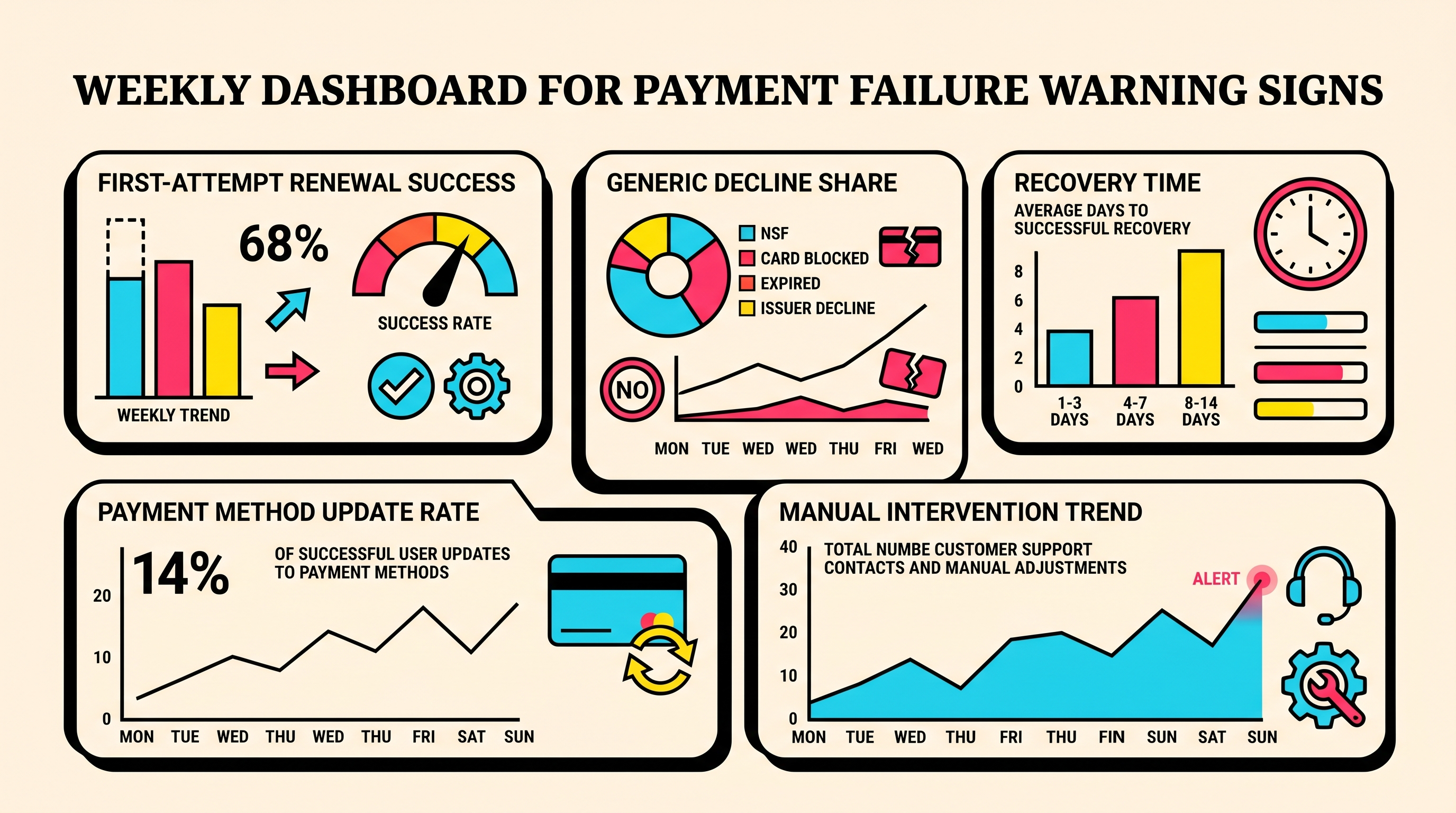
Soft declines are the ones you should treat as recoverable first, but only if your follow-up is sensible.
Typical soft-decline patterns include:
- insufficient funds
- temporary issuer unavailability
- processing errors
- rate-limit or velocity-style issues
- some authentication-required cases where the customer can complete verification
- generic retry-later style responses
The reason these are recoverable is simple: the customer relationship may still be healthy, and the payment method may still be valid. Timing, routing, or temporary account state is the problem.
Take insufficient funds. A failed renewal on the first of the month may clear on the third after payroll lands. Hammering the card five times in six hours is stupid. A few strategically timed retries are not.
Take issuer not available or processing error. Those are often infrastructure or network-level issues, not customer intent signals. A calm retry policy can recover revenue without dragging the customer into unnecessary friction.
Take authentication required. That is a strong sign the payment is not going through unattended, but it is still recoverable if the customer is prompted quickly with the right payment update or authentication path.
Common examples of hard declines in Stripe
Hard declines usually mean the current payment method is not going to recover through timing alone.
Common hard-decline patterns include:
- expired card
- invalid card number or invalid expiry details
- lost or stolen card
- card account closed
- restricted card or transaction not allowed
- pickup card or fraudulent signals
These are not subtle. If the card is expired, retrying the exact same credentials is cargo-cult billing. If the card was replaced, you need fresh payment details or an updater mechanism that already handled it. If the account is closed, your retries are just noise.
That is why hard declines need different handling. You move faster toward customer action, updated credentials, or graceful recovery fallback. You do not just lean harder on retries.
If expiry-related failures are common in your account, ChurnBot's page on expired card decline codes is worth keeping handy. Expired cards are one of the most boring and expensive forms of preventable churn.
The annoying truth: not every decline is labeled cleanly
Here is where teams get burned. Issuer responses are messy.
The classic example is do not honor. It sounds specific. It is not. It is a bucket of ambiguity from the issuer side and can represent risk concerns, insufficient confidence, or a bank simply refusing to explain itself. Some of those payments might recover on a later attempt. Some never will.
That means you should not rely on a naive binary where every code is permanently soft or permanently hard. You need decision rules.
A practical way to think about ambiguous declines:
- If a retry with better timing often works, treat it like a soft-decline workflow.
- If repeated retries fail without any customer action, escalate it toward hard-decline handling.
- If the issuer signal is opaque, limit retries and shorten the path to updating the payment method.
This is why a decline-code taxonomy matters more than one-off anecdotes. Pages like do not honor decline codes are useful because they help operators avoid telling fairy tales about what a code "must" mean.
How to build a smarter recovery workflow
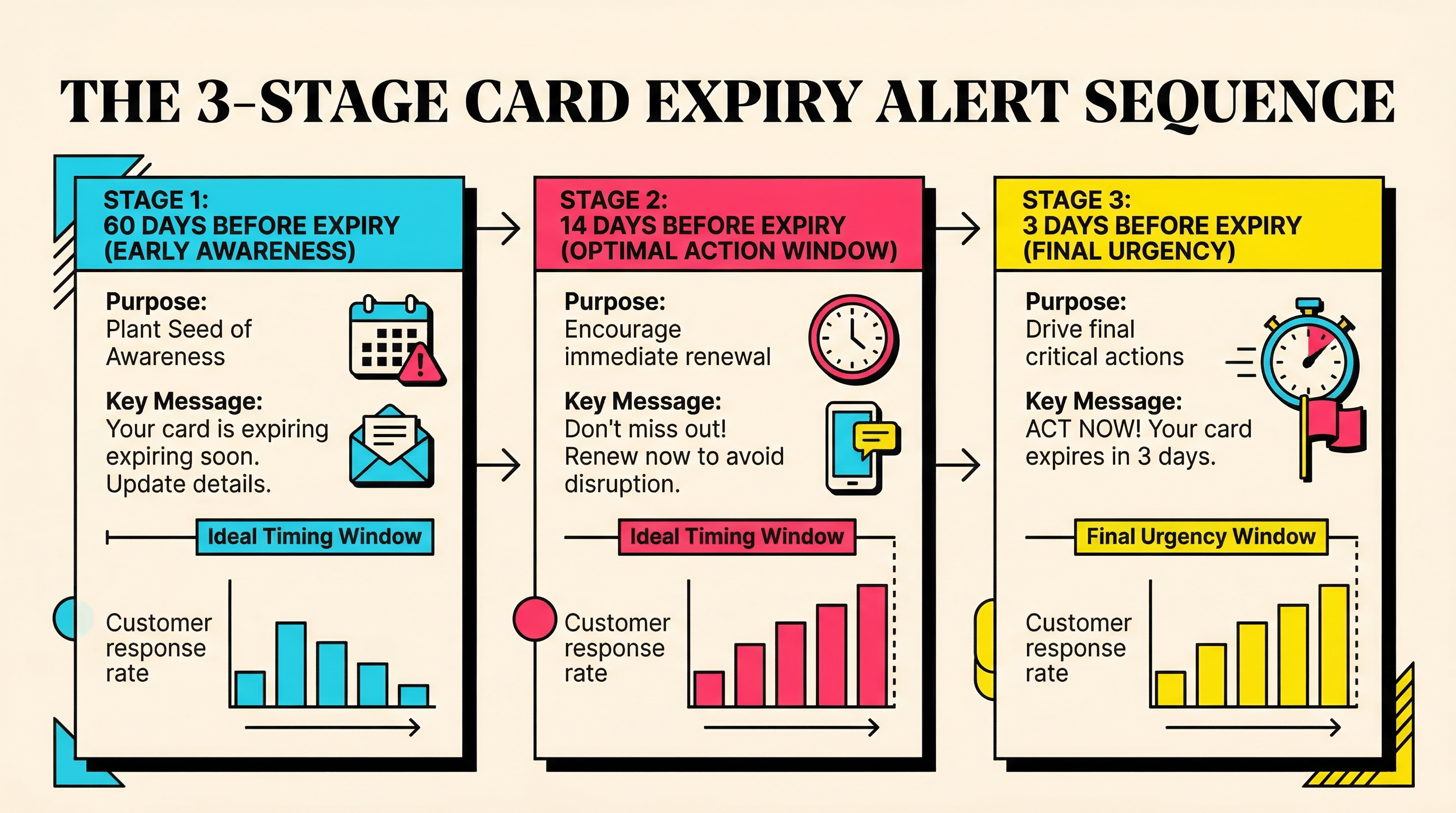
The goal is not to build the world's fanciest dunning system. It is to route each failed payment into the least stupid next action.
1. Classify declines into action buckets
Do not obsess over perfect semantics. Build buckets based on what should happen next:
- Retry later
- Prompt customer to authenticate
- Prompt customer to update payment method
- Stop retries and escalate internally
That alone improves recovery more than most teams expect, because it cuts out pointless repeated charges.
2. Use different retry logic for different decline patterns
Soft declines deserve measured retries. Hard declines usually do not.
A sane approach might look like this:
- insufficient funds: retry after payday-like intervals or spaced retries over several days
- issuer unavailable or processing error: shorter retries first, then taper
- expired card: no blind retries, move directly to payment-method update
- lost or stolen card: stop retries, prompt for a new card immediately
- ambiguous issuer declines: a limited retry sequence, then customer action
What matters is not the exact cadence. What matters is that cadence follows signal quality.
3. Align messaging with the decline type
Customers hate vague billing emails. "We couldn't process your payment" is technically true and operationally useless.
If you know the likely next step, your messaging should reflect it:
- for soft declines, reassure and explain that the system will retry
- for authentication issues, point the customer to complete the required step
- for stale-card problems, ask for an updated payment method fast
- for repeated ambiguous failures, give a clean path to replace the card
The more precisely your message matches the failure mode, the less revenue you lose to inertia.
4. Measure recovery by decline cohort
Total recovery rate hides everything. Break it down by decline family.
Track at least:
- first-attempt recovery rate for soft declines
- recovery rate after customer action for hard declines
- time-to-recovery by decline type
- cancellation or delinquency rate by decline type
- share of failed MRR sitting in ambiguous issuer buckets
Once you do this, you stop arguing about opinions and start seeing where money is leaking.
A monthly vs annual billing nuance most teams miss
Billing interval changes how declines behave.
On monthly plans, soft declines often recover better because the card was used recently, the customer still remembers the product, and the gap between successful charges is short. A temporary funds issue or issuer hiccup is annoying, but the payment method is usually still current.
On annual plans, hard declines become more painful because twelve months is a long time for cards to expire, be replaced, or disappear from memory. The customer may still want the product, but the stored payment method has quietly decayed. That means annual failed payments often need faster payment-method repair and less blind optimism from retry logic.
This is also why annual-plan churn can look worse than it really is. Some of what appears to be retention failure is just stale billing data. If you mix monthly and annual declines into one report, you will misread both retention quality and recovery performance.
At minimum, segment failed payments by billing interval and decline family. If annual expiries are piling up, that is not a signal to rewrite your onboarding. It is a signal to tighten payment-method maintenance and renewal recovery.
Where founders usually screw this up
They over-rely on retries
Retries are useful for the right decline types. They are garbage for dead cards and closed accounts. If your system retries everything equally, it is lazy by design.
They delay customer action for obvious hard declines
When the card is expired or replaced, every extra day before requesting an update hurts. Customers forget, the invoice ages, and involuntary churn starts looking weirdly permanent.
They classify everything as "payment failed"
That label is too broad to operate from. It collapses temporary, recoverable friction and fundamental payment-method failure into one useless bucket.
They do not link decline handling back to revenue reporting
If finance, support, and product cannot all see which decline categories recover and which do not, the team will keep optimizing the wrong parts of the funnel.
What good looks like in practice
A strong Stripe recovery setup is boring in the best way.
- Soft declines get smart retries.
- Hard declines trigger immediate payment-method repair.
- Ambiguous declines get a short leash, not endless automation theater.
- Customer emails are clear and timely.
- Reporting separates preventable billing friction from real retention problems.
That last point matters a lot. Not every failed renewal is a churn story. Some are just broken payment rails. If you cannot separate those, you will misread your retention health and probably blame product for billing sloppiness.
A simple operator checklist
If you want a practical place to start, audit your setup against this list:
- Do we group Stripe declines into operational buckets?
- Are expired-card failures routed straight to payment-method update?
- Are insufficient-funds retries spaced intelligently?
- Do repeated ambiguous declines stop after a reasonable limit?
- Can we see recovered revenue by decline cohort?
- Are annual-plan failures segmented from monthly-plan failures?
- Do billing emails match the likely recovery action?
If several of those answers are no, your recovery system is leaving money on the floor.
The real takeaway
The soft vs hard declines Stripe distinction matters because it forces discipline. It makes you stop treating failed payments like one giant blob and start matching actions to reality.
That is how you recover more revenue with less customer friction. Not by adding more retries everywhere. Not by writing longer dunning emails. Just by making better decisions after the first failure.
If you want to see where your Stripe account is leaking revenue from failed payments and involuntary churn, run a free churn audit at ChurnBot.
Related Posts
Stripe Insufficient Funds Recovery: A Playbook for SaaS Teams
Stripe Do Not Honor Recovery: What SaaS Teams Should Do Next
7 Failed Payment Segments Every Stripe Team Should Track
How healthy is your Stripe account?
Get a free churn health report. Find pending cancellations, failed payments, and expiring cards putting your MRR at risk.
Run Free Audit