7 Failed Payment Segments Every Stripe Team Should Track


Stripe teams love talking about failed payments as one big number. Failed payment rate. Recovery rate. Churn from billing. That is a nice dashboard shortcut and a terrible operating model.
If you lump every failed invoice into one generic bucket, you miss the real story. Some failures are temporary. Some are stale-card problems. Some are authentication issues. Some are high-value accounts quietly decaying in slow motion. Those segments do not need the same retry logic, the same customer messaging, or the same escalation path.
That is why failed payment segmentation Stripe teams use matters so much. Better segmentation does not just make reporting prettier. It tells you where revenue is recoverable, where billing friction is avoidable, and where your churn problem is not actually churn at all.
This guide breaks down seven failed payment segments every Stripe team should track, why each one matters, and what actions each segment should trigger.
Why segmentation matters more than aggregate failure rate
A top-line failed payment rate is fine for alerting. It is garbage for decisions.
Imagine two SaaS businesses that both show a 7 percent failed payment rate.
- Company A mostly has temporary insufficient-funds failures on monthly plans, and 60 percent recover within three days.
- Company B mostly has expired cards on annual renewals, and half of those customers never update their details.
Same headline number. Completely different recovery job.
When Stripe teams do not segment failed payments, they usually make one of four mistakes:
- they retry everything the same way
- they send generic billing emails to everyone
- they treat stale-card failures like retention problems
- they cannot forecast which unpaid invoices are actually salvageable
Segmentation fixes that. It gives you operational buckets that map to real next actions.
If you already track recovery at a high level, this is the missing layer between a raw decline feed and a useful billing system.
Segment 1: insufficient funds and other temporary liquidity failures
This is the classic soft-decline segment. The customer still exists. The payment method may still be valid. The problem is timing, not necessarily intent.
Typical examples include:
- insufficient funds
- temporary issuer availability issues
- some processing errors
- timing-sensitive debit or prepaid card failures
Why this segment matters:
- recovery odds are often decent with smart timing
- the wrong retry cadence can kill otherwise recoverable revenue
- customers often do not need immediate intervention
What to do:
- retry on a spaced schedule instead of spamming attempts
- watch whether recovery rates improve around payday or billing cycles
- avoid sending scary cancellation language on first failure
A team that treats this segment properly usually recovers more revenue with less customer friction. A team that treats it like a dead account wastes both issuer goodwill and customer patience.
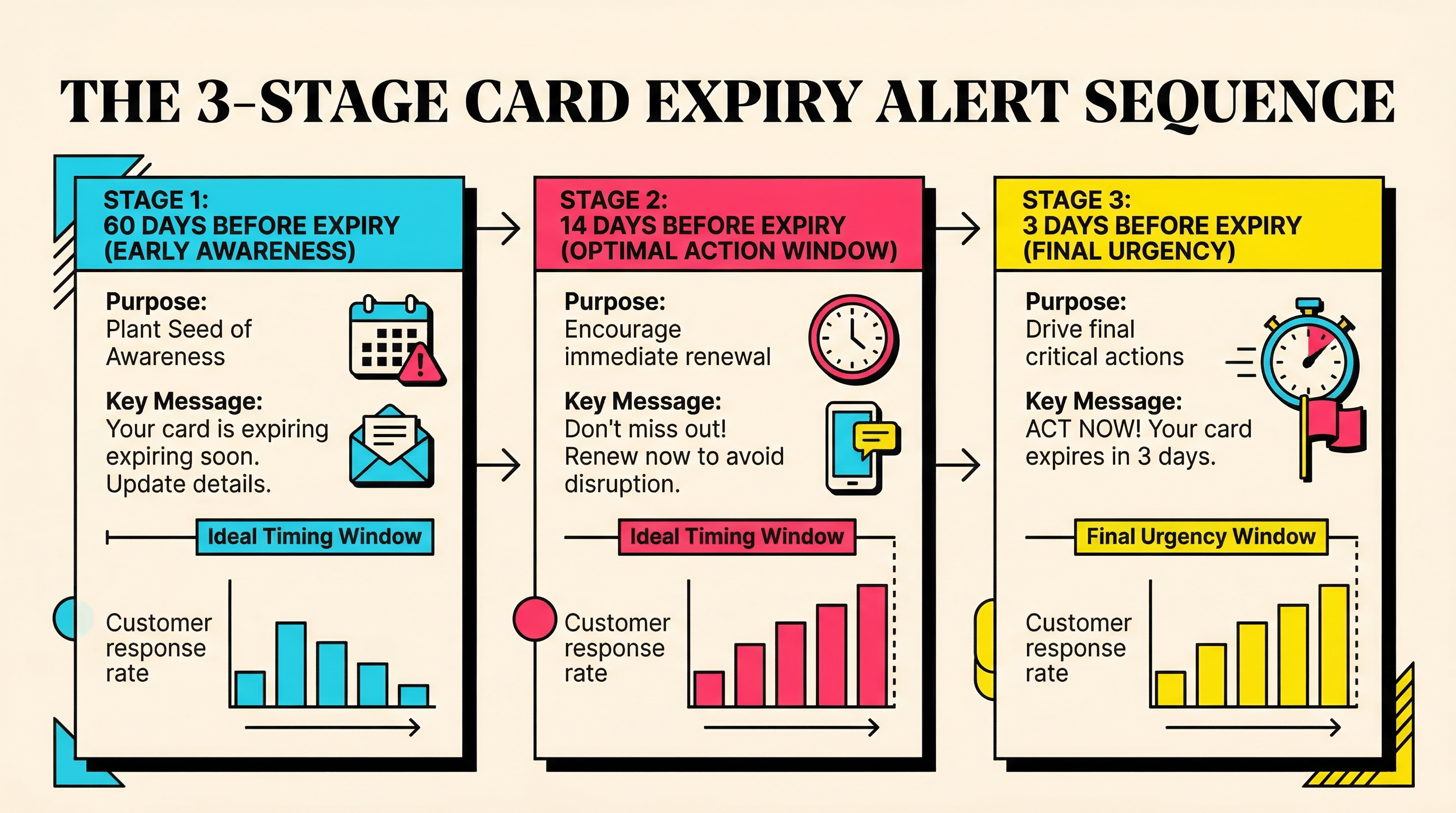
Segment 2: expired cards and stale payment credentials
This is one of the most boring and expensive segments in subscription billing.
The customer may want to stay. The bank account may be fine. The problem is that the card on file is stale. Annual plans get hit especially hard because a lot can happen to card details over twelve months.
This segment usually includes:
- expired card
- invalid expiry month or year
- replaced cards after routine renewal
- cards reissued after fraud or loss
Why this segment matters:
- blind retries are mostly pointless
- prevention tools like updater coverage matter a lot here
- recovery usually depends on fast payment-method repair
What to do:
- route the customer directly to a payment-method update flow
- shorten the time between first failure and customer action
- separate annual-plan expiry failures from monthly-plan ones
- monitor whether stale-card issues are increasing as your subscription base ages
If this segment is large, your business probably has a payment-maintenance problem, not a product-retention problem.
For a deeper look at the mechanics behind this bucket, the guide on Stripe Account Updater is useful because it focuses on prevention before renewal day even arrives.
Segment 3: authentication-required and SCA-sensitive failures
This segment matters because it sits in the awkward middle. The payment is not dead, but it is not going through unattended either.
Typical examples include:
- authentication required
- 3D Secure needed
- off-session charge needs customer confirmation
Why this segment matters:
- recovery can be strong if the customer gets the right prompt quickly
- generic retries without customer action usually waste time
- user experience matters more than brute-force automation
What to do:
- send a clear message that the payment needs verification
- link directly to the shortest possible action path
- track completion rate from prompt to successful recovery
- segment by geography because SCA-heavy regions behave differently
Too many teams bury this segment inside generic failure buckets. That is dumb. Authentication failures are operationally distinct and deserve their own workflow.
Segment 4: ambiguous issuer declines
This is the messy segment. The bank says something unhelpful, and your team is left guessing.
Typical examples include:
- do not honor
- generic decline
- issuer declined without clear reason
- transaction not permitted without enough context
Why this segment matters:
- it often becomes a junk drawer for unresolved revenue
- repeated retries can become theater instead of strategy
- without limits, this segment quietly bloats your delinquent invoices
What to do:
- set a limited retry policy with a fast escalation path
- move quickly toward payment-method replacement when retries fail
- monitor the share of failed MRR sitting in this segment
- break it out separately in reporting instead of hiding it inside "other"
This is one reason do not honor declines deserve explicit tracking. The code sounds precise and usually is not. If you do not segment it, you will tell yourself fake stories about why revenue was lost.
Segment 5: hard-stop payment method failures
Some failures are not subtle. The current payment method is not coming back.
Typical examples include:
- lost card
- stolen card
- account closed
- invalid account number
- pickup card or fraud-related hard stops
Why this segment matters:
- retries are low-value or pointless
- customer action is mandatory
- time-to-repair matters more than retry volume
What to do:
- stop repeated blind retries quickly
- request a new payment method immediately
- separate these accounts from soft-decline queues
- track how many recover after first contact versus aging into churn
Teams that fail here usually do one of two dumb things: they either keep retrying hopeless charges, or they let the invoice rot without a clean customer action path.
Segment 6: high-value accounts with failed payments
This segment is not about the decline code. It is about account value.
A failed $29 self-serve account and a failed $12,000 annual contract should not trigger the same operational response. Yet plenty of teams still run one-size-fits-all recovery flows because it is easier.
Why this segment matters:
- revenue concentration changes urgency
- larger accounts often have finance approval loops and longer billing chains
- human intervention can be worth it here when it is not worth it elsewhere
What to do:
- create a threshold for manual review or customer-success outreach
- separate high-value delinquency from low-value automated recovery queues
- measure recovery time and save rate for big accounts specifically
- review whether enterprise or annual accounts fail for different reasons than self-serve ones
This segment usually reveals that part of the failed payment problem is workflow design, not card mechanics. High-value accounts often need better coordination, not just better retries.
Segment 7: repeat offenders and chronic billing-risk accounts
Some accounts fail once. Some accounts keep showing up in your failed-payment feed like an unpaid internship.
This segment includes customers who:
- have repeated failed renewals across multiple cycles
- update cards often but still fail later
- regularly hit the same decline family
- recover late every single month
Why this segment matters:
- it predicts future support load and involuntary churn risk
- it exposes weak payment-method quality and account health
- it helps you identify where pre-dunning or proactive outreach is worth the effort
What to do:
- flag repeated failure frequency at the customer level
- separate one-off noise from chronic billing friction
- review whether the issue is card quality, account type, geography, or billing setup
- consider proactive reminders before the next renewal
This is where segmentation becomes predictive instead of reactive. If an account has already failed three times in six months, the next failure should not be treated like a surprise.
How to turn these segments into an operating model
You do not need a giant rev-ops project to make this useful. Start with a simple action framework.
Bucket each failed payment into a next-action group
Map every segment into one of four responses:
- retry later
- prompt for authentication
- request updated payment method
- escalate or review manually
This gets the billing queue out of vague territory fast.
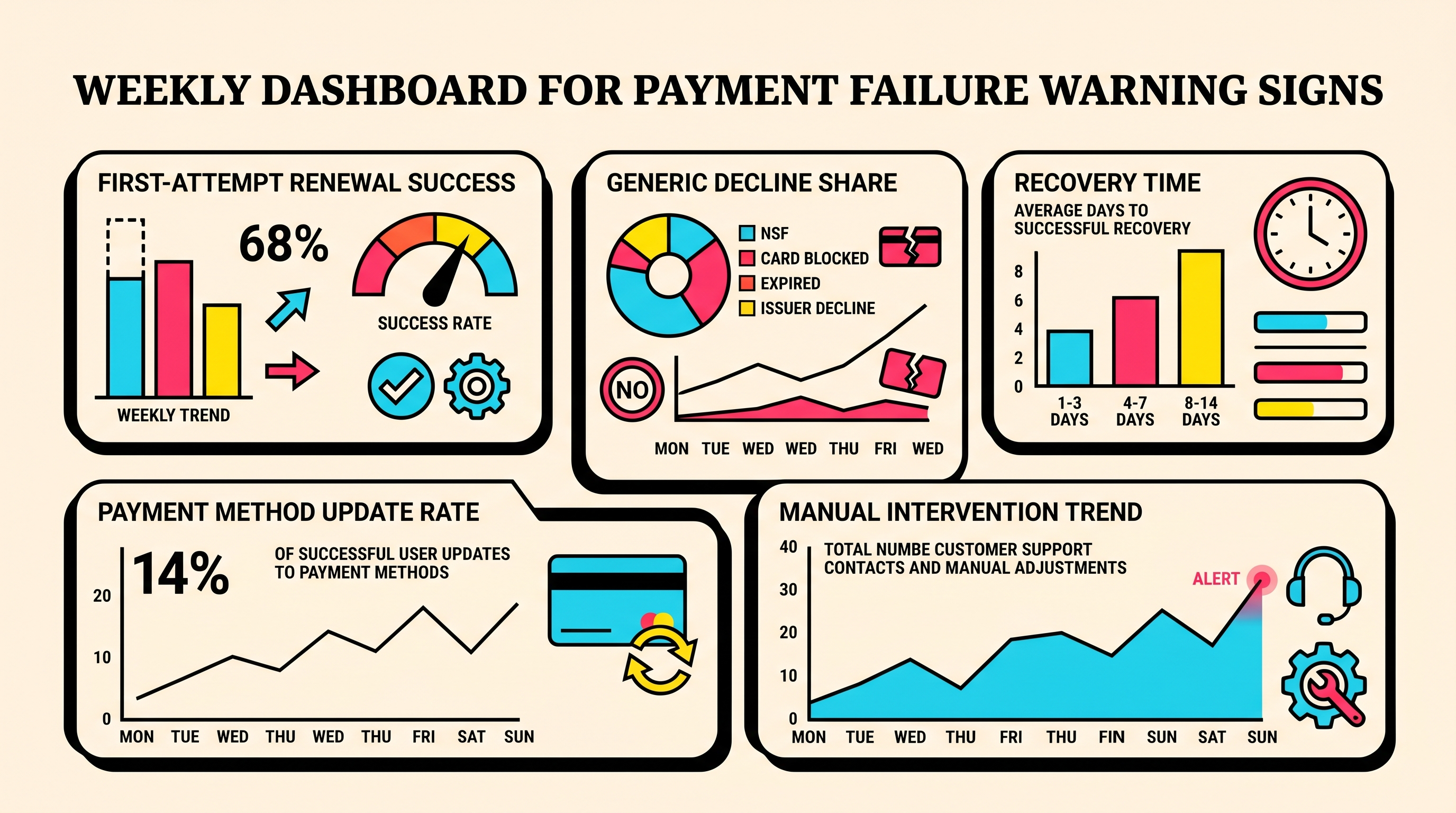
Track recovery by segment, not just in total
At minimum, measure:
- recovery rate by segment
- time-to-recovery by segment
- share of failed MRR by segment
- cancellation or delinquency aging by segment
- manual-touch rate for high-value accounts
These numbers tell you where to focus. If expired-card recoveries are terrible, fix payment-method update UX. If insufficient-funds recovery is weak, improve retry timing. If ambiguous issuer declines are bloating, shorten the leash.
Separate monthly from annual where it matters
This is worth repeating. Billing interval changes the story.
- monthly plans often recover better from temporary liquidity issues
- annual plans are more exposed to stale-card failures and higher-stakes approvals
- mixed reporting hides both patterns
If your annual failed-payment segment looks ugly, do not automatically blame retention. It may just be stale credentials plus weak recovery design.
Align messaging with segment reality
Customers do not need generic billing mush. They need the right next step.
- soft declines: explain that the system will retry
- stale-card issues: ask for an updated card now
- authentication failures: explain the verification step clearly
- hard-stop failures: request a replacement method without delay
When the message matches the problem, recovery gets easier.
The segmentation mistakes that cost teams money
Treating decline codes as the only segmentation layer
Decline reason matters, but so do account value, billing interval, and repeat-failure history. Use multiple lenses.
Letting "other" become your biggest category
If your largest failed-payment segment is a junk drawer, your reporting is lying to you.
Measuring activity instead of outcomes
Retry counts and email sends are not success. Recovered revenue and reduced preventable churn are success.
Failing to connect segmentation to real workflows
A dashboard category that does not change action is just decorative analytics.
The real payoff
The seven failed payment segments every Stripe team should track are not about making dashboards look sophisticated. They are about making better decisions after the first failure.
When you separate temporary cash-flow friction from stale-card problems, authentication needs, ambiguous issuer noise, hard-stop payment method failures, high-value account risk, and chronic billing-repeaters, the whole recovery system gets sharper.
You retry less stupidly. You message customers more clearly. You escalate where it is worth it. And most importantly, you stop confusing preventable billing friction with actual customer churn.
That is the difference between a team that merely observes failed payments and a team that actually recovers revenue.
If you want to see where failed payments and involuntary churn are leaking through your Stripe setup, run a free churn audit at ChurnBot.
Related Posts

Pre-Dunning: How to Prevent Failed Payments Before They Happen
The Complete Toolkit for Managing Failed Payments
How healthy is your Stripe account?
Get a free churn health report. Find pending cancellations, failed payments, and expiring cards putting your MRR at risk.
Run Free Audit