Stripe Account Updater: Reduce Failed Payments
If you run subscriptions on Stripe, expired cards are one of the dumbest ways to lose revenue. The customer often still wants the product. The bank account may be fine. The cardholder may not even know anything is broken. But the renewal fails, your retry logic starts firing, and the clock begins ticking toward involuntary churn.
That is where Stripe Account Updater matters. It is one of those billing levers that sounds small until you realize how many failed payments start with outdated card details rather than true inability to pay. For SaaS founders, that matters because expired cards and replaced cards are operational problems, not product-market-fit problems.
This guide breaks down what Stripe Account Updater actually does, where it helps, where it does not help, and how to tell whether it is making a meaningful dent in failed payments. The goal is simple: reduce avoidable churn without pretending every decline can be solved by another retry email.
What Stripe Account Updater actually does
Stripe Account Updater is designed to keep saved card details current when issuers or card networks provide updated card information. In plain English, when a customer's card expires or gets replaced after loss, theft, reissue, or routine renewal, Stripe can sometimes receive updated payment credentials automatically and use them for future billing attempts.
That matters because stored payment methods go stale all the time. Cards expire. Banks reissue cards after fraud events. Physical cards get replaced while the underlying customer relationship with your product remains healthy. If your billing system still points at dead card data, recurring payments will fail for reasons that have nothing to do with customer intent.
In the best case, Account Updater helps Stripe swap in the fresh details before the renewal attempt happens. That means the payment goes through without the customer getting dragged into a rescue flow. No billing support ticket. No awkward "please update your card" email. No preventable interruption to service.
The practical upside is not just a higher success rate on a single invoice. It is lower operational drag across your entire recovery funnel. Every prevented failure is one less retry to manage, one less dunning email to write, and one less customer at risk of slipping into involuntary churn.
How it reduces failed payments in real subscription flows
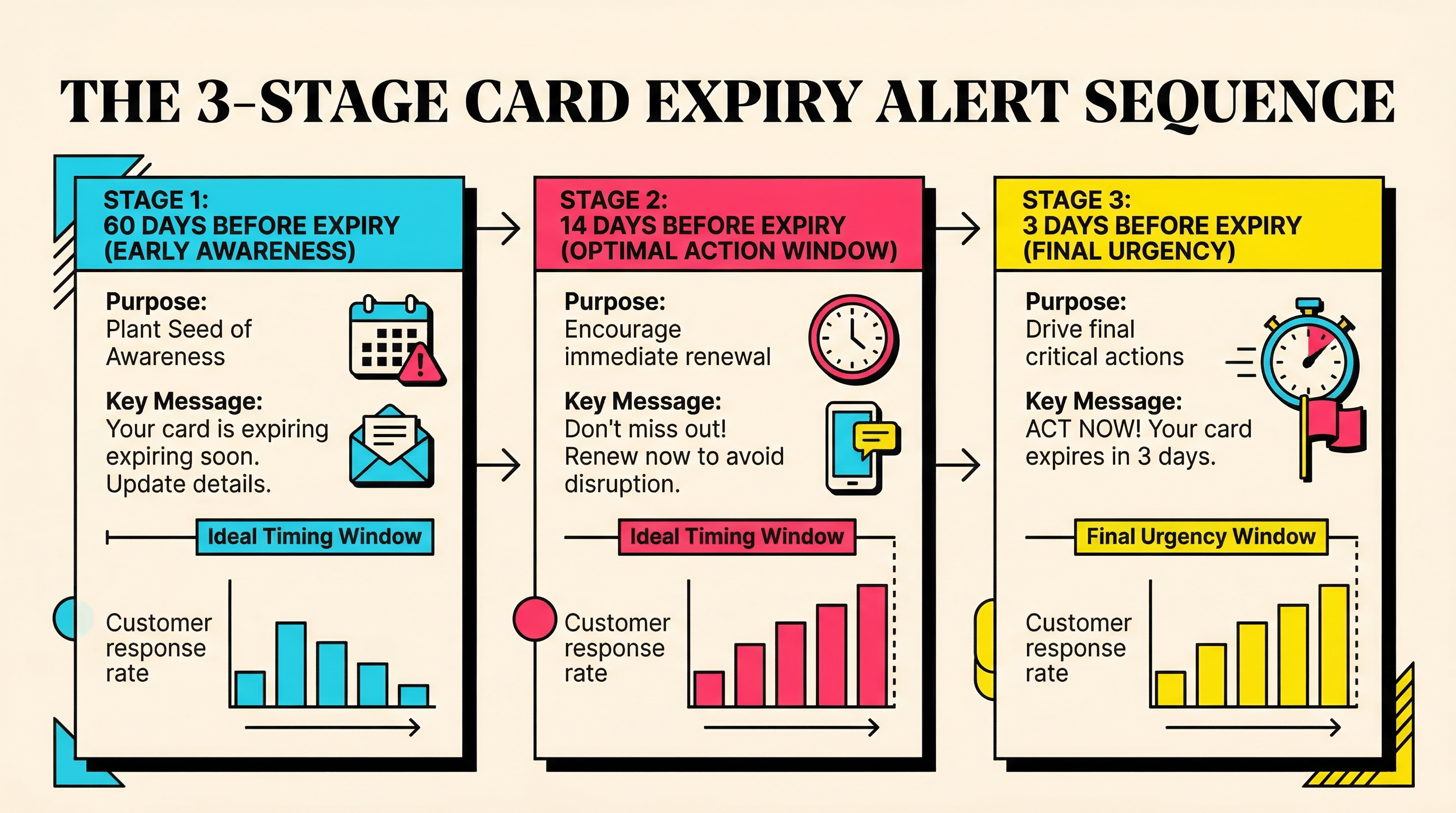
Most teams think about payment recovery after an invoice has already failed. Account Updater works earlier in the chain. It is a prevention mechanism more than a rescue mechanism.
A typical flow looks like this:
- A customer subscribes and saves a card.
- Months later, that card expires or gets replaced.
- The issuer or network makes updated card details available.
- Stripe receives or accesses that update where supported.
- Your next renewal uses the fresher payment details instead of the stale ones.
- A failure that would have triggered retries and dunning never happens.
That makes Account Updater especially relevant for subscriptions with annual plans, longer billing cycles, or low-touch products where customers are not logging in frequently. The longer the gap between initial checkout and the next renewal, the more likely stored card data will drift out of date.
It is also why teams that obsess only over retry timing miss part of the picture. Retry strategy matters, but prevention is cheaper than recovery. If you can avoid the failure entirely, you preserve revenue with less customer friction.
For founders already tracking decline patterns, this is tightly connected to card expiry issues. If you keep seeing expiration-related failures, you should understand both your raw decline mix and your prevention layer. ChurnBot's guide to expired card decline codes is worth reviewing because it helps separate avoidable stale-card problems from deeper billing issues.
What Account Updater helps with, and what it definitely does not
A lot of billing advice gets fuzzy here, so let us be blunt.
Where it helps
Account Updater is most useful when the problem is outdated credentials tied to an otherwise valid payer. That includes:
- expired cards after routine card renewal
- cards reissued after fraud or loss
- replacement cards with updated PAN or expiry details
- long-lived subscriptions where stored credentials age out between invoices
In these cases, the customer relationship is usually intact. They are not necessarily churning. Your billing data is just stale.
Where it does not help
Account Updater is not magic. It will not rescue every failed payment, and pretending otherwise is how teams build sloppy recovery assumptions. It generally will not solve:
- true insufficient funds events
- hard bank declines based on issuer risk decisions
- customer intent to cancel
- authentication issues that require customer action
- unsupported cards, unsupported regions, or networks with limited update coverage
If your decline profile is dominated by issuer ambiguity such as do not honor, then stale card credentials are probably not your main bottleneck. In that situation, smarter retries, better payment method collection, and tighter billing operations usually matter more than updater coverage.
The key lesson: Account Updater is one component in a larger involuntary churn system. It is a strong lever for a specific failure mode, not a substitute for recovery strategy.
Why founders underrate it
Founders tend to underrate Account Updater for three reasons.
First, it is mostly invisible when it works. Nobody celebrates the payment that did not fail. It just clears. That makes the mechanism easy to ignore compared with visible systems like dunning emails or support escalations.
Second, the impact shows up indirectly. You may notice fewer expiry declines, a better first-attempt renewal rate, or less manual card collection work. Those gains are real, but they do not always come labeled "thanks to updater."
Third, many teams have never done a clean before-and-after audit of preventable payment failures. They know churn is happening, but they have not isolated how much comes from stale cards versus other decline categories.
That is a mistake. Billing problems deserve category-level analysis. If you lump every failed renewal into one bucket, you will end up over-investing in customer messaging and under-investing in prevention.
How to measure whether it is working
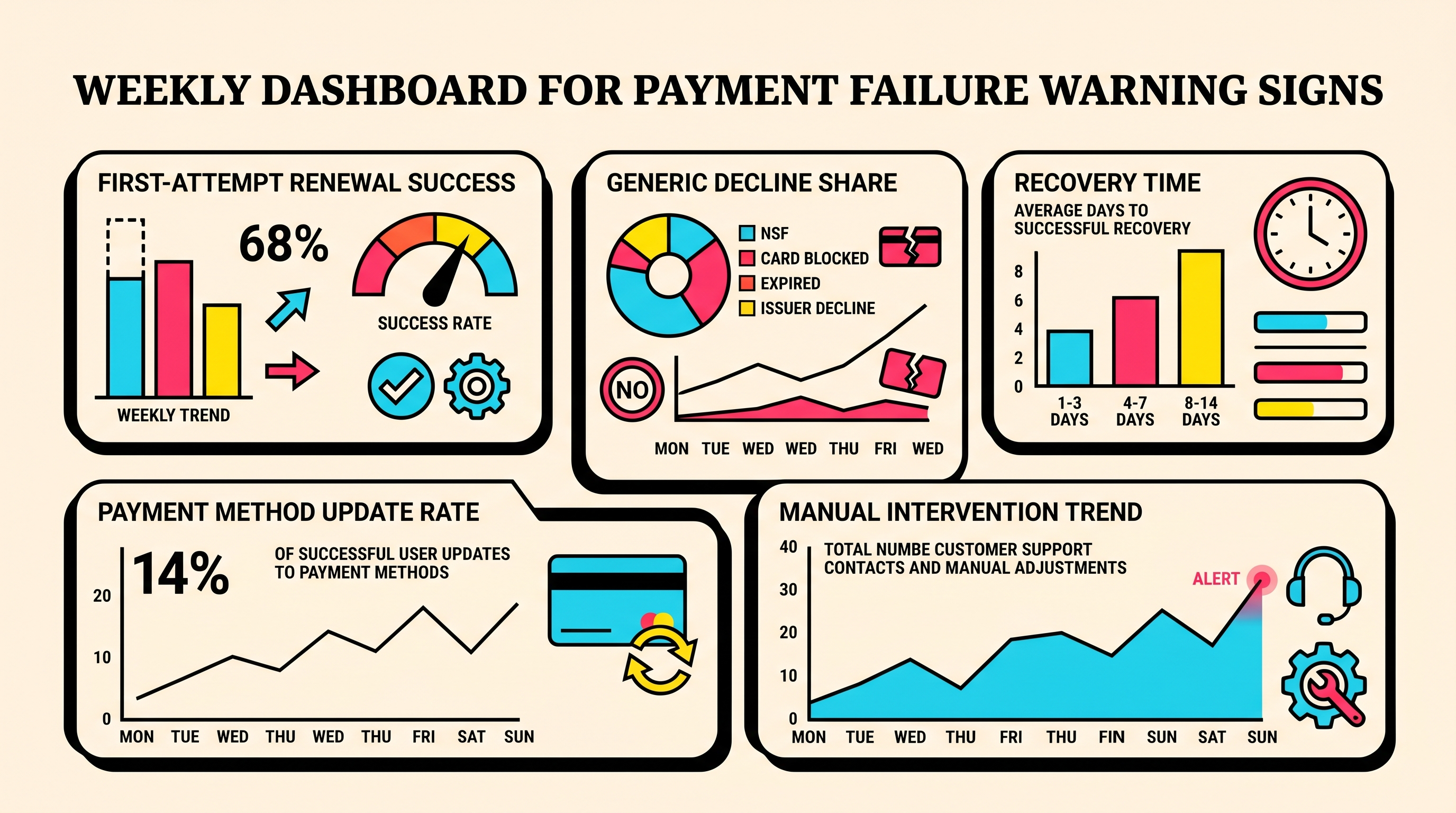
You do not need a perfect attribution model to judge whether Account Updater is pulling its weight. You do need a few grounded metrics.
1. Expiry-related decline rate
Start with the share of failed subscription payments tied to expired or invalid expiry details. If that slice is meaningful, stale credentials are part of your churn problem.
2. First-attempt renewal success rate
Look at how many recurring invoices succeed on the first try. If first-attempt performance improves while product, pricing, and customer mix stay broadly stable, your prevention layer may be doing real work.
3. Payment method update requests sent to customers
If you are frequently asking active customers to refresh their cards, that is a clue your system is still relying too heavily on manual fixes. Updater should reduce some of that load.
4. Recovery rate on card-expiry cohorts
Break out subscriptions that would historically have failed due to expired cards and compare recovery patterns over time. Even directional improvement is useful.
5. Support volume related to billing credential updates
This is not a finance metric, but it matters operationally. Fewer "my card changed" support interactions usually means your recurring billing stack is handling more of the work in the background.
If you want a broader audit of what healthy recovery performance looks like, pair this analysis with a revenue-leak review and benchmark work. The benchmarks page and related billing performance content on ChurnBot can help frame whether your failed-payment numbers are merely annoying or actively hurting growth.
Why annual plans usually feel the impact first
If you sell annual contracts, Account Updater deserves even more attention. Twelve months is plenty of time for a card to expire, get replaced, or disappear from the customer's mental radar. That means annual renewals are more exposed to stale credentials than monthly subscriptions, even when the customer is perfectly happy.
This is one reason some SaaS businesses get blindsided by renewal churn in otherwise healthy enterprise or prosumer cohorts. They assume a failed annual renewal signals weak intent, when the real problem is often boring card maintenance. If your business has a strong annual mix, classify those failures separately. You may discover that a chunk of apparent churn is really preventable billing friction.
A practical operator playbook
Most teams do not need a grand billing transformation. They need a tighter operational loop. Here is the practical playbook.
Audit your failed-payment mix
Do not start with guesses. Pull a sample of failed subscription payments and classify them. Separate expiry problems, insufficient funds, generic issuer declines, fraud-related blocks, and authentication issues.
If expiry-related failures barely register, Account Updater is not your first lever. If they show up constantly, you have a clear prevention opportunity.
Review your saved payment method hygiene
Ask ugly questions:
- How old are the cards attached to long-running subscriptions?
- What share of customers have only one payment method on file?
- Which plans have the longest gap between charges?
- Do annual contracts produce a disproportionate number of stale-card failures?
The answers usually expose where stale data is most likely to accumulate.
Tune the rest of the recovery flow anyway
Even with strong updater coverage, some payments will still fail. You still need a sane recovery system with sensible retries, clear customer messaging, and a clean payment update path. ChurnBot's post on pre-dunning and failed payment prevention is relevant here because it focuses on reducing failures before they become full recovery events.
Watch cohorts, not just totals
Averages lie. If you only track total recovery rate, you can miss meaningful movement in specific failure categories. Watch cohorts such as annual renewals, older subscriptions, and card-expiry declines separately.
Keep support and finance aligned
Billing failures often sit awkwardly between product, finance, and support. Make sure whoever owns subscription operations can see the same failure categories and outcomes. Otherwise the team will keep solving symptoms from different angles.
Common mistakes teams make with Account Updater
Treating it like a complete churn solution
It is not. If your product has poor retention, no amount of card-refresh infrastructure will save you. Account Updater only helps when the customer still intends to pay and the issue is stale card data.
Ignoring non-expiry declines
Some teams see a small lift from updater coverage and assume the job is done. Meanwhile, issuer declines, retry strategy, and payment-method mix remain weak. That leaves a lot of preventable revenue on the table.
Failing to segment by billing interval
Monthly and annual plans behave differently. Annual billing is often more exposed to stale credentials because more time passes between charges. If you do not segment, you will miss where Account Updater matters most.
Measuring only recovered revenue
Recovered revenue matters, but prevented failures matter just as much. A payment that succeeds on the first attempt is operationally better than one that fails, gets retried three times, and finally clears after an email chase.
Not having a fast fallback when updater does not help
When an updated credential is not available, the rest of your flow needs to take over cleanly. That means clear payment update UX, sensible retries, and no chaotic message spam.
The bigger point: prevention compounds
The best billing systems feel boring. That is a compliment.
They quietly prevent avoidable failures, route the remaining failures into smart recovery flows, and keep customers from experiencing your internal billing mess. Account Updater fits that philosophy perfectly. It does not replace dunning, retries, or payment-method collection. It makes all of them work on a smaller, cleaner problem set.
For SaaS operators on Stripe, that is the real value. You are not chasing a shiny optimization. You are reducing a category of failure that should never have become customer-facing in the first place.
If you suspect stale payment details are contributing to involuntary churn, run a proper audit before you guess. You can run a free churn audit at ChurnBot to spot failed payment recovery opportunities and see where preventable revenue leakage may be hiding.
Related Posts
10 Early Warning Signs of Growing Payment Failure Risk
Regional Payment Failure Patterns: What the Data Shows
Stripe Do Not Honor Recovery: What SaaS Teams Should Do Next
How healthy is your Stripe account?
Get a free churn health report. Find pending cancellations, failed payments, and expiring cards putting your MRR at risk.
Run Free Audit