Regional Payment Failure Patterns: What the Data Shows
Regional payment failures look random when you stare at a Stripe dashboard long enough. They are not random. They usually follow a pattern shaped by issuer behavior, local payment habits, card mix, fraud controls, regulation, and how aggressively you retry failed charges.
If you sell subscription software in more than one country, a single global dunning strategy will almost always leave money on the table. The retry cadence that works in the UK can underperform in Brazil. The card-update friction that feels tolerable in the US can crush recovery in markets where customers expect wallet-first checkout. The fraud settings that protect you in one region can quietly block legitimate renewals in another.
This is why strong operators stop asking, “What is our failed payment rate?” and start asking, “Where is it breaking, and why is it breaking there?”
In this guide, we’ll break down regional payment failure patterns, what usually drives them, and how to build a recovery system that reflects reality instead of averages. If your subscription revenue runs through Stripe, this is the kind of analysis that helps you cut involuntary churn without guessing.
Why regional payment failure patterns matter more than your global average
A blended failed payment rate is useful for board slides and almost useless for execution. It hides the outliers. If North America is running at a 7 percent failure rate and another region is sitting at 14 percent, the average tells a comforting lie.
For most SaaS teams, payment failure issues show up in five places:
- initial authorization failures on renewal
- soft declines that can recover with smart retries
- hard declines that need a payment method update
- authentication failures tied to SCA or issuer rules
- preventable churn caused by poor follow-up timing
Once you segment by region, a few ugly truths usually appear.
First, not all declines mean the same thing. “Do not honor” can reflect very different issuer behavior depending on geography. Second, customer willingness to update a card is not universal. Some regions have far higher friction once a customer has to leave the product and touch billing settings. Third, local payment preference matters. If customers prefer bank debit, wallet, or domestic methods over cards, your card-based subscription stack may be fighting the market.
That is why regional analysis is not a nice-to-have. It is one of the fastest ways to find revenue your current workflow is leaking.
The main regional patterns SaaS teams usually see
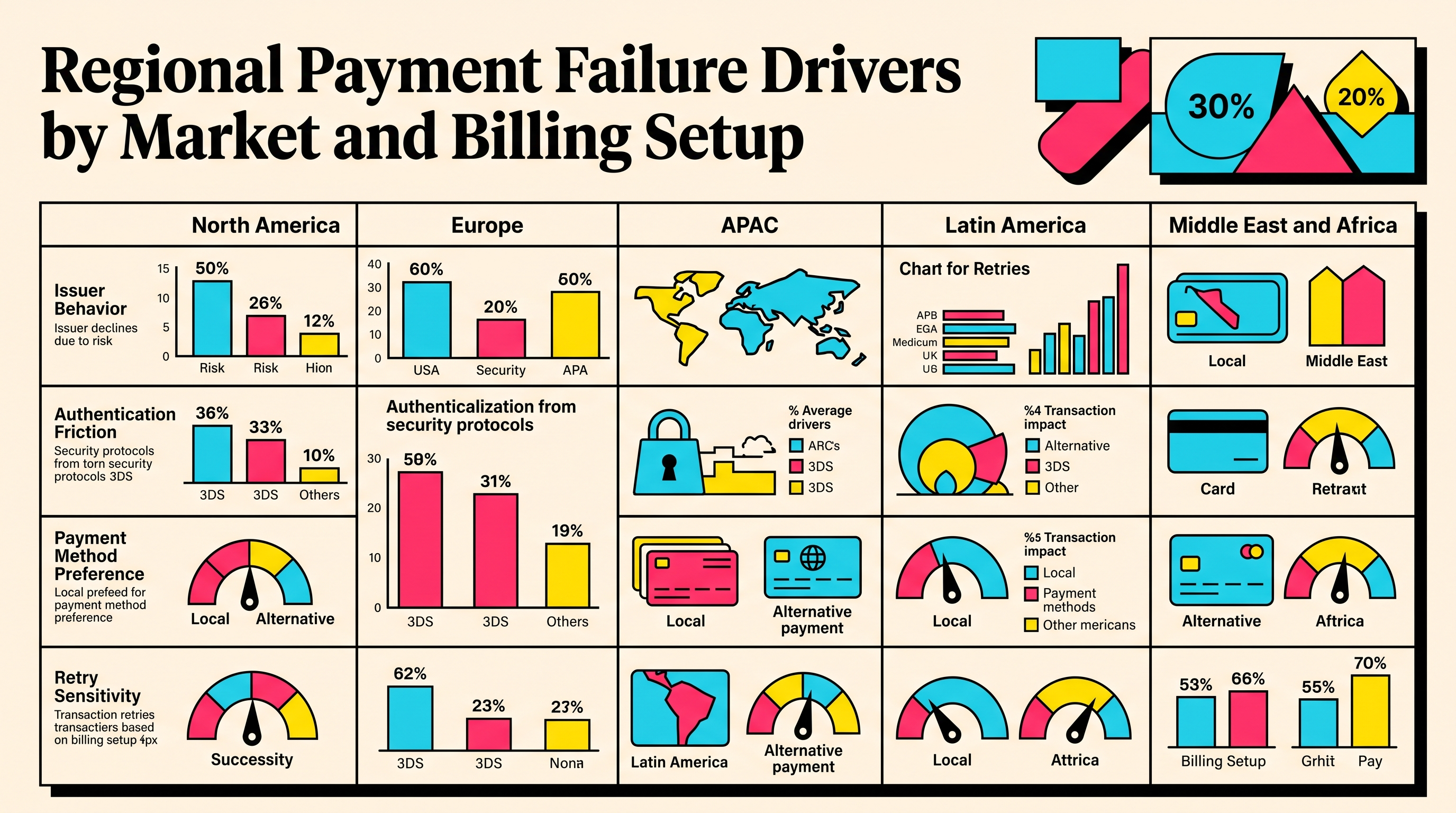
North America: higher card penetration, cleaner retries, expensive complacency
In the US and Canada, card penetration is high and recurring card billing is familiar. That sounds easy, and compared with many markets it is. But teams get lazy here because baseline recovery can look decent.
Common North American failure patterns include insufficient funds, expired cards, generic issuer declines, and occasional fraud-triggered false positives. Smart retries often perform relatively well because issuers are used to recurring subscription behavior and because card updater coverage can soften the blow of stale credentials.
The trap is assuming decent equals optimized. If you do not segment by card brand, issuer, and region within North America, you can miss pockets where recovery lags badly. Weekend retries, payroll timing, and reminder copy can all shift outcomes. Even a one or two point lift in recovery here matters because the volume is usually large.
UK and Europe: authentication and issuer caution shape outcomes
The UK and wider Europe often show a different profile. Strong Customer Authentication changed the game, and while recurring payments can be exempt from repeated step-up flows, edge cases still hurt conversion and renewal success.
You will often see more authentication-related issues, more payment method update friction after cards change, and more variation by country than founders expect. Germany does not behave like Spain. France does not behave like the Nordics. Treating Europe as one payment region is sloppy.
Another common issue is that teams see a generic decline code in Stripe and assume the fix is another retry. Sometimes it is. Sometimes the better move is to push the customer straight toward a clean payment method refresh, ideally with a low-friction update path and context that explains why the charge failed.
If you have not already, it is worth reviewing how payment gateway decline reasons beyond Stripe can mask local issuer behavior. The label in your dashboard is often the start of the investigation, not the conclusion.
APAC: mixed infrastructure, wider method diversity, more variance
Asia-Pacific is where averages go to die. You may have strong card performance in Australia and very different behavior in Southeast Asia. In some markets, domestic methods, wallets, and bank-based flows are far more trusted than cards for repeat billing.
That creates two practical problems. One, your default billing method may be mismatched to customer preference. Two, your recovery workflow may be optimized for card problems when the real issue is method fit.
Teams selling into APAC often need tighter segmentation, shorter feedback loops, and a willingness to test localized billing language. A reminder that says “update your card” is weak if the customer would rather switch methods entirely.
Latin America: volatility, issuer conservatism, and retry sensitivity
Latin American markets often show more payment volatility. Cross-border charges, issuer conservatism, prepaid card usage, installment culture, and fraud sensitivity can all increase failure rates.
This is the kind of region where retry timing matters a lot. Hammering the same card too quickly can hurt. A more patient schedule paired with stronger customer communication can outperform aggressive retry logic.
It is also where a one-size-fits-all fraud setup can become self-sabotage. Rules that were tuned around lower-risk geographies may block legitimate subscription renewals. If you are using Stripe, this is one place where operational teams should revisit Stripe API tricks for better payment success rates and audit whether billing metadata, retry logic, and payment method handling are actually helping.
Middle East and Africa: smaller volume, bigger edge cases
Many SaaS companies have lower total volume here, which is exactly why the region gets ignored. That is a mistake. Lower volume markets often carry a high concentration of edge cases: issuer-specific decline behavior, international card friction, authentication quirks, and uneven acceptance by country.
The right move is not to over-engineer. It is to avoid letting a small region vanish into “other.” If a geography has meaningful customer concentration or high-value accounts, give it its own line in reporting.
What actually causes regional differences
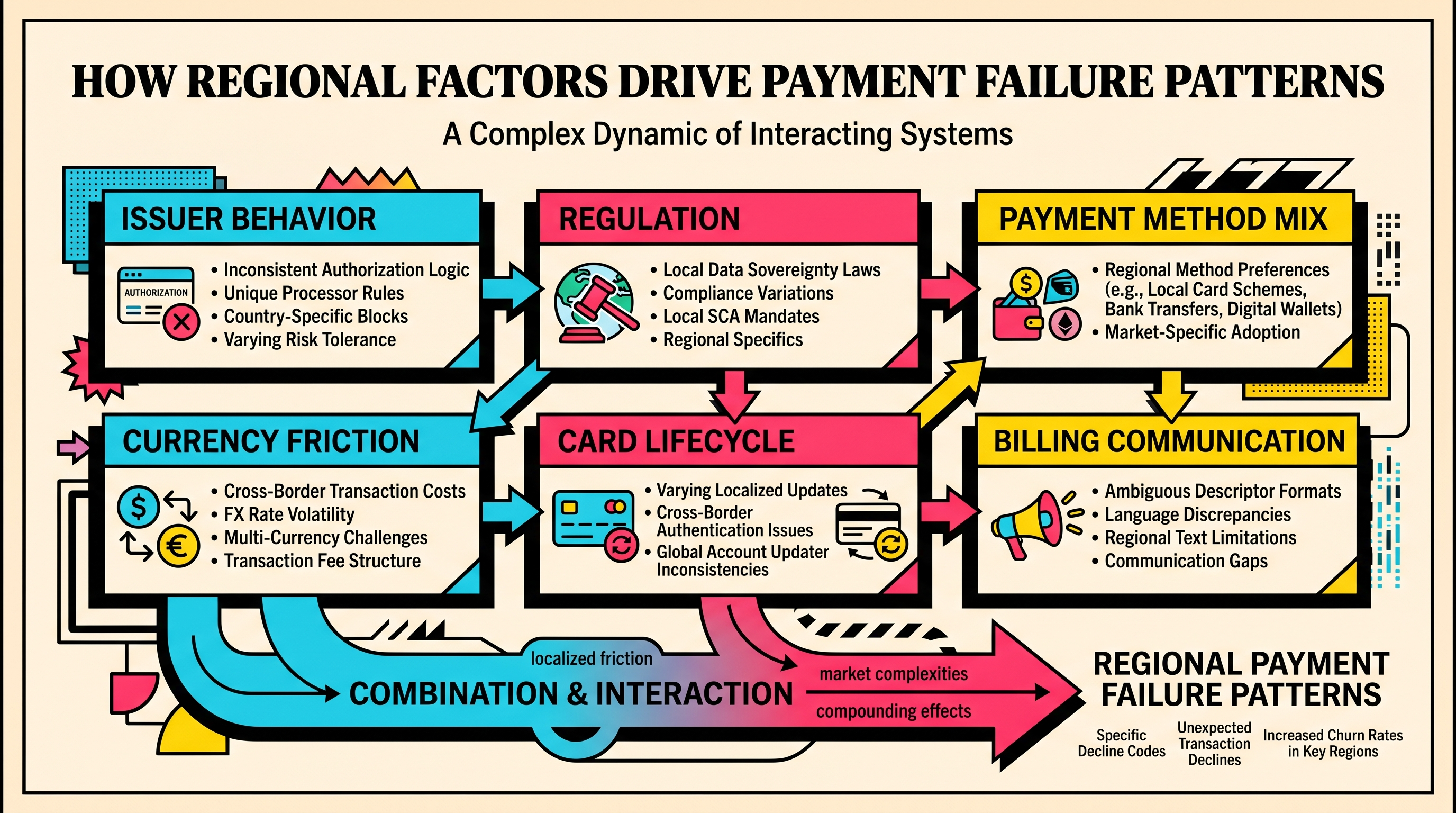
Regional differences in payment failure are usually the result of six overlapping forces.
1. Issuer behavior
Issuers are not robots with identical rules. They have different risk appetites, different fraud models, and different views on recurring billing. Some are tolerant of subscription retries. Some shut things down fast. Some expose better signals. Some hide behind vague declines.
This is why the same retry policy can recover well in one country and fail miserably in another.
2. Regulation and authentication requirements
Regulatory environments shape renewal behavior. SCA in Europe is the obvious example, but local mandates and banking expectations matter elsewhere too. When authentication interrupts what should have been a background renewal, churn risk goes up.
3. Payment method mix
If customers in a region prefer cards, your card recovery workflow has a fair shot. If they prefer bank debit or wallets, card-only recovery logic becomes a bottleneck. This is a strategic issue, not just an ops issue.
4. Currency and cross-border friction
Cross-border charges can trigger more scrutiny. Even when the cardholder has enough funds, the issuer may dislike the merchant location, currency, or transaction pattern. Founders often underestimate how much this affects recurring renewals.
5. Card lifecycle differences
Card expiry rates, replacement patterns, and updater coverage are not equal across regions. In some markets, expiring cards are a routine nuisance. In others, card replacement plus poor updater coverage can create a recovery cliff.
6. Customer expectations around billing communication
Some customers respond well to a simple billing email. Others need stronger urgency, clearer explanation, or a more mobile-friendly path. This is not about over-localizing every message. It is about removing unnecessary friction where behavior differs.
How to analyze your own regional payment failure patterns
If you want useful answers fast, do not start with a giant data science project. Start with a basic operational cut.
Step 1: segment failed payments by region and reason
At minimum, break failed renewals down by:
- country or billing region
- payment method type
- decline code or normalized failure reason
- first attempt vs retry
- recovered vs lost
- MRR at risk
Do this monthly and rolling 90-day. Monthly catches recent breakage. Rolling 90-day smooths noise.
Step 2: separate soft declines from hard declines
A soft decline is usually recoverable with timing, retries, or a cleaner retry context. A hard decline usually needs customer action. If you blend them, you will misdiagnose the problem.
For example, a region heavy on soft declines might need better retry spacing. A region heavy on expired cards might need earlier nudges and easier update flows.
Step 3: measure recovery rate by region, not just failure rate
This is where a lot of teams screw it up. Failure rate tells you where the fire starts. Recovery rate tells you whether your system can put it out.
Two regions can have similar failure rates and wildly different recovery outcomes. The one with weaker recovery is where your dunning and billing UX are underperforming.
If you need a reality check on what good looks like, compare your results against broader churn expectations in your category and region where possible. ChurnBot’s SaaS churn benchmarks library is useful for sanity-checking whether your retention assumptions are drifting away from market norms.
Step 4: look for timing effects
Regional billing success often moves with timing. Salary cycles, local holidays, bank processing windows, and even time-of-day effects can influence whether a retry clears.
You do not need perfect causality to act. If retries sent 24 hours later outperform immediate retries in one region, test around that insight.
Step 5: map failure patterns to intervention type
Every region should point to a default action path:
- retry-first
- authenticate-first
- update-method-first
- support-assisted recovery for high-value accounts
- payment-method expansion strategy
That is when reporting becomes operational instead of decorative.
A practical playbook for reducing regional payment failures
Build region-aware retry logic
This does not mean hand-coding 40 country-specific schedules on day one. It means graduating from one global retry sequence.
A good starting model is:
- group countries into a few behavior buckets
- define a retry cadence per bucket
- review outcomes every month
- promote or merge buckets based on evidence
You are looking for the smallest amount of complexity that produces a measurable lift.
Improve payment method update flows
When a renewal truly needs customer action, the update path must be stupidly easy. Mobile-friendly page. Clear explanation. Minimal clicks. No confusing account detours.
This matters everywhere, but it matters more in regions where issuer approval is less forgiving or where customers are less patient with billing friction.
Tune fraud controls with billing in mind
Fraud prevention matters. So does not nuking legitimate subscription revenue. If a region has unusually high false declines, your billing and fraud teams should review the interaction between risk rules and recurring payments.
Expand methods where the market demands it
If a region consistently underperforms on cards and the market prefers alternatives, the answer may not be a better dunning email. It may be offering payment methods customers actually trust.
Escalate intelligently for high-value accounts
Not every failed payment deserves manual attention. Some absolutely do. If a high-MRR customer in a difficult region fails renewal, a support-assisted save can be worth the cost.
Common mistakes founders make
The first mistake is treating all generic declines as the same problem. They are not.
The second is optimizing for global averages instead of regional leakage.
The third is retrying too aggressively in regions where patience works better.
The fourth is assuming the product is the churn problem when the billing stack is quietly bleeding renewals.
The fifth is refusing to revisit payment method strategy because “Stripe already handles billing.” Stripe gives you infrastructure. It does not magically choose the right operating model for your customer mix.
The simplest dashboard that actually helps
You do not need a fancy BI project to manage this. A practical dashboard has one row per region and five core metrics:
- renewal attempts
- failed renewal rate
- soft vs hard decline mix
- recovery rate within 7 and 30 days
- MRR lost to unresolved failures
From there, add notes on known drivers. For example: “High expired-card share.” “Authentication friction.” “Cross-border decline spike.” “Low wallet adoption.”
That little bit of operational context makes the numbers usable.
Final takeaway
Regional payment failure patterns are one of the clearest signals hiding inside a subscription business. They tell you where your retry logic is weak, where your billing UX is clumsy, where your payment method mix is outdated, and where your fraud setup might be punching your own revenue in the face.
Do not settle for a global failed payment rate and a shrug. Segment the data. Identify the regional differences. Match each pattern to a recovery playbook. Then iterate until the gap between regions starts to narrow.
That is how you turn payment recovery from a background process into a real retention lever.
If you want a faster way to spot where involuntary churn may be leaking revenue in your Stripe setup, run a free audit at ChurnBot.
Related Posts
10 Early Warning Signs of Growing Payment Failure Risk

Stripe Insufficient Funds Recovery: A Playbook for SaaS Teams
How healthy is your Stripe account?
Get a free churn health report. Find pending cancellations, failed payments, and expiring cards putting your MRR at risk.
Run Free Audit