10 Early Warning Signs of Growing Payment Failure Risk
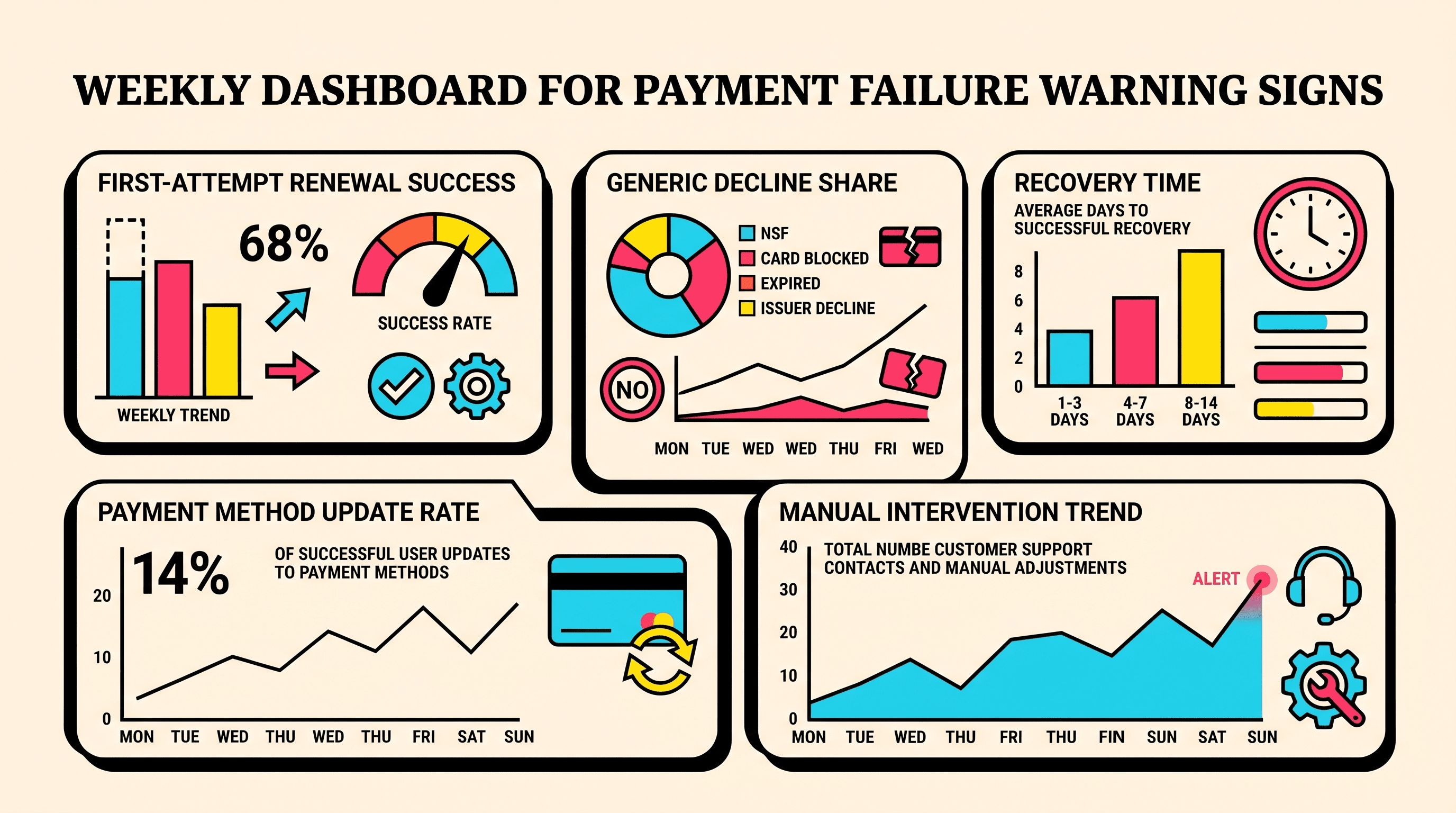
Payment failures rarely blow up a subscription business in one dramatic week. They usually creep in. A retry rate softens. More renewals bounce on the first attempt. Support sees a few more billing complaints. Recoveries start taking longer. Then, a month later, finance realizes the company is leaking more MRR than product churn alone can explain.
That is why smart operators watch for payment failure warning signs before the revenue damage shows up in a board deck. If you use Stripe for recurring billing, the earliest clues are usually sitting in plain sight inside your decline mix, retry outcomes, card update behavior, and billing workflows.
This guide breaks down the 10 most useful payment failure warning signs, what each one usually means, and what to do before failed renewals turn into involuntary churn. The goal is not to create more dashboards for the sake of it. The goal is to catch avoidable revenue loss early enough to fix it.
Why payment failure warning signs matter
Most SaaS teams react too late because they measure the lagging metric instead of the leading signal. They watch churn after the customer is already gone. Payment failure warning signs are better because they show stress upstream.
A payment system under strain usually shows the same pattern:
- first-attempt renewal success starts slipping
- generic decline codes become a bigger share of failed charges
- recovery takes longer, even when customers eventually pay
- more subscriptions require manual intervention
- support and billing complaints start clustering around the same issues
None of those signals guarantees disaster on its own. Together, they tell you the machine is getting noisier. That noise matters because involuntary churn compounds. A two-point deterioration in recovery can look small in isolation and still cost a painful amount of monthly recurring revenue once applied across hundreds or thousands of renewals.
If you already suspect billing friction is hiding inside your retention numbers, it helps to understand the anatomy of a failed payment. The mechanics matter because the fix depends on where the failure is happening.
1. First-attempt renewal success is trending down
The cleanest early warning sign is a drop in first-attempt renewal success rate. This is the percentage of recurring charges that succeed on the first try, before retries or customer intervention.
Why it matters: first-attempt success tells you how healthy your billing engine is before recovery logic starts masking the damage. A business can keep overall recovery looking respectable for a while by leaning on retries, but if first attempts are deteriorating, the underlying risk is still rising.
What it usually points to:
- more expired or replaced cards
- more issuer caution or false declines
- worsening payment method fit for your customer base
- bad timing on renewal attempts
- fraud settings that are clipping legitimate renewals
What to do: track first-attempt success weekly, broken out by market, payment method, plan type, and customer cohort. If the downtrend is concentrated in one segment, treat that as a diagnostic gift, not an annoyance.
2. Generic issuer declines are becoming a larger share of failures
Not all decline codes are equally useful. A rising share of vague codes like do_not_honor, generic_decline, or similar issuer catch-alls is an early smell that something is shifting below the surface.
Why it matters: when clear failure reasons like expired card or insufficient funds get crowded out by generic issuer responses, your recovery playbook gets weaker. You have less certainty about whether to retry, prompt for authentication, or ask for a new payment method.
What it usually points to:
- issuer risk models tightening up
- cross-border friction
- fraud tooling misaligned with recurring billing
- inconsistent transaction metadata
- regional changes in bank behavior
What to do: segment generic declines by country, card brand, BIN range if available, and first attempt versus retry. If the spike is regional, there is a good chance your retry strategy needs adjusting. If you want a deeper map of ambiguous failure reasons, the payment gateway decline reasons guide is worth revisiting.
3. Recovery rate looks flat, but recovery time is getting worse
This is one of the sneakier warning signs. Your team sees that a similar percentage of failed invoices eventually gets recovered, so everyone relaxes. Meanwhile the time to recovery stretches from two days to six, or from one billing email to three.
Why it matters: slower recovery still hurts cash flow, forecasting, and customer experience. It also means your system is working harder for the same result. That is rarely stable.
Longer recovery times often mean one of three things. Customers are confused. Retry timing is missing better windows. Or your update flow has become more annoying than you think.
What to do: track median days-to-recovery and the percentage recovered within 24 hours, 7 days, and 30 days. A flat topline recovery number can hide a worsening operating problem.
4. Payment method updates are rising after failed renewals
A healthy recovery system can absorb some failed charges with smart retries alone. When a growing share of recoveries requires customers to manually update payment details, something is off.
Why it matters: manual card updates are expensive in attention. Every extra click is a chance for the customer to postpone, forget, or decide the subscription is not worth the hassle.
What it usually points to:
- stale card credentials
- weak account updater coverage
- a customer base with frequent card replacements
- payment methods that no longer match how customers prefer to pay
- billing emails that explain the problem badly
What to do: measure the percentage of failed renewals that end in a method update. Then compare conversion from the update page by device type and region. If mobile conversion is ugly, fix that first. Billing UX is where too many SaaS companies quietly lose winnable renewals.
5. Retry performance is concentrating into one attempt
Another good warning sign is when only one retry attempt does the heavy lifting and the rest do almost nothing.
Why it matters: that pattern usually means the schedule is mis-timed. You are either retrying too soon, too often, or at moments that do not line up with customer liquidity, authentication windows, or issuer tolerance.
A balanced retry system does not need every attempt to perform equally, but it should not look like a miracle on attempt one followed by dead air.
What to do: audit recovery by retry number and time delay. Compare same-day retries with next-day and multi-day retries. If you have not done this in a while, reread why payment retry timing matters more than retry count. Most teams overfocus on how many retries they have and underfocus on when those retries happen.
6. Support tickets about billing confusion are increasing
A dashboard signal is great. Human complaints are often better.
When customers start asking why a payment failed, whether they were charged twice, why the update link is broken, or whether they need to re-enter the same card again, believe them. Support volume is a live sensor for friction that dashboards can blur.
Why it matters: payment failures are not just a finance issue. They are an experience issue. Confused customers delay action. Delayed action becomes churn.
What to do: tag support tickets related to failed payments, card updates, authentication issues, duplicate attempts, and unclear billing notices. Review them weekly. You are looking for repeated language, not isolated edge cases.
7. Recovery performance varies wildly by region or issuer
A blended number can hide a billing problem that is obvious once you split the data. If one region or issuer group is underperforming the rest, that is a textbook warning sign.
Why it matters: regional or issuer-specific underperformance usually means the default recovery playbook is too generic. The retry cadence, fraud posture, payment method mix, or communication timing is mismatched to reality.
What to do: review failed payment and recovery trends by geography and issuer cluster. Even basic segmentation helps. A single global retry strategy is usually lazy, not elegant.
8. More recovered invoices require manual ops work
If finance, support, or success teams are stepping in more often to save failed renewals, the system is probably degrading.
Why it matters: manual saves can preserve revenue in the short term, but they are a terrible foundation for scale. Rising human intervention usually means automation is no longer handling the common path well.
Common examples include:
- support sending custom payment links
- finance manually chasing enterprise accounts
- success teams nudging customers outside the billing workflow
- ops re-running invoices or editing subscriptions to get renewal through
What to do: define what counts as manual recovery and track its share. If it is rising, investigate the automation gap rather than celebrating the heroic saves.
9. Involuntary churn is rising faster than total churn
This one sounds obvious, but teams still miss it because they report churn in aggregate. If involuntary churn is growing faster than overall logo churn or revenue churn, you have a billing problem until proven otherwise.
Why it matters: product churn and payment churn need different fixes. Conflating them wastes time. A retention team can spend weeks tweaking onboarding while billing leakage keeps getting worse in the background.
What to do: split churn into voluntary and involuntary buckets every month. Then review involuntary churn as a share of total churn. If that share is climbing, your payment failure warning signs are already becoming revenue loss.
10. You cannot explain the decline mix without hand-waving
This is the final warning sign, and honestly one of the most useful. If the team cannot clearly answer why failed payments went up, which decline reasons changed, which segments are affected, and what action path follows from that data, then observability is already behind the business.
Why it matters: poor visibility causes slow fixes, bad assumptions, and lazy retries. It turns a solvable operations issue into a recurring surprise.
What to do: make sure someone can answer four questions every week:
- what changed in failed payment volume?
- what changed in decline mix?
- where did recovery weaken?
- what action are we taking because of it?
If nobody owns those answers, payment failure risk will keep sneaking up on you.
What to track every week
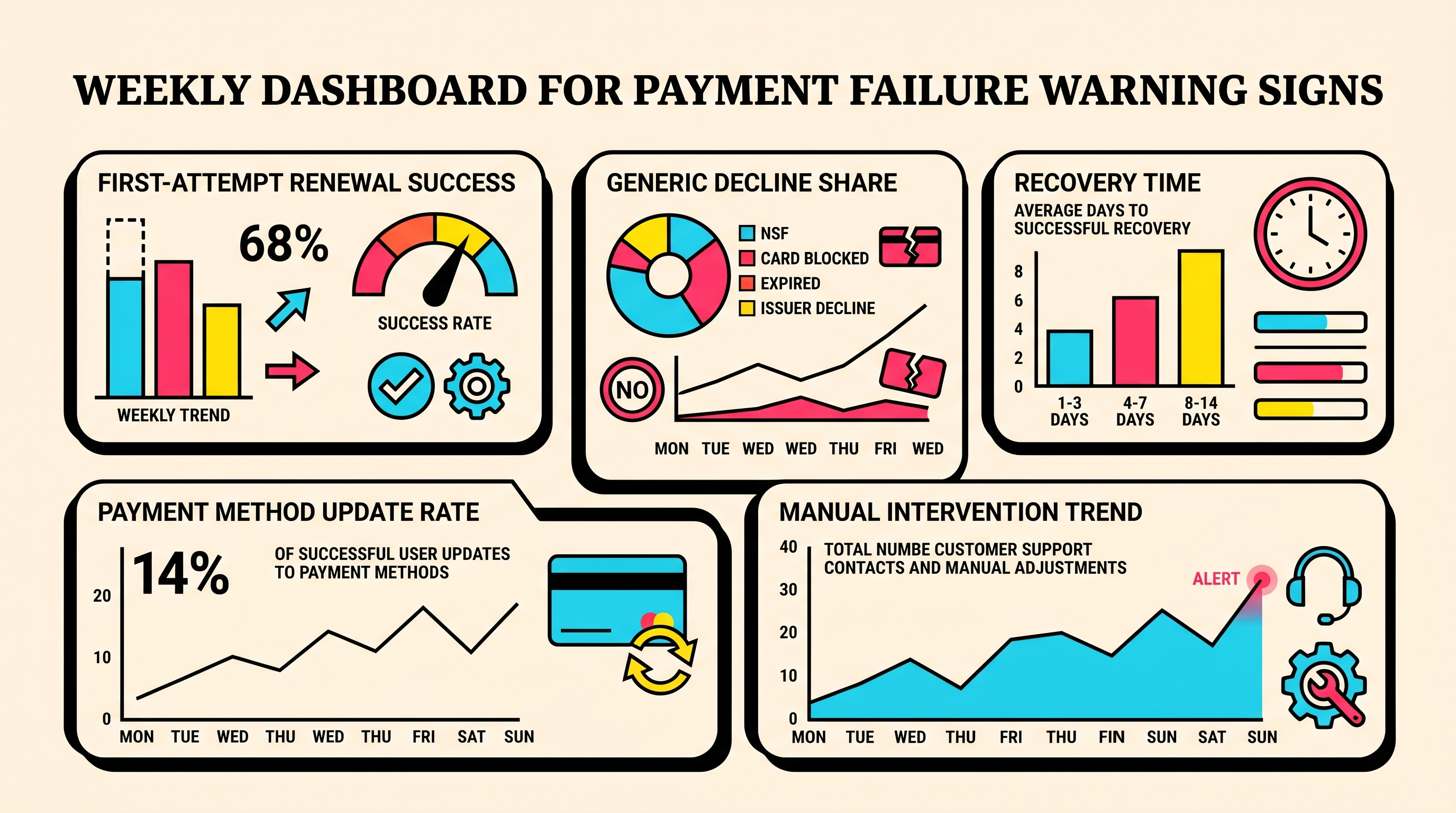
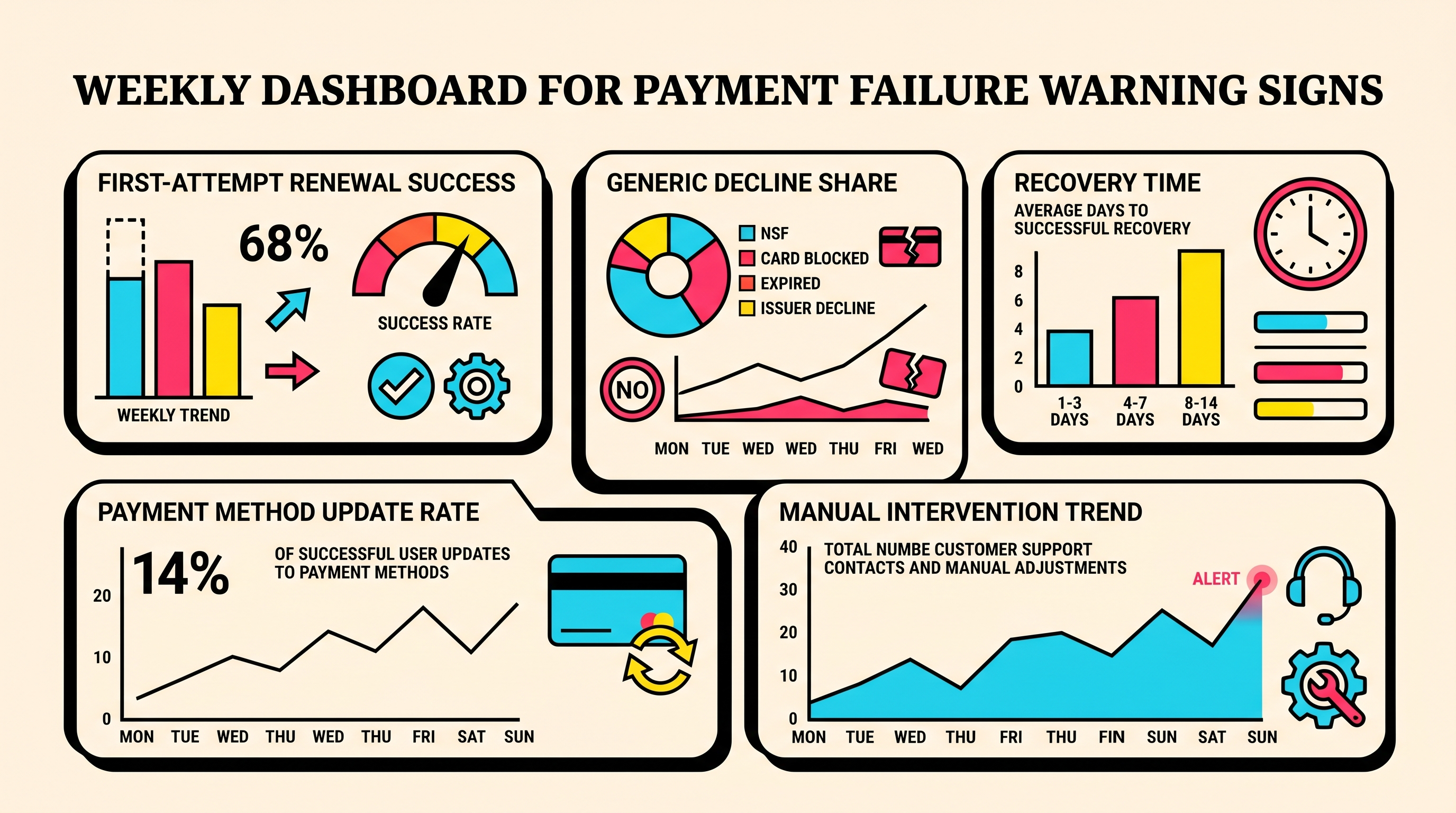
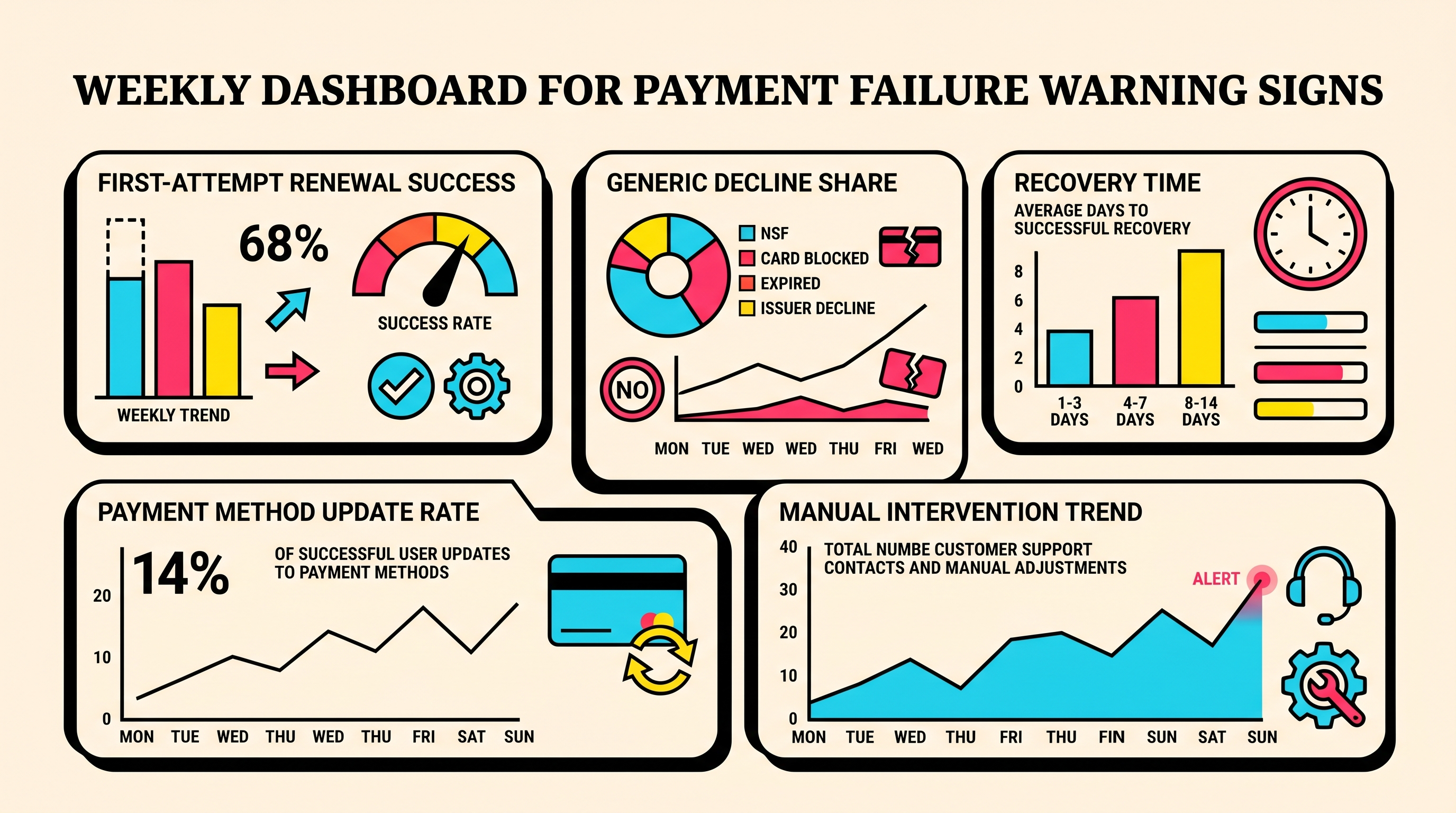
You do not need a giant BI program to catch these signals. A practical weekly dashboard can be small and still be brutally useful.
Track at least these metrics:
- first-attempt renewal success rate
- failed payment rate by segment
- top decline codes and their trend
- share of generic declines
- recovery within 24 hours, 7 days, and 30 days
- median time to recovery
- percentage of recoveries requiring payment method update
- percentage requiring manual intervention
- involuntary churn as a share of total churn
Keep the dashboard narrow enough that someone actually reads it. Most teams do better with one opinionated billing health view than five pretty charts nobody uses.
How to respond when the warning signs appear
The right response depends on which warning sign moved first, but the playbook is usually straightforward.
Tighten diagnosis before adding more retries
The dumbest move is often the most common one: failed payments rise, so the team adds more retries and hopes for the best. That can work temporarily, but it can also create more noise, more customer frustration, and worse issuer outcomes.
Start by identifying whether the shift is coming from timing, card lifecycle issues, authentication friction, geography, or issuer behavior.
Fix billing UX before blaming customers
If update rates are rising and conversions are weak, assume the billing flow is guilty until proven innocent. Make the update path short, mobile-friendly, and obvious. Explain what happened in plain English. Do not make customers hunt through account settings just to pay you.
Revisit retry timing
If recovery is concentrating into one attempt or taking longer, retry timing is a likely culprit. Test spacing, time of day, and region-specific schedules. This is usually where easy wins live.
Review fraud and risk controls
If generic declines or false positives rise, inspect your fraud posture. A recurring subscription renewal should not be treated like a suspicious one-off ecommerce purchase. If your controls do not reflect that distinction, revenue gets punched for no good reason.
Decide when manual escalation is worth it
For high-value accounts, manual saves can still make sense. Just do not let them become your default billing strategy. Use them as an escalation path, not as a substitute for fixing the system.
Common mistakes that make the problem worse
A few mistakes show up constantly:
- treating all failed payments as a single bucket
- optimizing for total recovery while ignoring recovery speed
- copying the same retry logic to every region
- neglecting mobile billing UX
- waiting for churn to rise before investigating payment issues
- assuming Stripe infrastructure means Stripe strategy
Those are fixable mistakes. They just become expensive if you leave them alone too long.
Final takeaway
Payment failure warning signs are useful because they show you where involuntary churn is starting, not just where it finished. If first-attempt success is slipping, generic declines are climbing, recovery is slowing, update friction is rising, or manual saves are becoming normal, do not shrug it off as billing noise. That is the revenue system asking for attention.
Catch the signals early. Segment the problem properly. Fix timing, flows, and follow-up before failed renewals become lost customers.
If you want a quick read on where your Stripe setup may be leaking revenue, run a free churn audit at ChurnBot.
Related Posts
Regional Payment Failure Patterns: What the Data Shows

Stripe Insufficient Funds Recovery: A Playbook for SaaS Teams
How healthy is your Stripe account?
Get a free churn health report. Find pending cancellations, failed payments, and expiring cards putting your MRR at risk.
Run Free Audit