5 Stripe API Tricks for Better Payment Success Rates

Most teams treat failed payments like background noise. Stripe sends a webhook, the retry rules do whatever they do, and someone glances at churn once a month. Meanwhile revenue leaks out through avoidable friction.
That is the wrong way to run a subscription business.
If you use Stripe, you already have access to a bunch of API-level levers that can improve payment success rates without changing your pricing, launching a new product, or begging customers to come back. The point is not to over-engineer your billing stack. The point is to remove dumb failure points.
This guide covers five Stripe API tricks for better payment success rates. None of them are magic. All of them are practical. And together they can turn payment recovery from a vague hope into a measurable system.

1. Use setup intents properly before the first off-session charge
A huge number of recurring payment problems start before the subscription even goes live.
If you collect a card once, save it casually, and then try to charge it off-session later, you are inviting avoidable failures. Banks want stronger signals that the payment method was set up correctly for future use. Stripe gives you that path through SetupIntents.
The core idea is simple: when a customer first enters payment details, tell Stripe you want to use that method for future off-session billing. That lets Stripe handle authentication requirements up front instead of surprising you on renewal day.
const setupIntent = await stripe.setupIntents.create({
  customer: customerId,
  payment_method_types: ['card'],
  usage: 'off_session'
});
When you confirm that setup on the frontend, Stripe can trigger the right authentication flow while the customer is still present. That matters because a customer who is already in checkout is much more likely to complete 3D Secure than one who gets hit with a failed renewal later.
This is especially important if you sell into Europe or any region where Strong Customer Authentication creates extra friction. If your first off-session invoice is the first time the bank sees a properly prepared mandate, you are already behind.
The practical win is not theoretical. Better setup usually means fewer authentication_required surprises later, fewer support tickets, and fewer renewals failing for reasons that were preventable during signup.
If you want a useful companion read, the guide on how to set up Stripe payment method update links shows what to do when a saved method still needs refreshing later.
2. Segment retry logic by decline reason instead of retrying everything blindly
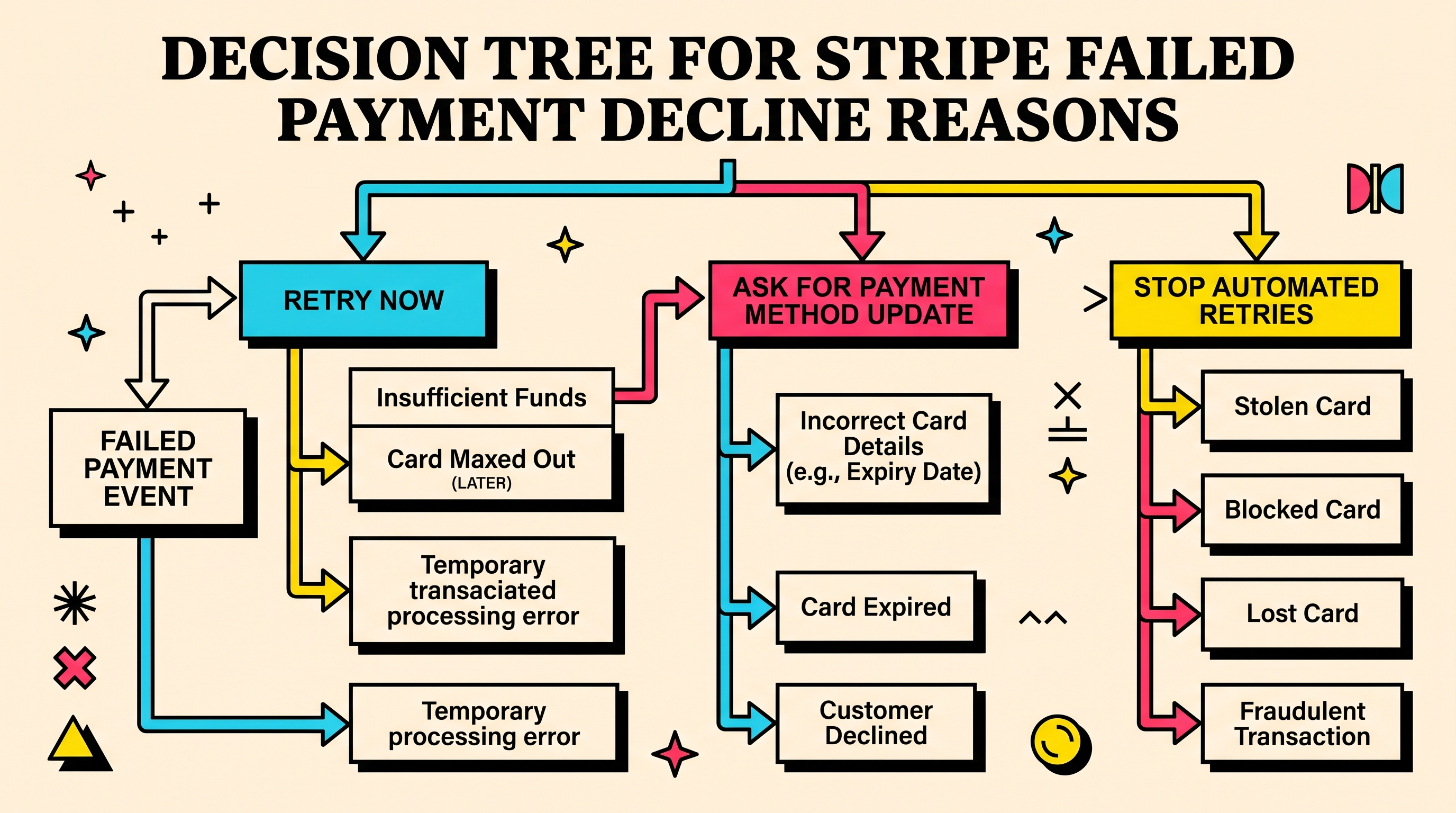
Most retry logic is lazy.
A payment fails, so the system retries on a generic schedule and hopes the next attempt lands. Sometimes that works. Often it wastes time, annoys the customer, and drags down recovery rates.
Stripe exposes failure context you can use to decide what should happen next. At minimum, you should separate soft declines from hard failures.
Soft declines often include things like temporary insufficient funds, network hiccups, or issuer availability issues. Those can recover well with well-timed retries. Hard failures, like stolen card or invalid account states, usually need a different path. Hammering those with the same retry schedule is pointless.
const charge = invoice.charge && await stripe.charges.retrieve(invoice.charge);
const declineCode = charge?.outcome?.reason || charge?.failure_code;

if (['insufficient_funds', 'issuer_not_available', 'processing_error'].includes(declineCode)) {
  // Keep in automated retry flow
} else if (['expired_card', 'authentication_required'].includes(declineCode)) {
  // Push customer into payment method update flow fast
} else {
  // Escalate, pause, or mark as low-probability recovery
}
This does not need to be perfect on day one. It just needs to be more intelligent than one-size-fits-all retries.
A good starting point is to map your top ten failure reasons and assign each one to a default action:
- retry later
- request updated payment method
- require customer action
- stop automated recovery and handle differently
That alone gives you a better payment success engine than a lot of SaaS teams have.
Stripe's own retries can help, but they are still just one layer. If you do not understand which failures are recoverable and which ones need customer intervention, your recovery system is basically a shrug with webhooks.
For a deeper look at how failure states evolve, The Anatomy of a Failed Payment is worth linking into your internal playbook.
3. Generate deep-linked customer actions the moment failure happens
If a payment fails and your recovery email tells the customer to log in, find billing settings, and update their card somewhere in the app, congratulations: you built a drop-off funnel.
When failure happens, the best next step is the most direct one. Stripe's Billing Portal sessions let you create secure links that take customers straight into the action you need them to complete.
const session = await stripe.billingPortal.sessions.create({
  customer: customerId,
  return_url: 'https://yourapp.com/billing?updated=true',
  flow_data: {
    type: 'payment_method_update'
  }
});
That flow_data block matters. It cuts out navigation friction and sends the customer directly to the payment method update flow instead of a generic account overview.
This is one of those small implementation details that has outsized impact. Founders tend to think recovery fails because customers are unwilling. A lot of the time, recovery fails because the path is annoyingly indirect.
Here is the better operating model:
- Payment fails.
- Webhook fires.
- You create a fresh, time-limited recovery link.
- Your email or in-app notice contains one clear CTA.
- Customer lands on the exact action screen.
- You listen for successful update and retry the invoice.
That is much better than sending people on a billing scavenger hunt.
This API trick also pairs nicely with segmented recovery messaging. If the failure reason is expired_card, send an update link. If the problem looks retryable, delay the interruption and let automation do the work first. Different failure states deserve different customer experiences.
4. Listen for payment method changes and trigger recovery immediately
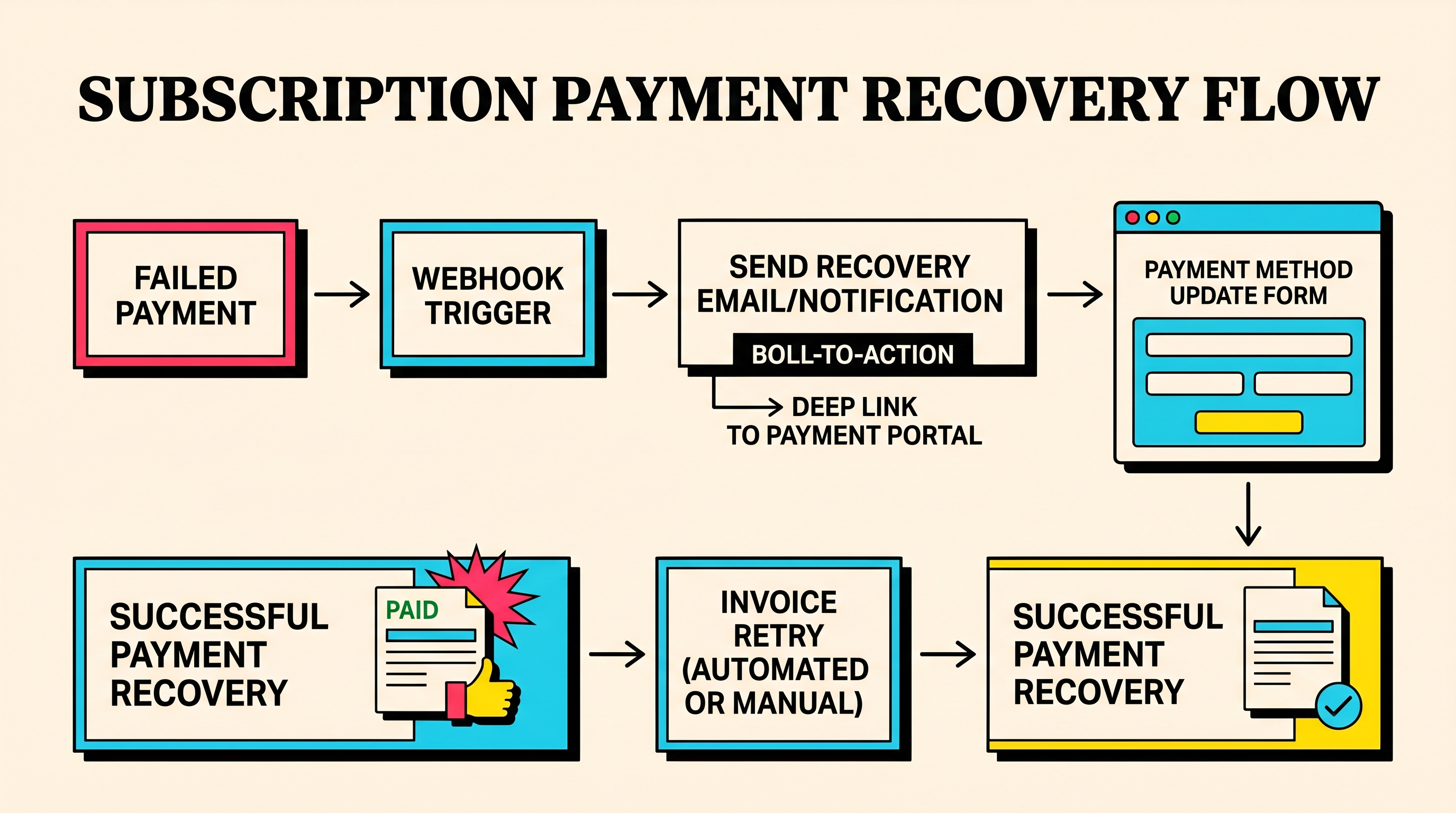
A surprising number of teams wait too long after a customer updates their card.
The customer does the hard part. They open the email, click through, enter a new card, complete authentication, and leave thinking the problem is solved. Then the business does nothing until the next scheduled retry window.
That delay is stupid.
If Stripe tells you a valid payment method has been attached or the customer object has been updated, you should check whether there is an open unpaid invoice and attempt collection again right away where appropriate.
app.post('/webhooks/stripe', async (req, res) => {
  const event = req.body;

  if (event.type === 'payment_method.attached') {
    const customerId = event.data.object.customer;
    const invoices = await stripe.invoices.list({
      customer: customerId,
      status: 'open'
    });

    for (const invoice of invoices.data) {
      await stripe.invoices.pay(invoice.id).catch(() => null);
    }
  }

  res.json({ received: true });
});
You will want guardrails. Do not blindly retry every invoice in every account state. Check subscription status. Check whether the invoice is actually collectible. Log failures cleanly. But the principle stands: when the customer fixes the payment method, your system should react quickly.
This improves payment success for two reasons.
First, the customer's intent is fresh. They are actively trying to stay subscribed. Second, you reduce the weird trust gap where someone updates payment details but still receives overdue notices because your retry engine is asleep at the wheel.
This is also where a decent recovery dashboard helps. If you measure time from payment method update to successful recovery, you will quickly see whether your flow is sharp or sluggish.
5. Enrich your billing data with metadata so you can actually debug failures
This is the least flashy trick on the list, and it might be the most useful.
Many billing systems fail not because Stripe lacks data, but because the business never stores enough context to learn from what happened. Every failed invoice should be traceable back to the customer segment, plan, acquisition path, region, or account owner details that matter for analysis.
Stripe metadata is not glamorous, but it is incredibly practical.
await stripe.subscriptions.create({
  customer: customerId,
  items: [{ price: priceId }],
  metadata: {
    plan_family: 'growth',
    billing_owner: 'self-serve',
    acquisition_channel: 'content',
    region: 'uk'
  }
});
You can also attach metadata to invoices, customers, or payment intents depending on what you need to analyze later.
Why does this help payment success rates?
Because once failures happen, you can stop looking at them as one ugly blob. You can answer questions like:
- Do annual plans recover better than monthly plans?
- Are certain regions producing more
do_not_honorfailures? - Is one acquisition cohort more likely to fail on first renewal?
- Are high-value accounts getting stuck in the same recovery bottleneck?
Without this context, every failed payment review turns into vague storytelling. With context, you can spot patterns and decide where to focus.
This is the same logic behind building a strong payment recovery funnel. If you cannot segment the data, you cannot improve the system in a reliable way.
How to combine these tricks into one cleaner recovery system
Individually, each trick helps. Together, they create a much better operating loop.
A practical Stripe recovery stack looks like this:
At signup
Use SetupIntents correctly so future off-session charges have the strongest chance of succeeding.
At first failure
Inspect the decline context. Decide whether the next move is retry, customer update, or escalation.
During recovery outreach
Generate a fresh deep link for the exact action you want the customer to take. Do not make them wander through settings.
After customer action
Listen for updated payment methods and retry quickly instead of waiting for some generic timer.
During analysis
Use metadata and decline segmentation to find the bottlenecks that are actually costing you money.
That is a real system. It is not fancy for the sake of being fancy. It is just less sloppy.
Common mistakes founders make with Stripe recovery
There are a few patterns that show up again and again.
Treating payment success as purely a finance problem
It is not. Payment success sits at the intersection of billing logic, product UX, customer communication, and data quality. If one of those is weak, recovery suffers.
Optimizing only for retries
Retries matter, but they are not the whole story. Some failures need customer action fast. Others need a better setup flow upstream. If your whole playbook is "retry again later," you are missing the bigger picture.
Sending recovery emails with weak calls to action
You do not need persuasive copywriting gymnastics. You need clarity. Tell the customer what failed, what they need to do, and what happens next.
Failing to measure stage-by-stage conversion
If you do not know how many customers clicked, updated, and ultimately recovered, you cannot tell whether your weak point is messaging, UX, or collection logic.
Assuming Stripe defaults are enough forever
Stripe gives you solid primitives. That does not mean the default setup is optimal for your business. Founders who win here are usually the ones who review the details instead of assuming billing is handled.
What to do this week
If you want the fastest path to better payment success rates, do these five things in order:
- Audit whether your saved payment method flow uses SetupIntents for off-session billing.
- Pull your top decline reasons from the last 60 to 90 days.
- Map each reason to a retry, update, or escalation path.
- Review every customer-facing recovery link for friction.
- Measure how long it takes to recover after a customer updates payment details.
That will give you a much better picture than staring at one top-line churn number and hoping the answer reveals itself.
Stripe already gives you the hooks. The real question is whether you are using them like a system or like a pile of disconnected billing events.
One extra rule: do not measure success only by whether a retry eventually clears. Measure how fast it clears, how many customers had to intervene, and which failure types keep repeating. Fast recovery with low friction is healthier than a messy recovery that technically works three emails later.
If you want a quick way to spot failed payment leaks and recovery opportunities in your Stripe setup, run a free churn audit at https://churnbot.co/audit.
Related Posts

7 Failed Payment Segments Every Stripe Team Should Track
9 Strategies to Stop Losing Customers to Payment Failures
Pre-Dunning: How to Prevent Failed Payments Before They Happen
How healthy is your Stripe account?
Get a free churn health report. Find pending cancellations, failed payments, and expiring cards putting your MRR at risk.
Run Free Audit