How to Create a Multi-Channel Payment Recovery Strategy
Most payment recovery flows are basically one-channel hope dressed up as strategy.
A card fails, Stripe retries a few times, maybe an email goes out, and everyone crosses their fingers. If the customer misses the inbox, never sees the reminder, or cannot fix the payment quickly, that revenue quietly falls through the floor.
That is not a recovery strategy. That is a shrug.
A real multi-channel payment recovery strategy gives customers more than one path back to paid status. It combines timing, message type, channel selection, and billing context so the right reminder reaches the right customer in the least annoying way possible.
Done well, this does two things at once. It recovers more failed payments, and it does it without turning your product into a desperate nag machine.
This guide shows how to build a multi-channel payment recovery strategy step by step, when each channel should fire, what to say, what to measure, and where founders usually screw it up.
What a multi-channel payment recovery strategy actually means
Multi-channel does not mean blasting the same reminder across every channel you can find.
It means using different channels for different jobs.
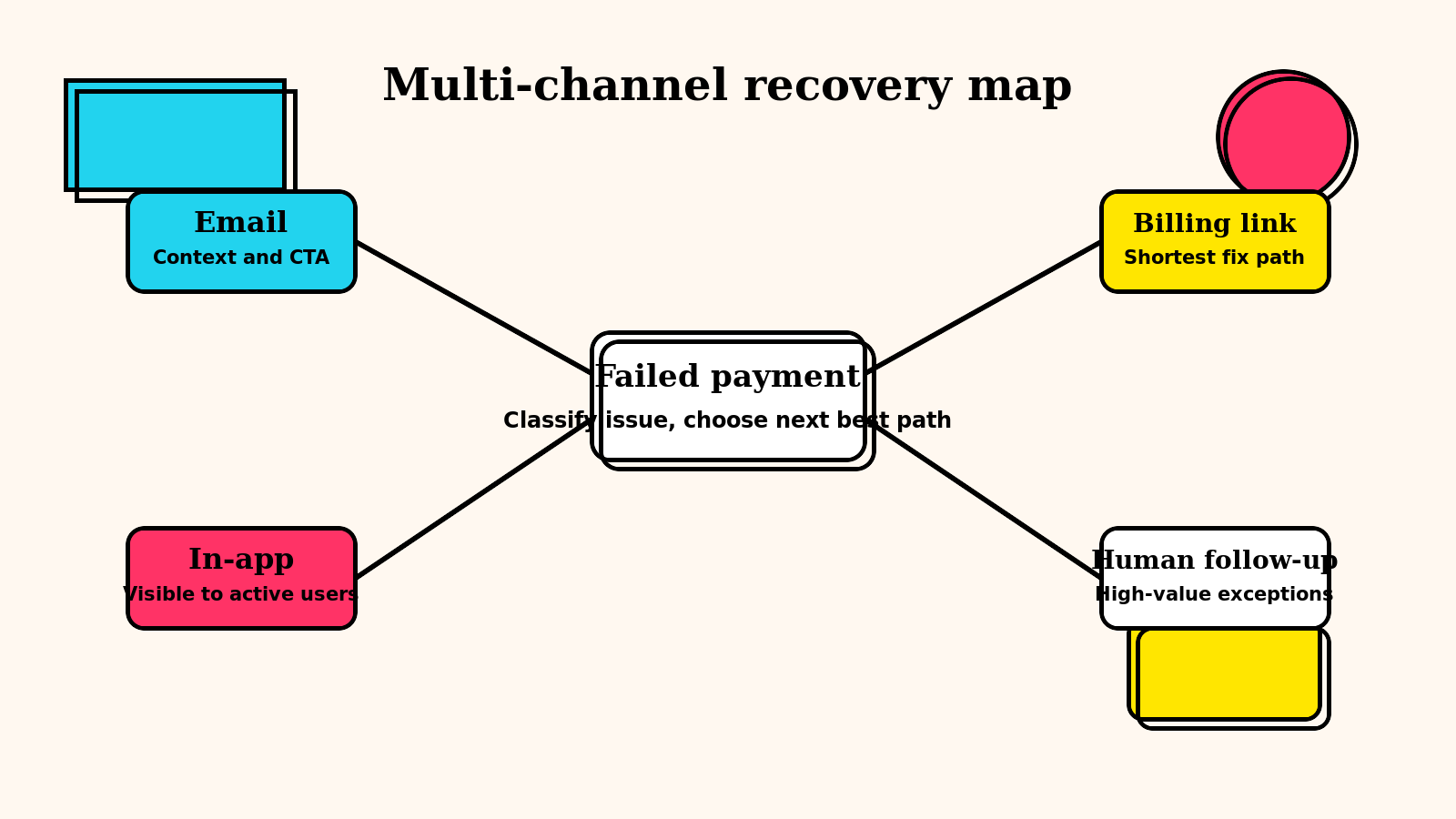
In payment recovery, the usual channels are:
- email for primary reminders and context
- in-app notices for active users who are still logging in
- billing portal or payment update links for the actual action step
- customer support or success outreach for high-value edge cases
- SMS or transactional messaging for urgent, time-sensitive nudges where appropriate
The key point is that each channel has a role.
Email is good for explanation. In-app messaging is good for visibility when the user is already engaged. SMS is good for short urgency, but only when used carefully. Human outreach is expensive, so it should be reserved for accounts where the economics justify it.
A good recovery system uses these channels like tools, not like a panic button.
Why single-channel recovery underperforms
Most teams default to email because it is easy, cheap, and already part of the billing stack. That is fine as a starting point. It is not fine as the whole plan.
Single-channel recovery usually breaks for predictable reasons:
- the customer does not see the message
- the message arrives too late
- the message explains the issue but does not reduce friction
- the customer is active in the product but ignores billing email
- the failure type needed a different treatment altogether
Imagine a customer whose card expired. They are still logging into your app every day. If your only recovery motion is an email sequence, you are ignoring the strongest signal available: the customer is present and still getting value.
Now imagine a different customer who has gone quiet in the product but would respond quickly to a clean payment update link in email. For that user, in-app recovery might barely matter.
That is why channel mix should follow customer context, not team habit.
If you want a strong baseline before layering channels, review manual vs automated payment recovery. Multi-channel is not a substitute for automation. It is the next step after automation exists.
Start with failure types, not channels
Before you decide where to message someone, decide what kind of failed payment you are dealing with.
That sounds obvious, but a lot of teams skip it.
Different failure types deserve different recovery paths:
Temporary soft declines
Examples include insufficient funds, bank-side processing errors, or temporary issuer issues. These often recover with well-timed retries plus one clean reminder.
Payment method problems
Examples include expired cards, closed cards, or outdated credentials. These usually need a direct payment method update flow, not endless retries.
Authentication-required failures
These need customer action. If you treat them like ordinary declines, recovery rates tank for no good reason.
High-value account exceptions
Some accounts deserve human intervention, a support ticket, or a customer success nudge because the revenue at risk is big enough.
Once you classify failures like this, channel decisions get easier. The channel should support the action required.
That is also why a good strategy pairs well with guides like how to set up Stripe payment method update links and analyzing your payment recovery funnel. One gives you the friction-reducing action path. The other helps you see where each stage is leaking.
The five-channel recovery stack that works for most SaaS
You do not need ten channels. Most SaaS teams can build a solid system around five.
1. Email: your default recovery backbone
Email should still do most of the heavy lifting.
Why? Because it is asynchronous, cheap, and good at carrying enough context to explain what happened and what the customer should do next.
A strong recovery email does four things:
- clearly states that a payment failed
- explains whether access or renewal is affected
- gives one primary action
- links directly to the payment update or recovery flow
That last part matters a lot. If the email forces the customer to log in and hunt through billing settings, you built friction into the most important step.
Email is especially effective for:
- expired cards
- upcoming retry reminders
- grace-period warnings
- authentication-required follow-ups
- final notices before access changes
Where teams get sloppy is sending long, vague billing emails that sound like legal notices. Recovery emails should sound clear, practical, and a little urgent without being melodramatic.
2. In-app messaging: your visibility layer for active customers
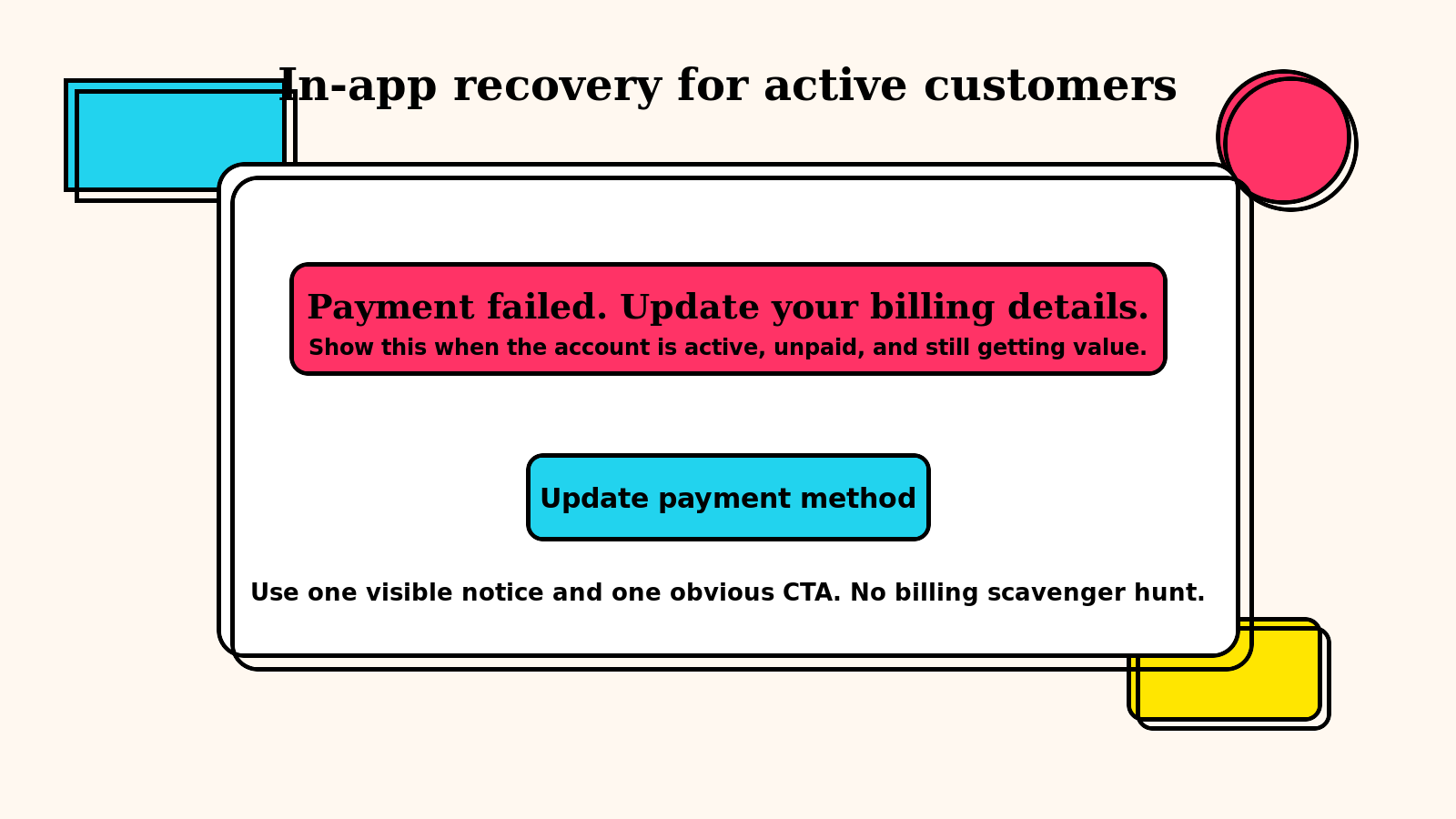
If a customer is still using the product after a failed payment, in-app messaging is criminally underused.
This is the easiest visibility win in the whole strategy.
An in-app notice works because it reaches the user while value is being experienced. The product is already proving its worth. That creates much better recovery conditions than an inbox reminder read six hours later.
Good in-app recovery messages should be:
- impossible to miss, but not obnoxious
- tied to billing status
- clear about the consequence if ignored
- connected to the exact update-payment action
This channel is particularly powerful when:
- the customer is active daily or weekly
- the account owner logs in directly
- your product has a dashboard or home screen that can show billing status cleanly
It is less useful when the payer and the user are different people, which is common in larger B2B accounts. In those cases, email and human outreach usually matter more.
A simple rule works well: if the account has logged in since the failure, they should probably see an in-app payment notice until the issue is resolved or escalated.
3. Payment update links or billing portal sessions: your conversion engine
This is not a communication channel in the usual sense, but it is the most important part of the whole system.
Every recovery message should point toward the shortest possible action path.
That usually means:
- a secure billing portal session
- a deep link to update payment details
- a clean authentication flow for SCA-related issues
Your strategy is only as good as the action path behind it.
Founders often overfocus on message copy and underfocus on link friction. That is backwards. A mediocre message with a great action path will outperform a brilliant message that dumps the customer on a confusing account page.
The best multi-channel systems are boringly consistent. Every reminder, whether email, in-app, or support outreach, drives toward the same simple resolution path.
4. Human outreach: use it where the economics are real
Human follow-up should not be the default. It is too expensive for that.
But for the right accounts, it is worth it.
Use manual outreach when:
- the account has high MRR or expansion potential
- the customer has a known relationship with support or customer success
- the failure is blocking renewal on a strategically important account
- automated recovery has failed but the account still looks healthy otherwise
This can be an email from a real person, a support ticket, or a light-touch message from customer success. The tone should not be "pay us immediately." It should be "looks like billing hit a snag, here is the fastest way to fix it."
The trap is using human outreach to compensate for a weak automated system. That scales like garbage. Human outreach should be an escalation layer, not the whole machine.
5. SMS or transactional messaging: sharp knife, use carefully
SMS can work extremely well for specific recovery moments, but it is easy to abuse.
This is not the first channel most SaaS teams should add. It is a later-stage optimization when:
- customers have explicitly consented
- the payment issue is time-sensitive
- the account value justifies the extra touch
- the message is short and actionable
Good SMS use cases:
- a final-day grace period reminder
- a high-value renewal at risk
- a short nudge after the customer started but did not complete an update flow
Bad SMS use cases:
- every routine failed payment
- spammy multi-message sequences
- vague notices with no direct action link
Think of SMS as a pressure valve, not a broadcast channel.
Build the timeline before you write a single message
A multi-channel strategy fails fast when timing is messy.
Before you obsess over copy, map the timeline.
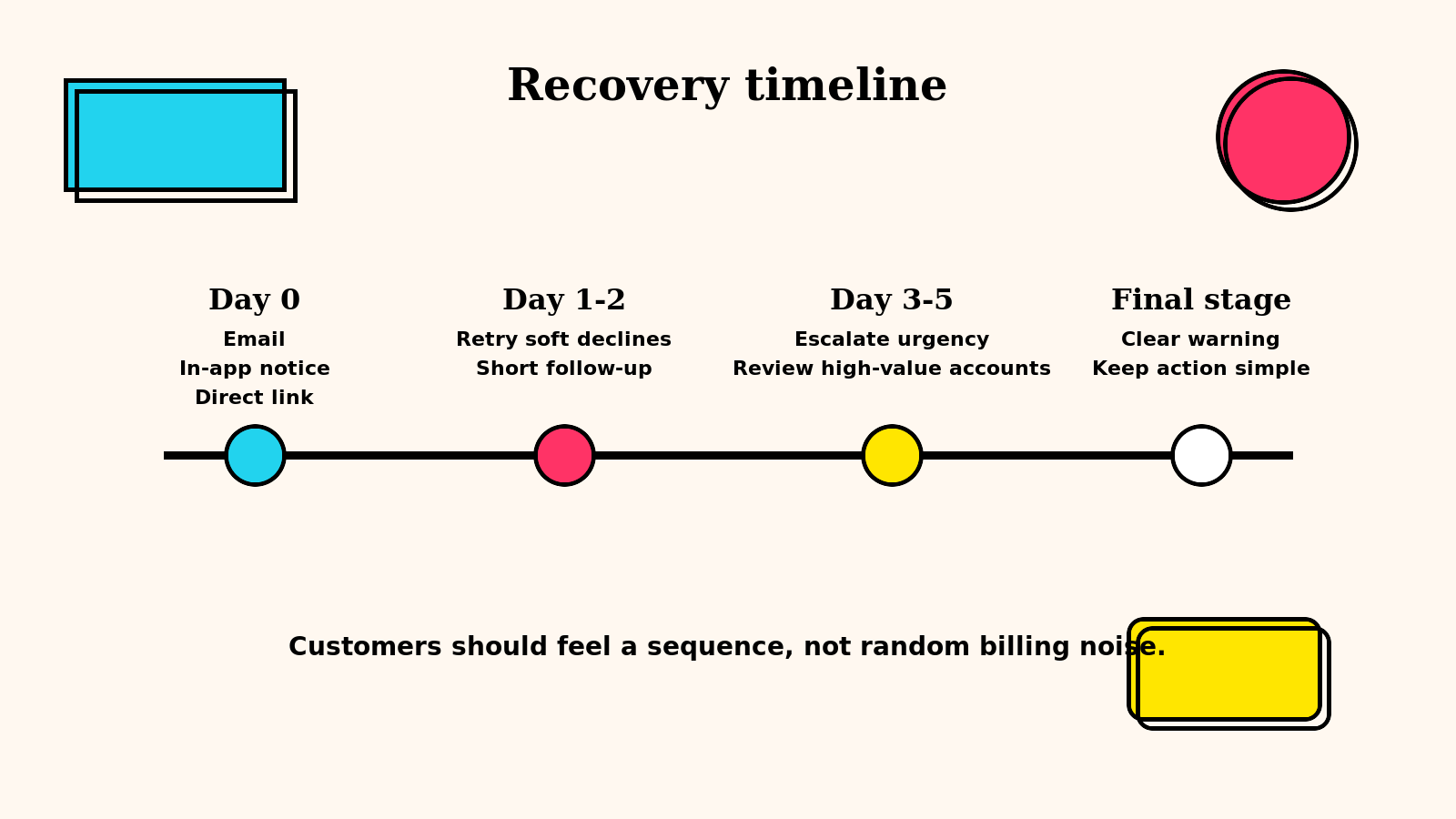
A practical recovery timeline for many SaaS businesses looks like this:
Day 0: failure detected
- trigger immediate internal classification
- send primary recovery email if action is needed
- show in-app billing notice for active users
- generate direct payment update link
Day 1 to 2: first retry or follow-up
- retry automatically for recoverable soft declines
- send a short follow-up if no action has happened
- keep the in-app notice visible
Day 3 to 5: escalation stage
- increase urgency in email
- route high-value accounts to human review
- use SMS only if it fits the account and consent model
Final grace-period stage
- send clear final warning
- explain what happens to access or renewal
- keep the action path dead simple
That sequence will vary by ARPU, billing cycle, customer type, and product access rules. But the principle holds: customers should feel a coherent progression, not random billing noise.
Match channels to account context
This is where the strategy gets smarter.
Not every customer should get the same treatment.
Segment your recovery logic using signals like:
- account value
- self-serve vs sales-led
- active vs inactive product usage
- payment failure reason
- geography or compliance constraints
- customer role, meaning payer vs day-to-day user
Examples:
- A low-ARPU self-serve user with an expired card gets email plus in-app notice.
- A high-value B2B account with an invoice issue gets email plus customer success follow-up.
- An authentication-required renewal gets immediate email with the exact action link and in-app visibility if the user logs in.
- A temporarily declined card on an otherwise healthy self-serve account may need just retries plus one light reminder.
This is how you avoid turning every billing issue into the same blunt instrument.
What to put in each message
Most recovery messaging fails because it is either too vague or too aggressive.
Use a simple structure instead:
Subject or headline
Say what happened. No cute copy.
Examples:
- Your subscription payment did not go through
- Update your payment method to keep access
- Action needed to complete your renewal
Body copy
Include:
- what failed
- whether the customer needs to do anything
- what happens if nothing changes
- one clear action link
Call to action
Only one primary CTA.
Not three buttons. Not a billing menu. One step.
Tone
Be calm, direct, and respectful. Billing friction is already annoying. Do not make it feel like collections theater.
If your current emails sound like auto-generated punishment notices, fix that first.
Metrics that tell you whether multi-channel is working
A multi-channel strategy is not better because it feels more sophisticated. It is better only if it improves outcomes.
Track these metrics:
- failed payment rate
- recovery rate by failure type
- recovery rate by channel combination
- time to recovery
- payment method update completion rate
- retry success rate after customer action
- involuntary churn rate
- support tickets triggered by billing friction
The useful question is not just "did the customer recover?"
It is:
- which path recovered them
- how long it took
- whether the recovery was smooth or messy
- whether one channel was doing real work or just making noise
For example, if email-plus-in-app clearly outperforms email alone for active users, that is signal worth acting on. If SMS barely moves recovery but spikes complaints, kill it.
This is also where payment recovery benchmarks for SaaS help. Founders are often too impressed by recovery rates that are merely average.
Common mistakes in multi-channel recovery
The same mistakes show up over and over.
Sending the same message everywhere
Different channels have different jobs. Copy-pasting the same text into email, in-app, and SMS is lazy and usually worse than using fewer channels well.
Adding channels before fixing the action path
If updating payment details is still a maze, more channels just send more people into the maze.
Escalating too fast
Customers should not feel harassed because one retry failed. Use urgency with intent.
Ignoring active product usage
If users are logging in while unpaid, that is valuable context. Use it.
Failing to separate payer and user
In B2B SaaS, the person seeing the product may not control the card. In-app prompts alone will not solve that.
Letting billing and product teams operate separately
Recovery performance usually lives at the boundary between billing infrastructure, lifecycle messaging, and product UX. If those teams are misaligned, the customer gets a weird experience.
A founder-friendly implementation plan
If your current setup is mostly email plus hope, keep the rollout simple.
Phase 1
- audit current failure reasons
- map existing emails and retry timing
- add direct payment update links everywhere
Phase 2
- add in-app notices for active unpaid accounts
- segment messaging by failure type
- create a high-value account escalation rule
Phase 3
- test second-channel escalation timing
- add optional SMS for the few cases where it makes sense
- report recovery rate by channel path, not just overall
That is enough to build a real system without disappearing into a six-week billing project.
Final takeaway
A multi-channel payment recovery strategy is not about being louder. It is about being smarter.
Use email for context. Use in-app for visibility. Use direct payment update flows for action. Use humans for high-value exceptions. Use SMS like the sharp knife it is.
The goal is simple: make it easy for good customers to fix billing problems before they turn into churn.
If your current recovery flow is basically Stripe retries plus one generic email, there is almost certainly money being left on the floor.
If you want a quick way to spot failed-payment leaks and involuntary churn risk in your Stripe setup, run a free churn audit at https://churnbot.co/audit.
Related Posts

7 Failed Payment Segments Every Stripe Team Should Track
6 Hidden Stripe Settings That Reduce Payment Failures
Pre-Dunning: How to Prevent Failed Payments Before They Happen
How healthy is your Stripe account?
Get a free churn health report. Find pending cancellations, failed payments, and expiring cards putting your MRR at risk.
Run Free Audit