Payment Recovery Benchmarks: What Good Looks Like in SaaS

If you're running a SaaS business on Stripe, you already know that failed payments are a reality. But here's the question most founders never ask: how well should your payment recovery be performing?
Without benchmarks, you're flying blind. You might be recovering 30% of failed payments and thinking that's decent, when top-performing SaaS companies are hitting 70%+. Or you might be over-investing in a recovery system that's already performing above average.
This guide breaks down real payment recovery benchmarks across the SaaS industry, so you can see exactly where you stand and where the biggest opportunities are hiding.
What Is Payment Recovery Rate?
Payment recovery rate measures the percentage of failed subscription payments that you successfully collect after the initial failure. The formula is straightforward:
Recovery Rate = (Recovered Failed Payments / Total Failed Payments) × 100
For example, if 100 payments fail in a month and you recover 55 of them, your recovery rate is 55%.
This metric is critical because involuntary churn (customers lost to payment failures, not deliberate cancellations) accounts for 20-40% of total SaaS churn. Every percentage point improvement in recovery rate translates directly to retained MRR.
The Baseline: Where Most SaaS Companies Start
Before any recovery optimization, most SaaS companies operating on Stripe's default settings recover roughly 15-25% of failed payments through Stripe's built-in retry logic alone.
That's the floor. If you're in this range, you're essentially relying on Stripe to retry the charge a few times and hoping the customer's payment method sorts itself out. No dunning emails. No card update prompts. No proactive outreach.
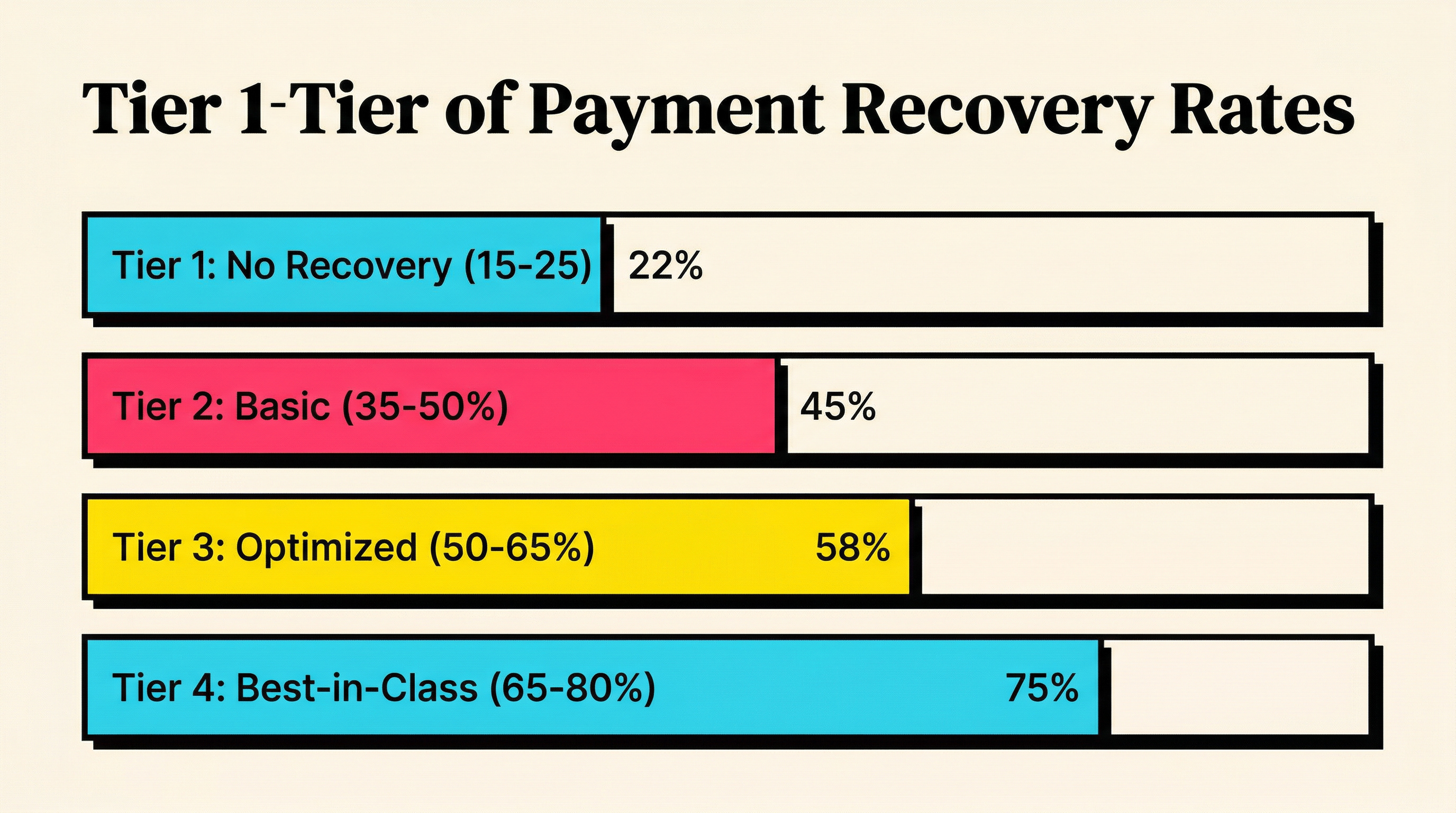
Here's how recovery rates typically break down across the industry:
Tier 1: No Recovery System (15-25%)
- Relying solely on Stripe's automatic retries
- No dunning emails or customer communication
- No card updater services
- This is where most early-stage startups sit, often without realizing how much revenue they're losing
Tier 2: Basic Recovery (35-50%)
- Stripe Smart Retries enabled
- Basic dunning email sequence (2-3 emails)
- Simple payment update page
- This is the "we set something up" tier. Most SaaS companies with any recovery effort land here
Tier 3: Optimized Recovery (50-65%)
- Multi-channel dunning (email + in-app notifications)
- Optimized retry timing based on decline codes
- Card updater integration (Visa Account Updater, Mastercard ABU)
- Payment method diversification
- Pre-dunning alerts for expiring cards
Tier 4: Best-in-Class (65-80%)
- All of the above, plus machine learning-driven retry optimization
- Personalized dunning sequences based on customer segment
- Multiple payment method fallbacks
- Real-time monitoring and intervention
- Proactive card expiry management months in advance
Recovery Benchmarks by Decline Type
Not all payment failures are created equal. Your recovery rate will vary dramatically depending on why the payment failed. Understanding these differences is essential for setting realistic targets.
Soft Declines vs Hard Declines
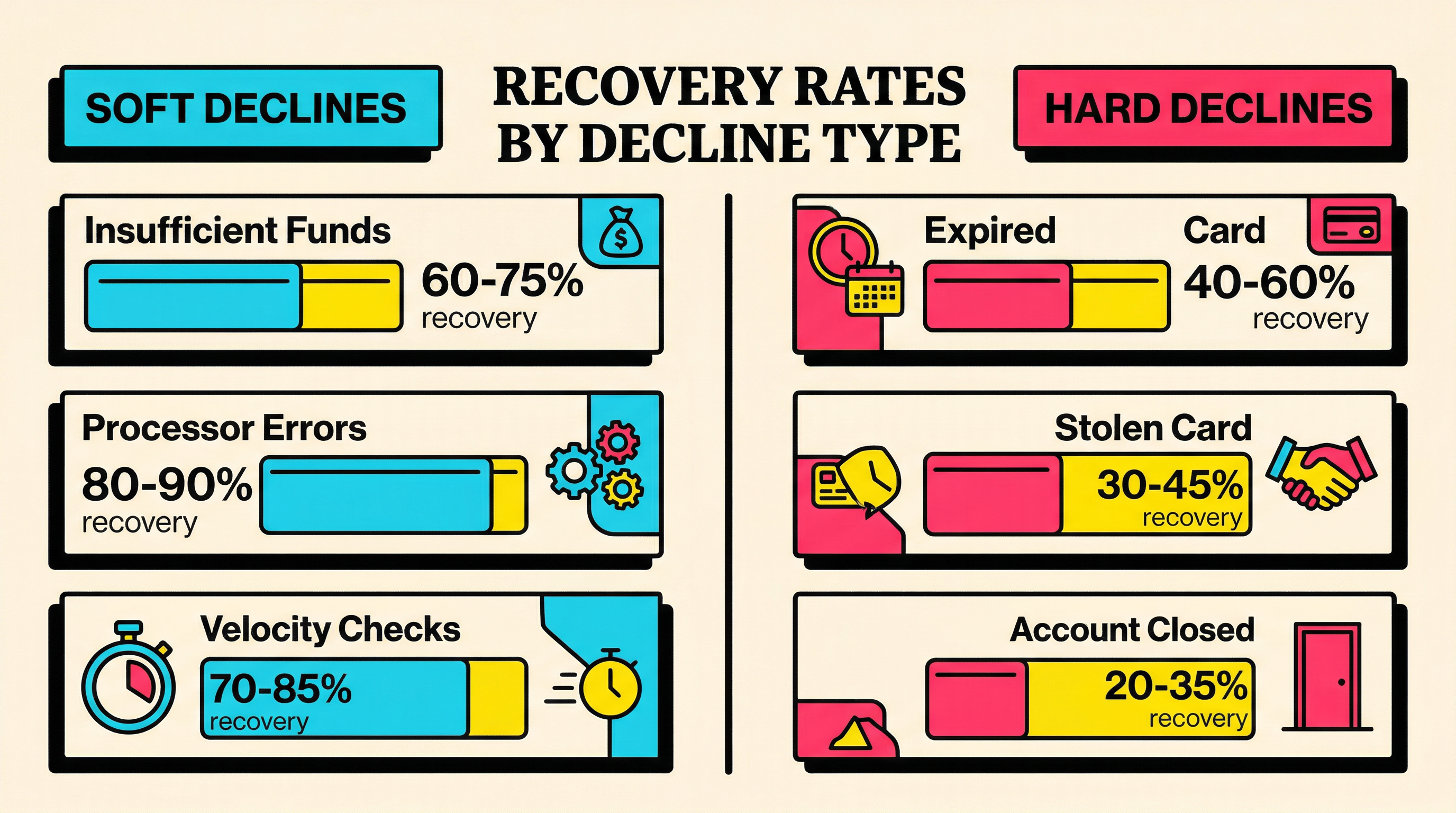
Soft declines are temporary failures. The card is valid but the transaction couldn't be processed right now. Think insufficient funds, temporary holds, or processor timeouts. These have the highest recovery potential.
- Insufficient funds: 60-75% recoverable with proper retry timing
- Processor/network errors: 80-90% recoverable (often succeeds on immediate retry)
- Rate limiting/velocity checks: 70-85% recoverable with delayed retry
Hard declines are permanent or semi-permanent failures. The card is expired, stolen, or the account is closed. These require customer action to resolve.
- Expired card: 40-60% recoverable with card updater + dunning
- Card reported stolen/lost: 30-45% recoverable (requires new payment method)
- Account closed: 20-35% recoverable (customer must add entirely new card)
- Do not honor (generic): 35-50% recoverable depending on underlying reason
For a deeper look at what each decline code means for your business, check the Stripe decline codes reference.
Recovery Benchmarks by Company Stage
Your company's size and stage affect what "good" looks like. Here's what the data shows:
Early Stage (Under $1M ARR)
- Average recovery rate: 25-35%
- Why it's lower: Limited engineering resources, no dedicated payments person, often using only Stripe defaults
- Biggest opportunity: Simply adding a 3-email dunning sequence can boost recovery by 15-20 percentage points
- Target: Aim for 45-50% within 90 days of implementing basic dunning
Growth Stage ($1M-$10M ARR)
- Average recovery rate: 40-55%
- Why it improves: More resources for payment infrastructure, some dunning automation in place
- Biggest opportunity: Card updater integration and retry timing optimization
- Target: 55-65% is achievable with focused effort
Scale Stage ($10M+ ARR)
- Average recovery rate: 55-70%
- Why it's higher: Dedicated payments team, sophisticated tooling, data-driven optimization
- Biggest opportunity: ML-driven retry optimization and personalized dunning
- Target: 65-80% with full optimization stack
The Metrics That Matter Beyond Recovery Rate
Recovery rate is the headline number, but it doesn't tell the full story. Here are the supporting metrics you should track alongside it:
Time to Recovery
How quickly are you recovering failed payments? Industry benchmarks:
- Within 24 hours: Top performers recover 30-40% of all recoverable payments in the first day, primarily through smart retries
- Within 7 days: 60-70% of all recoverable payments should be captured by day 7
- Within 14 days: 80-90% of everything you'll recover happens within two weeks
- After 21 days: Diminishing returns. If a payment hasn't been recovered by day 21, the odds drop to single digits
The implication: your recovery system needs to be fast. Front-load your retry attempts and dunning emails in the first week.
Revenue Recovery Rate
This differs from payment recovery rate because it accounts for the dollar value of recovered payments, not just the count. A company might recover 50% of failed payments by count but 65% by revenue if higher-value subscriptions have better recovery rates (which they typically do, because enterprise customers are more responsive to dunning).
Benchmark: Revenue recovery rate is usually 5-15 percentage points higher than payment recovery rate.
Dunning Email Performance
If you're sending dunning emails, track these:
- Open rate benchmark: 45-65% (much higher than marketing emails because these are transactional)
- Click-through rate: 20-35%
- Payment update rate: 8-15% of recipients update their payment method per email
- Optimal sequence length: 3-5 emails over 14 days performs best. Beyond that, you're mainly annoying people
Involuntary Churn Rate
The ultimate outcome metric. What percentage of your customers are you losing to payment failures after recovery efforts?
- Below 0.5% monthly: Excellent. Top-tier recovery.
- 0.5-1.0% monthly: Good. Room for optimization but not bleeding.
- 1.0-2.0% monthly: Average. Significant revenue opportunity on the table.
- Above 2.0% monthly: Needs urgent attention. You're losing substantial MRR to preventable churn.
What Moves the Needle: The Recovery Stack
Now that you know where the benchmarks sit, here's what actually moves companies from one tier to the next.
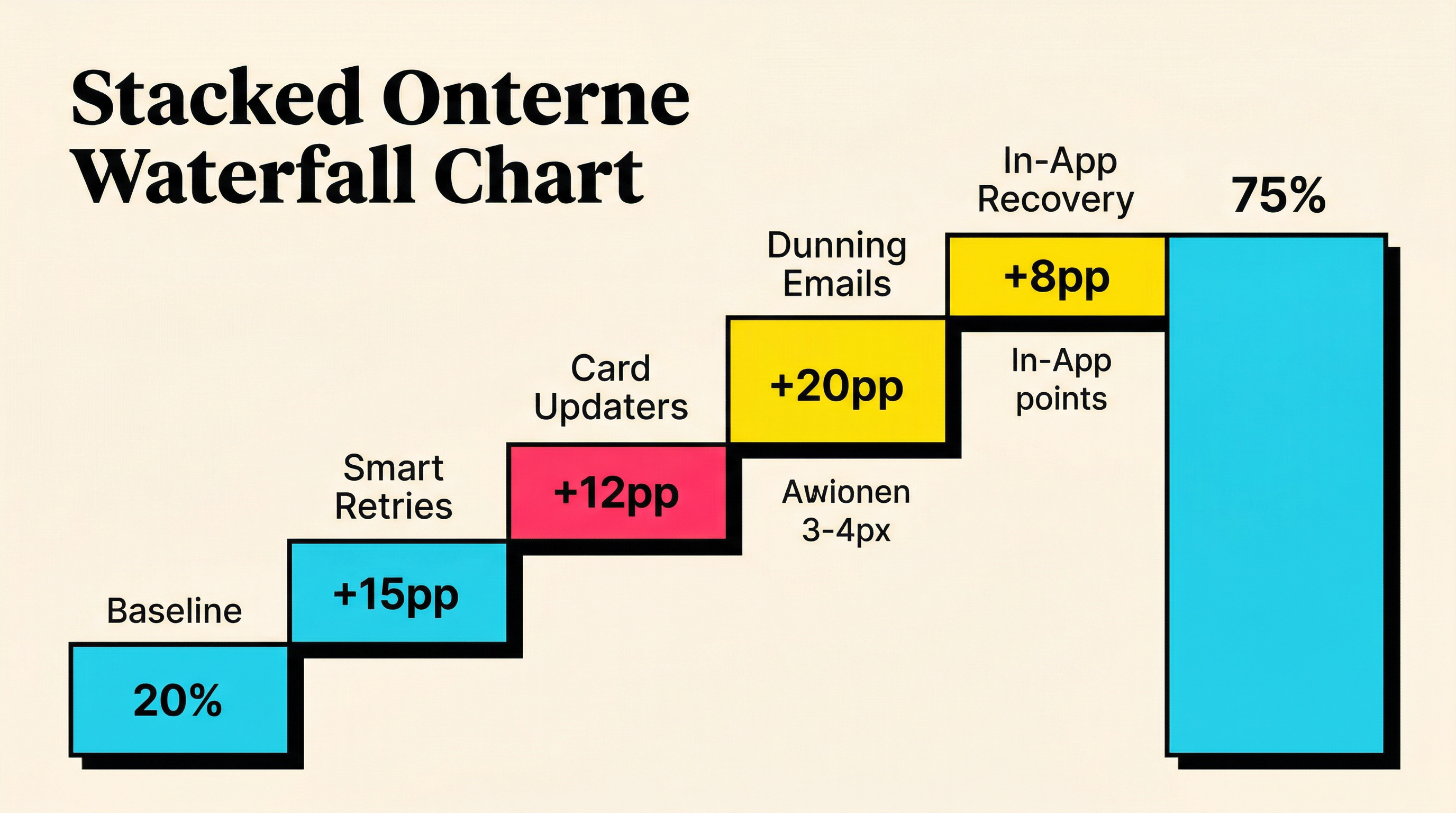
1. Smart Retry Logic
Impact: +10-20 percentage points over default retries
Stripe's default retry logic is better than nothing, but it's generic. The biggest gains come from customizing retry timing based on the decline reason.
For insufficient funds, retrying on the 1st or 15th of the month (common paydays) recovers significantly more than random retry timing. For processor errors, an immediate retry often succeeds. For expired cards, retrying is pointless without a card update. You can explore the difference between Stripe's built-in approach and custom logic in more detail on our blog.
2. Card Updater Services
Impact: +10-15 percentage points
Visa Account Updater and Mastercard Automatic Billing Updater automatically refresh expired or replaced card details with issuing banks. This is the single highest-ROI recovery mechanism because it works silently in the background with zero customer friction.
Expired cards account for roughly 42% of all payment failures. Card updaters can resolve a large portion of these without any customer action.
3. Dunning Email Sequences
Impact: +15-25 percentage points
A well-crafted dunning sequence is still one of the most effective recovery tools. Key benchmarks for optimization:
- Email 1 (day 1): Informational. "Your payment failed, here's a link to update." Recovers 5-8%.
- Email 2 (day 3-4): Urgency. "Your subscription is at risk." Recovers 3-5%.
- Email 3 (day 7): Escalation. "You'll lose access in X days." Recovers 2-4%.
- Email 4 (day 10-12): Final notice. "Last chance before cancellation." Recovers 1-3%.
The tone matters more than most founders think. Direct, clear, and helpful outperforms aggressive or guilt-driven messaging every time.
4. In-App Payment Recovery
Impact: +5-10 percentage points
Don't rely solely on email. When a customer logs into your product with a failed payment, show a prominent banner or modal with a direct link to update their payment method. This catches customers who ignore emails but still actively use your product.
5. Pre-Dunning Prevention
Impact: Prevents 20-30% of failures from occurring
The best recovery is prevention. Monitor card expiry dates and notify customers 30-60 days before their card expires. Companies that implement pre-dunning see a measurable drop in payment failure rates because customers update their cards proactively.
Building Your Recovery Benchmarking Dashboard
To track your progress, you need a simple dashboard with these key metrics:
- Monthly payment failure rate (total failed / total attempted)
- Recovery rate by count (recovered / failed)
- Recovery rate by revenue (recovered MRR / failed MRR)
- Average time to recovery (median days from failure to successful charge)
- Involuntary churn rate (lost to payment failure / total active subscribers)
- Recovery rate by decline code (break down by the top 5 decline reasons)
Review weekly. Trends matter more than snapshots. A recovery rate that's climbing from 40% to 50% over three months tells you your optimizations are working, even if you're not yet at the 65% benchmark.
The Revenue Impact: Running the Numbers
Let's make this concrete. Say you're running a SaaS company with:
- $100K MRR
- 5% monthly payment failure rate ($5,000 in failed payments)
- Current recovery rate: 30%
At 30% recovery, you're saving $1,500/month and losing $3,500/month to involuntary churn. That's $42,000/year in preventable revenue loss.
If you move from 30% to 60% recovery (achievable with the optimization stack above):
- Recovered: $3,000/month (up from $1,500)
- Lost: $2,000/month (down from $3,500)
- Annual revenue saved: $18,000 more per year
And that compounds. Retained customers continue paying month after month. The lifetime value of those recovered customers over 12 months could be 5-10x the initial recovered payment.
At $1M MRR, the same math yields $180,000 in additional annual revenue. At $10M, it's $1.8M. The numbers scale linearly, and the ROI on recovery optimization is almost always positive.
Common Mistakes That Tank Recovery Rates
Before you start optimizing, avoid these pitfalls that keep recovery rates artificially low:
Retrying hard declines repeatedly. If a card is expired or closed, retrying the same card 8 times won't help. It wastes retry attempts and can increase your decline rate with processors. Match your retry strategy to the decline code.
Sending dunning emails from no-reply addresses. Customers who want to resolve the issue can't reply. Use a real email address and monitor responses. Some customers will reply with questions or need manual help.
Waiting too long to start dunning. Every day you wait after a failed payment, recovery probability drops. Send the first dunning email within hours, not days.
Not segmenting by customer value. A $500/month enterprise customer deserves a different recovery approach than a $9/month user. High-value customers might warrant a personal email or phone call.
Ignoring payment method diversity. If a customer's credit card fails, offering alternative payment methods (ACH/direct debit, PayPal, wire transfer for enterprise) can save the relationship.
What to Do Next
Here's a practical action plan based on where you are today:
If you're at 15-25% (no recovery system):
- Enable Stripe Smart Retries if you haven't
- Set up a basic 3-email dunning sequence
- Create a simple payment update page
- Expected improvement: reach 40-50% within 60 days
If you're at 35-50% (basic recovery):
- Implement card updater services
- Optimize retry timing by decline code
- Add in-app payment failure notifications
- Expected improvement: reach 55-65% within 90 days
If you're at 50-65% (optimized):
- Build pre-dunning for expiring cards
- Segment dunning by customer value
- A/B test email copy, timing, and frequency
- Expected improvement: reach 65-75% over 6 months
Not sure where you currently stand? Run a free churn audit to see your actual payment failure rate, recovery rate, and the specific revenue you're leaving on the table. It takes 2 minutes and connects directly to your Stripe account.
The gap between where you are and where the benchmarks say you could be is almost always worth closing. For most SaaS companies, payment recovery is the highest-ROI revenue optimization you're not doing.
Related Posts

7 Failed Payment Segments Every Stripe Team Should Track
The Complete Toolkit for Managing Failed Payments
Stripe Do Not Honor Recovery: What SaaS Teams Should Do Next
How healthy is your Stripe account?
Get a free churn health report. Find pending cancellations, failed payments, and expiring cards putting your MRR at risk.
Run Free Audit