Voluntary vs Involuntary Churn: Where to Focus First

Every SaaS founder hates churn. But not all churn is created equal.
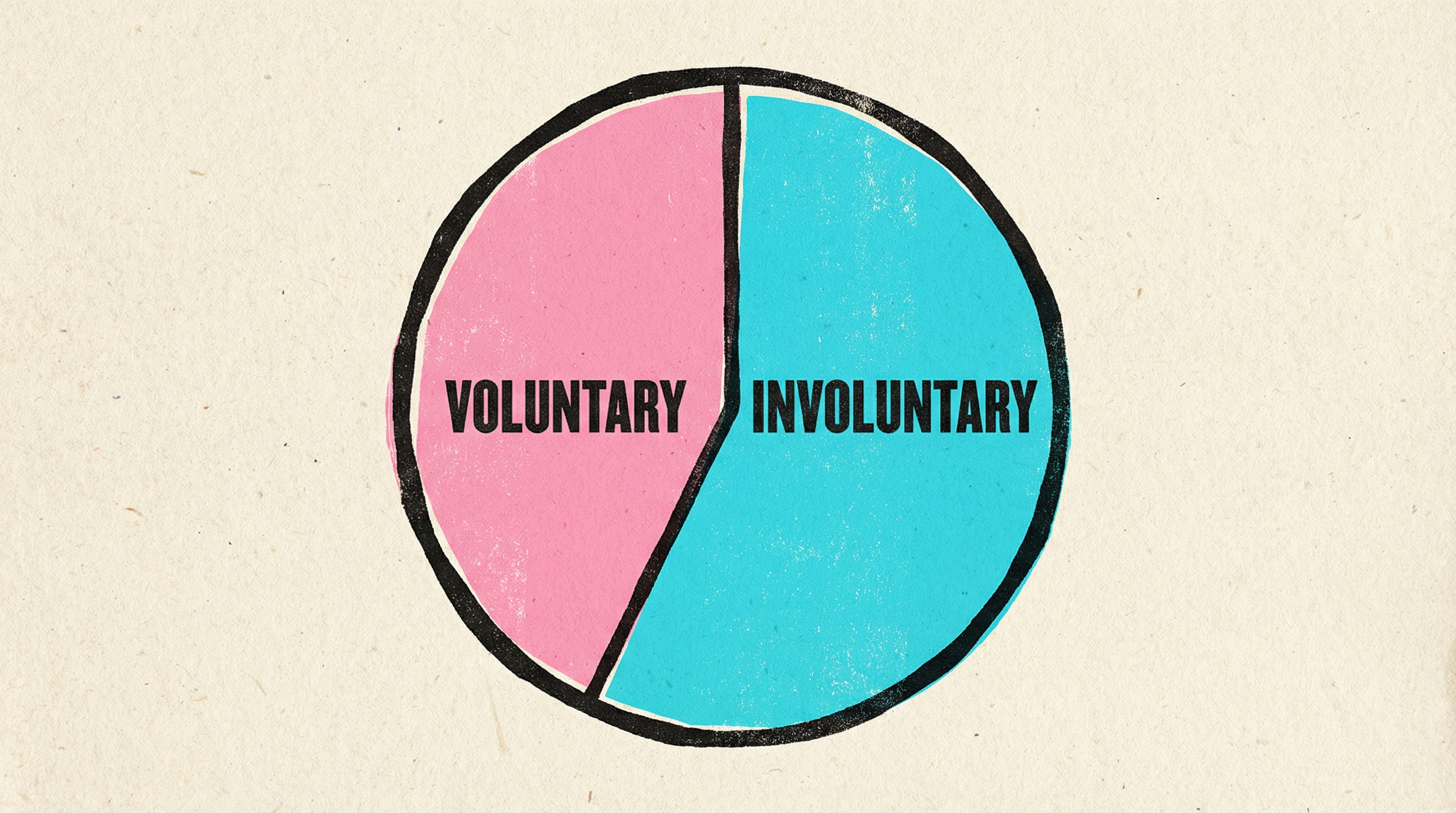
When a customer cancels because they don't see value, that's voluntary churn. When they want to stay but get kicked out because their payment failed, that's involuntary churn. One is a product problem. The other is a billing problem.
Most founders obsess over the wrong one.
The Two Types of Churn (And Why It Matters)
Voluntary Churn: The Product Problem
Voluntary churn happens when a customer actively decides to leave. They log in, find the cancel button, and click it. The reasons vary:
- They found a better alternative
- They're not getting enough value
- Budget constraints forced a decision
- They no longer need your product
- Onboarding failed and they never got started
Voluntary churn is painful because it signals a product or value problem. It means you failed to convince someone to stay. The solution requires fundamental changes: better onboarding, stronger value props, competitive differentiation, pricing adjustments.
The average SaaS voluntary churn rate sits between 5-7% monthly for B2C products and 0.5-1% monthly for B2B products, according to industry benchmarks. If you're significantly higher, you have a product-market fit issue.
Involuntary Churn: The Hidden Revenue Killer
Involuntary churn happens when a customer wants to stay but can't. Their payment fails. Maybe their card expired. Maybe they hit their credit limit. Maybe their bank flagged the transaction.
They didn't choose to leave. The billing system kicked them out.
Here's the kicker: involuntary churn accounts for 20-40% of total SaaS churn, yet most founders don't track it separately. They lump it in with voluntary churn and assume it's a product problem.
It's not. It's a billing operations problem. And it's entirely fixable.
Why Involuntary Churn Happens (And How Often)
The data is stark. Industry research shows that:
- 15-25% of all subscription payment attempts fail
- 60-70% of these failures are recoverable with proper retry logic
- Card expiration accounts for 30-35% of failed payments
- Insufficient funds causes 20-25% of declines
- Fraud blocks and technical issues make up the rest
Stripe's own data reveals that businesses lose between 2-5% of MRR every month purely to involuntary churn. For a $50k MRR SaaS, that's $12k-$30k annually walking out the door for reasons completely unrelated to product quality.
The Most Common Payment Failure Reasons
When you dig into your Stripe decline codes, you'll see patterns:
- expired_card - Customer's card expired and they haven't updated it
- insufficient_funds - Temporary balance issue (highly recoverable)
- card_declined - Generic decline from issuing bank
- incorrect_cvc - Saved card has wrong security code
- do_not_honor - Bank rejected without specific reason
The first two alone account for more than half of all involuntary churn. Both are preventable with the right systems.
The Business Case: Why Fix Involuntary Churn First
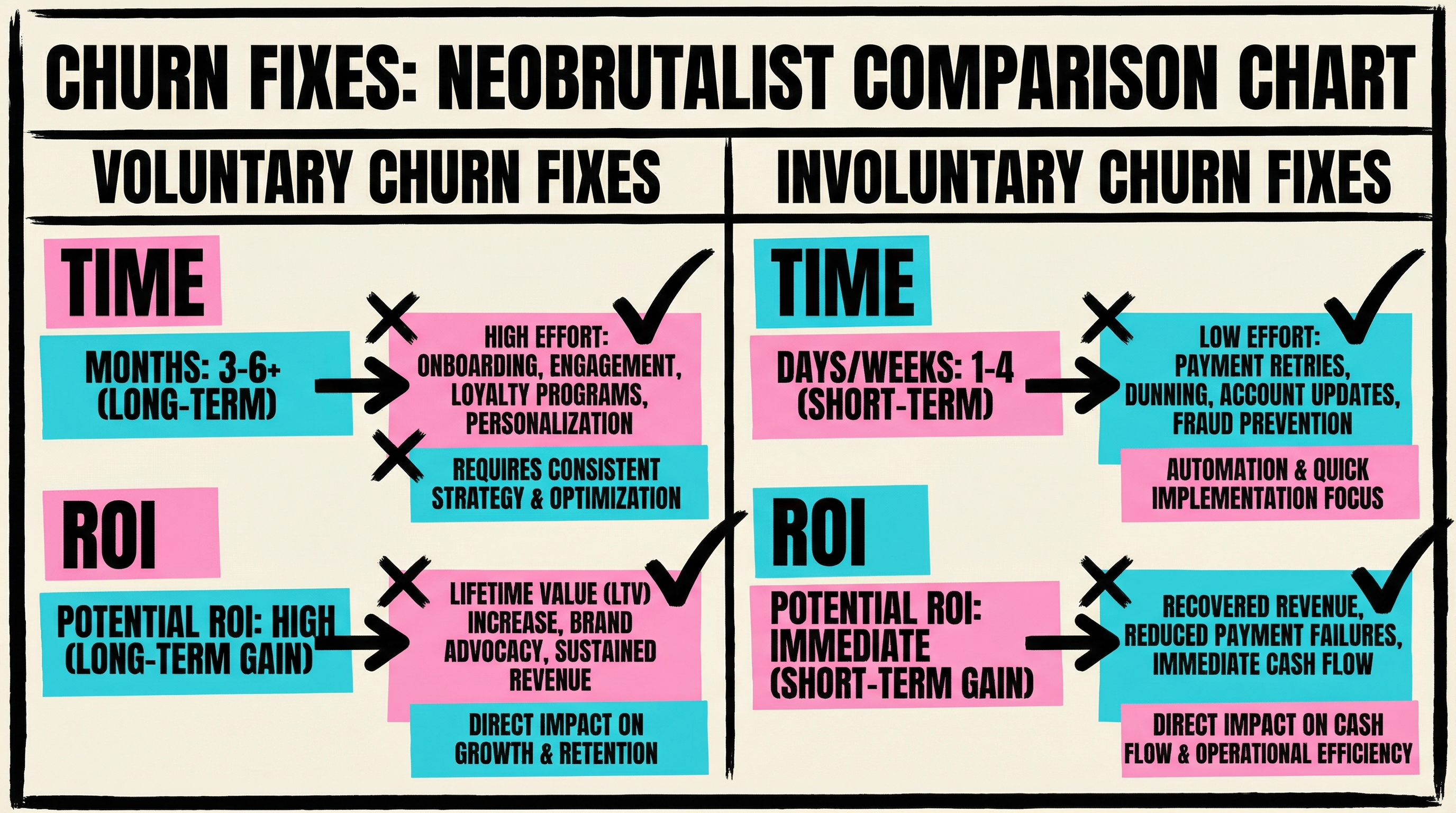
Reason 1: Speed to Impact
Voluntary churn requires product changes, marketing adjustments, pricing experiments, better onboarding flows. These take months to design, build, test, and deploy.
Involuntary churn fixes can deploy in days:
- Set up card expiry notifications (2 hours)
- Enable Stripe's Smart Retries (5 minutes)
- Implement a basic dunning email sequence (1 day)
- Add a payment update prompt in-app (1 week)
You can recover 30-50% of involuntary churn within the first month of implementation.
Reason 2: ROI Is Immediate and Measurable
When you reduce voluntary churn, the payoff is long-term and diffuse. Did that onboarding change work? Hard to tell. Was it the new pricing? Maybe. Attribution is murky.
When you reduce involuntary churn, the metrics are crystal clear:
- Recovery rate: percentage of failed payments successfully retried
- Involuntary churn rate: failed payments ÷ total active subscriptions
- Revenue recovered: MRR saved from payment recovery
You can see the money come back. If you recover $5k in failed payments this month, that $5k shows up in your MRR. No ambiguity.
Reason 3: Customer Sentiment
Here's a truth most founders miss: customers who churn involuntarily are angry.
They wanted to stay. They were happy. Then you cut off their access because of a billing hiccup. Now they're annoyed, they've moved to a competitor, and they're unlikely to come back.
Voluntary churn is a clean break. Involuntary churn is a fumbled relationship.
When you prevent involuntary churn, you're not just saving revenue. You're preserving customer relationships. Those customers stick around, renew, and upgrade because you didn't accidentally kick them out.
Reason 4: The Math Favors Low-Hanging Fruit
Let's run the numbers for a hypothetical $100k MRR SaaS:
- Total monthly churn: 5% ($5k lost MRR)
- Voluntary churn: 3% ($3k lost MRR)
- Involuntary churn: 2% ($2k lost MRR)
You could spend six months improving your onboarding to reduce voluntary churn from 3% to 2.5%. That saves $500/month.
Or you could spend one week implementing payment recovery and reduce involuntary churn from 2% to 1%. That saves $1,000/month.
Same effort, double the return. And the involuntary churn fix doesn't require rethinking your entire product.
How to Tackle Involuntary Churn First
Step 1: Measure It Separately
Most analytics tools lump all churn together. You need to split it.
In Stripe, filter churned subscriptions by cancellation reason:
- invoice.payment_failed = involuntary churn
- customer.subscription.deleted = voluntary churn
Track your involuntary churn rate monthly:
Involuntary Churn Rate = (Failed Payment Cancellations) / (Active Subscriptions) × 100
If you're above 1.5% monthly, you're leaving money on the table.
Step 2: Implement Smart Retries
Stripe offers built-in Smart Retries that automatically retry failed payments at optimal times based on ML models trained on billions of transactions.
Enable it in your Stripe Dashboard:
- Go to Settings → Billing → Subscriptions and emails
- Enable "Smart Retries"
- Set retry attempts (recommended: 4 retries over 2 weeks)
This alone can recover 30-40% of failed payments with zero dev work.
Step 3: Set Up Pre-Dunning Notifications
Catch problems before they happen:
- Email customers 7 days before their card expires
- Send in-app notifications when a payment method is about to expire
- Remind them 3 days before renewal if their card is expiring soon
Customers who update their card proactively never churn involuntarily.
Step 4: Build a Dunning Sequence
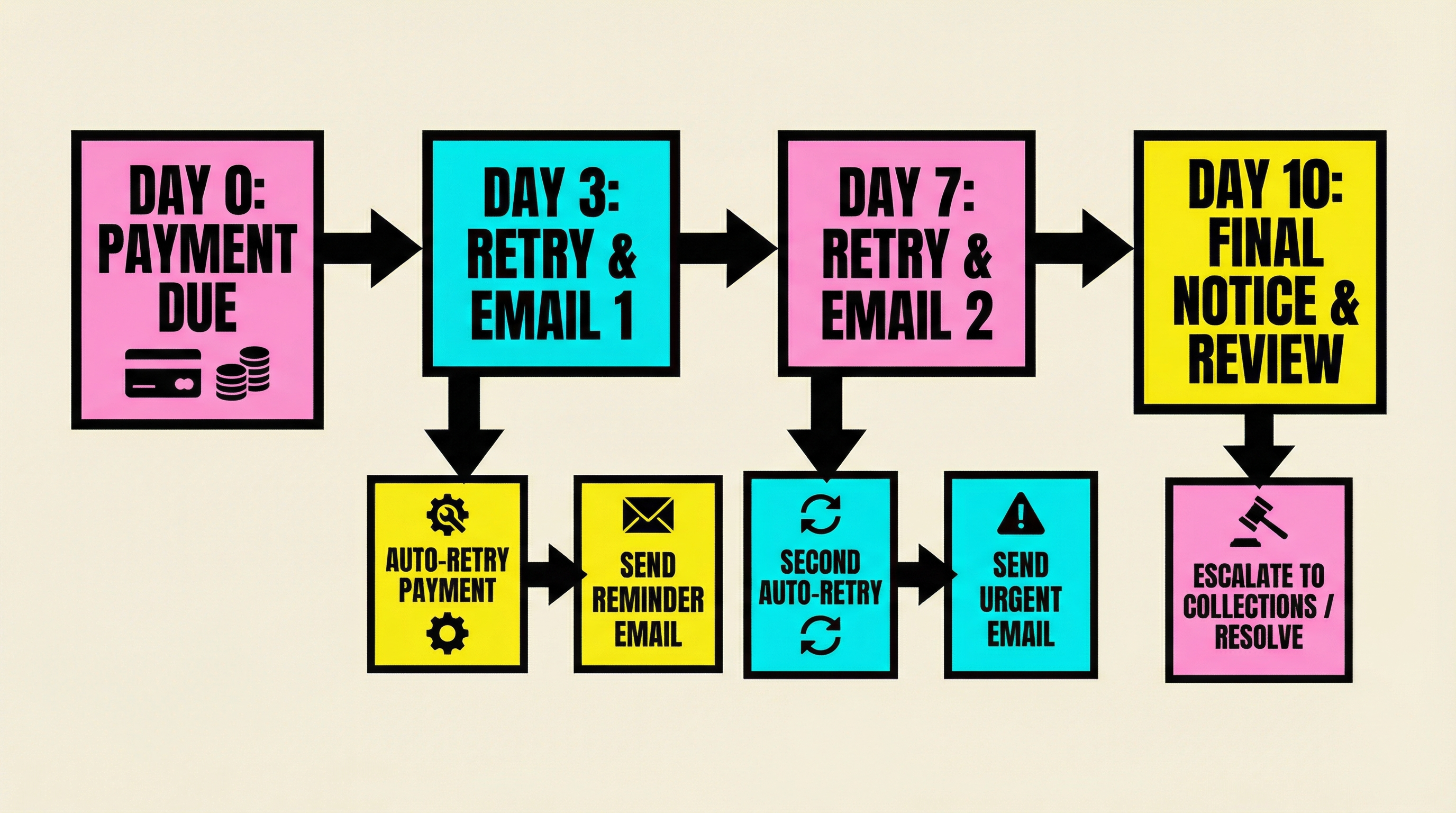
When a payment fails, send a series of dunning emails:
- Day 0: Payment failed, please update your card
- Day 3: Reminder with link to update payment
- Day 7: Final notice before account suspension
- Day 10: Account paused, update to restore access
Use a friendly, helpful tone. You're not threatening them. You're helping them stay subscribed. Learn more about effective dunning email strategies.
Step 5: Add In-App Payment Prompts
When a payment fails, show a banner in your app:
⚠️ Your payment failed. Update your card to keep access.
Make the update flow one-click. Don't force them to dig through settings.
Step 6: Monitor and Optimize
Track these metrics weekly:
- Payment failure rate: percentage of charges that fail
- Recovery rate: percentage of failed payments that succeed on retry
- Dunning email open rate: are customers seeing your messages?
- Time to recovery: how long does it take to recover a failed payment?
If your recovery rate is below 50%, your dunning sequence needs work.
When to Shift Focus to Voluntary Churn
You don't ignore voluntary churn forever. But you delay it until involuntary churn is under control.
Here's the threshold:
- Involuntary churn rate < 1% monthly
- Payment recovery rate > 60%
- Card expiry notification coverage > 90%
Once you hit those benchmarks, you've fixed the billing leak. Now you can afford to focus on the harder problem: keeping customers who are actively choosing to leave.
At that point, your churn reduction strategy shifts:
- Improve onboarding conversion
- Build better activation loops
- Run win-back campaigns for churned users
- Analyze exit surveys and cancellation reasons
- Test pricing and packaging changes
These initiatives take longer and require more cross-functional coordination. But they're worth doing once you're not hemorrhaging revenue from preventable payment failures.
The Tools That Help
You don't need to build everything from scratch. Several tools specialize in involuntary churn reduction:
- Stripe Billing - Built-in Smart Retries and dunning email templates
- Baremetrics Recover - Automated dunning with proven email sequences
- ProfitWell Retain - AI-optimized recovery campaigns
- Churn Buster - Dunning campaigns for Stripe subscriptions
- Gravy - Full-service payment recovery team
Or run a free audit to see exactly where your Stripe account is leaking revenue: churnbot.co/audit.
For a deeper comparison, see our guide on tools to reduce involuntary churn in Stripe.
The Bottom Line
If you're a SaaS founder trying to reduce churn, start with involuntary churn.
It's faster to fix. It has clearer ROI. It preserves customer relationships. And it doesn't require rethinking your entire product.
Once your billing is airtight and you're recovering 60%+ of failed payments, then invest in voluntary churn reduction.
But until then? Fix the leaky bucket before you pour more water in.
Want to know how much involuntary churn is costing you? Run a free churn audit at churnbot.co/audit and see exactly where your Stripe account is losing revenue.
Related Posts

7 Failed Payment Segments Every Stripe Team Should Track
The Complete Toolkit for Managing Failed Payments
Stripe Do Not Honor Recovery: What SaaS Teams Should Do Next
How healthy is your Stripe account?
Get a free churn health report. Find pending cancellations, failed payments, and expiring cards putting your MRR at risk.
Run Free Audit