7 Dunning Email Strategies That Actually Recover Failed Payments
Failed payments are the silent profit killer in SaaS. While you're busy optimizing conversion funnels and chasing new MRR, 20-40% of your existing customers are churning involuntarily—not because they want to leave, but because their credit card declined and your dunning emails didn't work.
Here's the thing: most dunning email strategies are terrible. They're either too aggressive ("YOUR ACCOUNT WILL BE SUSPENDED"), too passive ("Oops, your payment failed"), or completely missing the mark on timing and psychology.
After analyzing thousands of failed payment recovery flows, I've identified 7 dunning email strategies that consistently outperform the defaults. These aren't theoretical best practices—they're battle-tested tactics that recover revenue.
What Makes a Dunning Email Strategy Actually Work?
Before we dive into specific strategies, let's set the baseline. A good dunning email strategy needs three things:
- The right timing - Send too early and you waste sends; too late and the customer has already moved on mentally
- The right tone - Dunning emails walk a tightrope between urgency and empathy
- The right friction - Make updating payment info dead simple, not a login odyssey
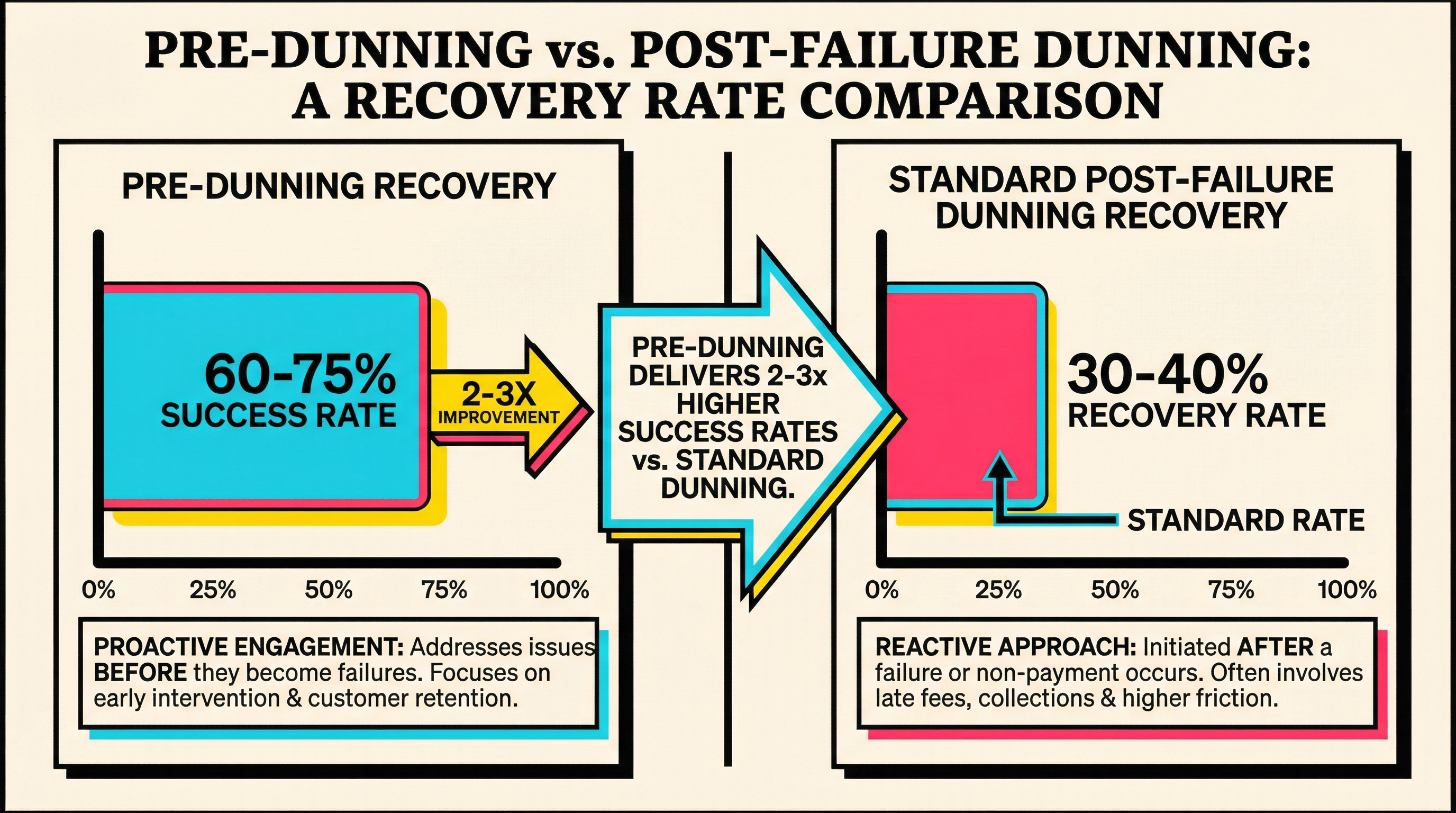
Most SaaS companies fail on at least two of these. The result? Recovery rates that hover around 30-40% when they could be 60-70%.
Let's fix that.
Strategy #1: The Pre-Dunning Email (Before Payment Fails)
The best dunning email is the one you send before the payment fails.
Pre-dunning emails target cards that are about to expire or have shown signs of risk (soft declines, previous failures, etc.). The recovery rate on pre-dunning is 2-3x higher than post-failure dunning, because you're catching customers before they mentally disengage.
What to include:
- Subject line: "Update your payment method" (not "Your card is expiring")
- Body: Simple, direct request to update their card
- CTA: One-click link to update payment info (no login required)
- Timing: 7-14 days before expiry for expiring cards; immediately after a soft decline
Why it works:
Customers haven't been locked out yet. There's no embarrassment, no urgency panic, no service disruption. They're still in the mindset of being a happy customer who just needs to update a detail.
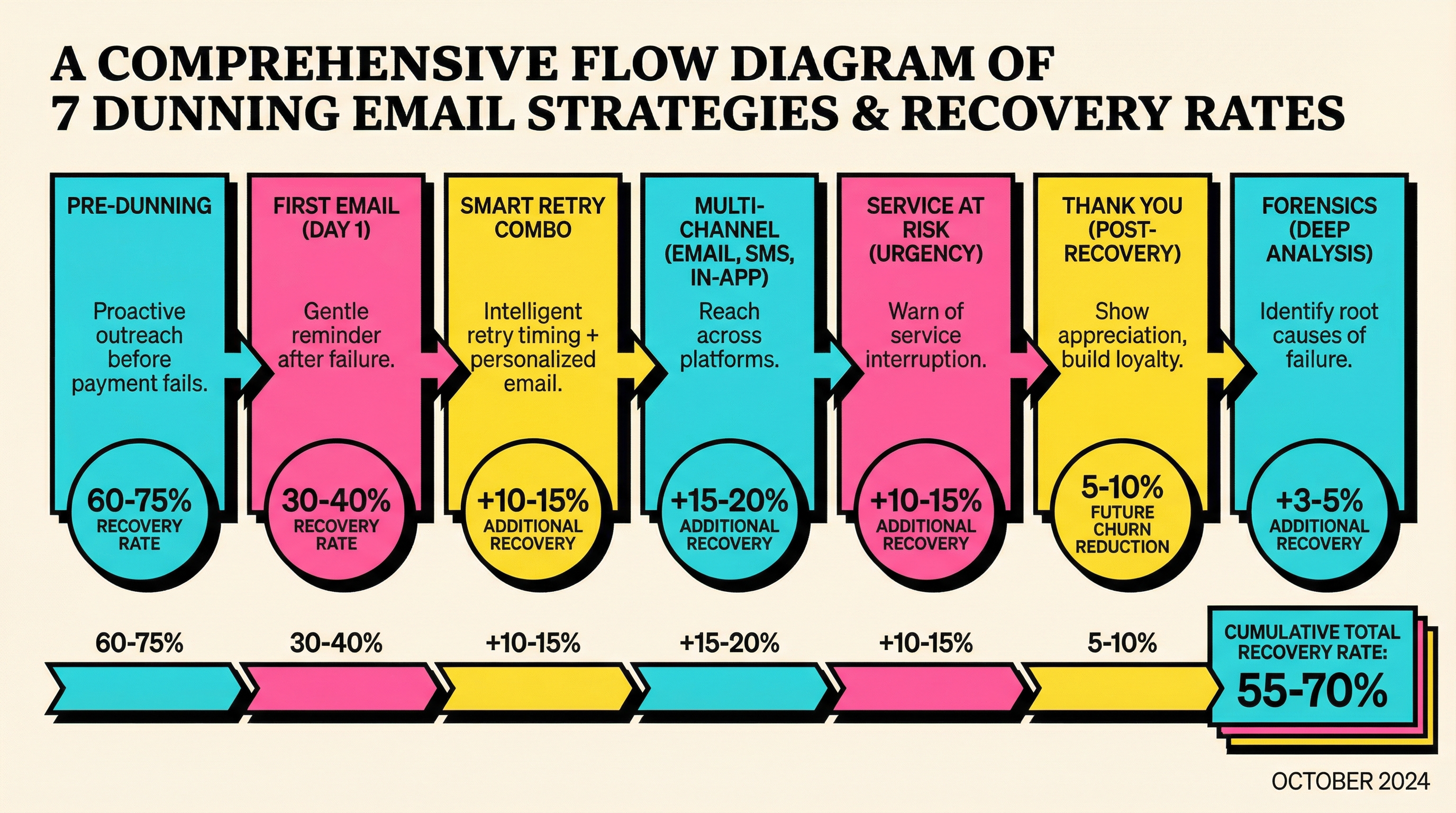
Real impact: Companies using pre-dunning see 15-25% fewer failed payments in the first place. That's involuntary churn you never have to recover from.
Strategy #2: The First Failed Payment Email (Sent Within 24 Hours)
When a payment fails, speed matters. The longer you wait, the more the customer's mental model shifts from "active subscriber" to "someone who needs to deal with this later."
Your first dunning email should go out within 24 hours of the failure—ideally within 6-12 hours.
What to include:
- Subject line: "We couldn't process your payment" (clear, not alarming)
- Body: Acknowledge the failure, explain what happened ("Your card was declined"), and offer a simple fix
- CTA: Direct link to update payment info
- Timing: 6-24 hours after first failure
- Tone: Helpful, not accusatory. This isn't the customer's fault—it happens to everyone.
Why it works:
Most declines are temporary or fixable (expired cards, insufficient funds that clear in a day, bank fraud flags). Catching customers early means they haven't moved on yet. They still identify as your customer.
One critical detail: Don't suspend their account yet. Give them 3-5 days of grace period. You want them to keep using your product while you work through recovery.
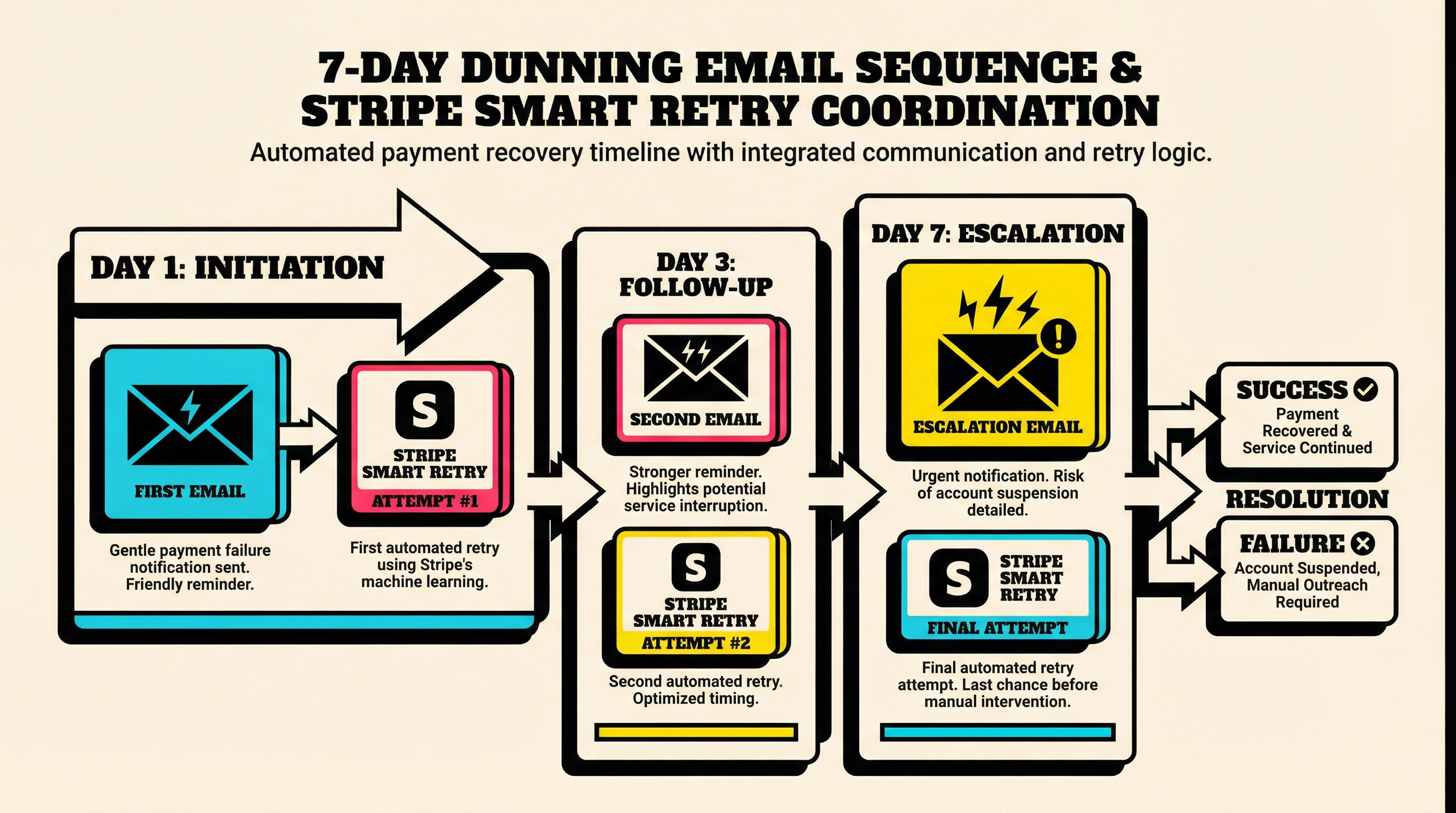
Real impact: The first email in a dunning sequence recovers 30-40% of failed payments on its own if sent within 24 hours. Wait 3 days and that drops to 15-20%.
Strategy #3: The Stripe Smart Retry + Email Combo
Stripe automatically retries failed payments on a smart schedule based on the decline code. Most SaaS companies treat this as a "set it and forget it" feature. That's a mistake.
The best dunning strategy combines Stripe's smart retries with coordinated emails timed around those retry attempts.
How it works:
- Payment fails → Stripe queues a retry based on the decline code
- You send an email 24 hours before Stripe's next retry attempt: "We're going to try your card again tomorrow. If you've updated your payment info, you're all set. If not, click here to avoid service interruption."
- Stripe retries → succeeds or fails
- If it succeeds, send a confirmation email ("We're back on track!")
- If it fails again, escalate to Strategy #4
Why it works:
You're not spamming the customer with generic "update your card" emails. You're giving them timely, contextual information about what's happening and when. This builds trust and increases the likelihood they'll actually take action.
Bonus: You avoid the awkward situation where the customer updates their card manually but Stripe retries the old card before the update propagates.
Real impact: Coordinating emails with Stripe's retry schedule increases recovery rates by 10-15% compared to random email timing.
Strategy #4: The Multi-Channel Escalation (Email + In-App + SMS)
By the third or fourth failed payment attempt, it's clear that email alone isn't working. Time to escalate.
The most effective dunning strategies use multi-channel escalation: email + in-app banner + SMS (if you have phone numbers).
What to include:
- Email: More urgent subject line ("Action required: Update your payment method"), clearer consequences ("Your account will be paused in 3 days")
- In-app banner: Non-dismissible banner at the top of your app with a prominent "Update Payment" button
- SMS (optional): Short, direct message with a link ("Hi [name], we couldn't process your payment. Update here: [link]")
Why it works:
Not all customers check email regularly. Some live in your app but never open promotional emails. Others respond to SMS faster than anything else. Multi-channel escalation catches customers wherever they're actually paying attention.
One key detail: Don't blast all channels at once. Escalate gradually. Email first (days 1, 3, 5), in-app banner from day 3 onwards, SMS on day 7 only if email hasn't worked.
Real impact: Multi-channel dunning recovers an additional 15-20% of payments that single-channel (email-only) flows miss entirely.
Strategy #5: The "Service at Risk" Email (Clear Consequences)
At some point, you need to communicate consequences. But here's where most SaaS companies blow it: they either threaten too early ("Your account will be deleted in 24 hours!") or never threaten at all ("Whenever you get a chance...").
The right balance is a clear, calm explanation of what happens next.
What to include:
- Subject line: "Your [product] service will be paused on [date]"
- Body: Explain exactly what "paused" means (can't log in, data is safe, no deletion), when it happens, and how to avoid it
- CTA: One-click payment update link
- Timing: 3-5 days before you actually pause the account
Why it works:
Clarity reduces anxiety. Customers need to know:
- What will happen
- When it will happen
- How to fix it
Vague threats ("Your account is at risk") trigger stress but not action. Specific deadlines ("Your account will be paused on February 15th at 11:59 PM") create urgency without panic.
Real impact: Adding a clear "service at risk" email 3-5 days before suspension recovers an additional 10-15% of payments that softer language misses.
Strategy #6: The Post-Recovery "Thank You" Email (Close the Loop)
Most dunning sequences end when the payment goes through. That's a missed opportunity.
The best dunning strategies include a "thank you" email sent immediately after successful recovery. This does two things:
- Confirms to the customer that they're back in good standing (reduces anxiety)
- Reinforces positive behavior ("Thanks for updating your payment info—we're all set!")
What to include:
- Subject line: "You're all set—thank you!"
- Body: Short, cheerful confirmation that payment went through and service continues uninterrupted
- Timing: Within 1 hour of successful payment recovery
Why it works:
Failed payments are stressful for customers. They worry about whether the update worked, whether they'll be charged twice, whether their account is still active. A simple confirmation email eliminates that anxiety.
Bonus: It makes your brand feel human and considerate, which increases long-term retention.
Real impact: Post-recovery emails don't directly recover revenue, but they reduce future churn by 5-10% by improving customer experience during a stressful moment.
Strategy #7: The "Failed Payment Forensics" Email (Learn and Improve)
Here's a strategy almost no one uses: send a question instead of a request.
After a payment fails and you've exhausted the standard dunning sequence, send one final email asking why the payment failed.
What to include:
- Subject line: "Quick question about your payment"
- Body: "We noticed your payment didn't go through, and we want to make this easier for you. Was it: (a) Card expired, (b) Insufficient funds, (c) Bank declined, (d) Something else? Reply and let us know—we might be able to help."
- Timing: 7-10 days after initial failure, after standard recovery attempts
Why it works:
Some customers want to stay but face a real issue (their company doesn't allow automatic billing, they switched banks, etc.). Asking directly opens a conversation that can lead to manual recovery.
Bonus: You learn about systematic issues in your billing process ("Three customers this week said their bank flagged it as fraud—we need to fix our merchant descriptor").
Real impact: The forensics email recovers an additional 3-5% of payments (small but meaningful for high-value customers) and provides qualitative feedback that improves your entire payment infrastructure.
How to Implement These Strategies Without Overcomplicating Your Stack
If you're using Stripe, you already have most of the building blocks:
- Stripe Smart Retries - Turned on by default, handles retry timing
- Stripe Billing Webhooks -
invoice.payment_failed,invoice.payment_succeeded, etc. - Customer email - Stored in Stripe customer object
- Payment update link - Stripe Checkout or Billing Portal
You need:
- An email service (SendGrid, Postmark, Resend, etc.)
- A simple workflow engine or cron job to listen to Stripe webhooks and trigger emails
- Pre-written email templates for each stage
If you don't have engineering resources to build this, tools like Stunning or ProfitWell Retain can handle dunning automation. But honestly, a basic version is ~200 lines of code and a weekend project.
The ROI is immediate. If you're losing $10k/month to involuntary churn and these strategies recover even 30% of that, you've just added $3k MRR—permanently—for a one-time implementation effort.
The Psychology Behind Effective Dunning Email Strategies
Why do some dunning emails work and others don't? It comes down to psychology.
Failed payments trigger loss aversion. Customers don't want to lose access to your product, but they also experience inertia ("I'll deal with this later"). Effective dunning emails overcome inertia by:
- Reducing friction - One-click update links, no login required
- Creating urgency - Specific deadlines, clear consequences
- Removing shame - "This happens to everyone, here's how to fix it"
- Building trust - Transparent communication, no dark patterns
Bad dunning emails amplify inertia by being vague ("Your payment failed"), passive ("Update when you can"), or hostile ("YOUR ACCOUNT WILL BE TERMINATED").
The best dunning emails feel like a helpful nudge from a friend, not a collections notice from a faceless corporation.
Benchmarks: What Good Recovery Rates Look Like
How do you know if your dunning email strategy is working? Here are realistic benchmarks:
- Pre-dunning (card expiry alerts): 60-75% success rate (customers update before failure)
- First dunning email (within 24h): 30-40% recovery rate
- Second email (day 3-5): Additional 15-20% recovery
- Multi-channel escalation (day 7+): Additional 10-15% recovery
- Total recovery rate: 55-70% of all failed payments
If your recovery rate is below 40%, your dunning strategy needs work. If you're above 60%, you're doing better than most SaaS companies.
One caveat: Recovery rates vary by failure type. Expired cards recover at 70-80%. Insufficient funds recover at 40-50%. Fraud blocks recover at <10%. Track your recovery rates by decline code to identify where to focus optimization efforts.
Want to see exactly where your Stripe account is leaking revenue? Run a free churn audit at ChurnBot and get a breakdown of your failed payments by decline code, customer segment, and recovery opportunity.
Common Dunning Email Mistakes to Avoid
Even with the right strategies, execution matters. Here are the most common mistakes:
1. Waiting too long to send the first email
Every day you wait, your recovery rate drops 5-10%. Send the first email within 24 hours.
2. Making customers log in to update payment info
Friction kills conversions. Use Stripe Checkout or Billing Portal links that work without login.
3. Suspending service too early
Give customers 5-7 days of grace period. Cutting off access on day 2 feels punitive and increases voluntary churn.
4. Using generic "no-reply" sender addresses
Dunning emails from "no-reply@yourcompany.com" feel robotic and untrustworthy. Use a real address ("billing@yourcompany.com" or "founder@yourcompany.com") and allow replies.
5. Never testing or iterating
Your dunning emails are worth thousands of dollars per month. A/B test subject lines, CTAs, and timing. Even a 5% improvement is meaningful.
6. Ignoring mobile experience
Most customers will read dunning emails on mobile. Make sure your payment update flow works flawlessly on a phone.
7. Treating all decline codes the same
A card expiry is different from insufficient funds is different from a fraud block. Customize your messaging based on the decline reason (Stripe gives you this in charge.failure_code).
The Business Impact of Better Dunning Email Strategies
Let's do the math. Assume you have:
- $100k MRR
- 5% monthly churn
- 40% of churn is involuntary (failed payments)
- Current recovery rate: 30%
- Improved recovery rate: 60% (using strategies above)
Current state:
- Monthly involuntary churn: $100k × 5% × 40% = $2,000
- Recovered: $2,000 × 30% = $600
- Lost: $1,400/month
Improved state:
- Recovered: $2,000 × 60% = $1,200
- Lost: $800/month
- Gain: $600/month = $7,200 annually
And that compounds. Every month you keep a customer, you increase LTV and reduce CAC payback. Over 12 months, improving your recovery rate from 30% to 60% adds $7,200 in retained MRR plus the downstream LTV of those customers (another 12-24 months of revenue, on average).
For a $100k MRR company, better dunning email strategies are worth $15-20k in retained LTV over 24 months. For a $1M MRR company? $150-200k.
That's not a rounding error. That's a material revenue line.
Wrapping Up: Start With One Strategy Today
You don't need to implement all 7 strategies at once. Start with one:
- If you have no dunning emails: Implement Strategy #2 (first failed payment email within 24 hours)
- If you have basic dunning: Add Strategy #1 (pre-dunning for expiring cards)
- If your recovery rate is stuck: Add Strategy #4 (multi-channel escalation)
Pick one, ship it this week, measure the impact. Then add the next strategy.
Failed payments are the highest-leverage problem in SaaS. Customers who churn involuntarily wanted to stay—you just made it too hard for them to pay you. Fix that, and you'll recover thousands in MRR without spending a dollar on ads.
Ready to see exactly where your Stripe account is leaking revenue? Run a free churn audit at churnbot.co/audit and get a detailed breakdown of your failed payments, recovery opportunities, and revenue at risk. Takes 2 minutes, zero Stripe permissions required.
Related reading: Why 40% of SaaS Churn Is Completely Preventable
Related Posts

7 Failed Payment Segments Every Stripe Team Should Track
The Complete Toolkit for Managing Failed Payments
Stripe Do Not Honor Recovery: What SaaS Teams Should Do Next
How healthy is your Stripe account?
Get a free churn health report. Find pending cancellations, failed payments, and expiring cards putting your MRR at risk.
Run Free Audit