Why 40% of SaaS Churn Is Completely Preventable
You're losing customers who never wanted to leave.
Every month, subscription businesses watch revenue disappear — not because customers cancelled, but because a credit card expired, a bank flagged a transaction, or a payment simply failed. This is involuntary churn, and it accounts for up to 40% of all SaaS churn.
The worst part? Most founders don't even realize it's happening until they look at the numbers.
In this post, we'll break down exactly what involuntary churn is, why it's so dangerous, and what you can do about it — starting today.
The Silent Revenue Killer
Voluntary churn gets all the attention. Product teams obsess over feature requests, support teams chase NPS scores, and growth teams run retention campaigns. Meanwhile, failed payments quietly drain revenue in the background.
Here's what makes involuntary churn so dangerous:
- It's invisible. Customers don't complain before they churn — they don't even know it happened. There's no angry email, no cancellation survey, no warning. One day they're a paying customer, the next they're gone.
- It compounds. A 3% monthly involuntary churn rate means you're losing over 30% of revenue annually to payment failures alone. At scale, this becomes tens or hundreds of thousands of dollars.
- It's fixable. Unlike voluntary churn, which requires product changes, customer success efforts, and sometimes fundamental business model shifts, involuntary churn has clear, mechanical solutions.
Think about that last point for a moment. You're spending thousands on acquisition, pouring money into product development, and running elaborate retention campaigns — while a completely fixable problem quietly erodes your revenue every single month.
How Big Is the Problem, Really?
Let's put some industry numbers on this.
According to multiple studies across the SaaS industry, involuntary churn typically accounts for 20-40% of total churn for subscription businesses. For some companies, especially those with a large percentage of credit card payments and consumer-facing products, it can be even higher.
Here's a quick mental model. If your total monthly churn rate is 5%, roughly 1.5-2% of that might be involuntary. That sounds small until you compound it:
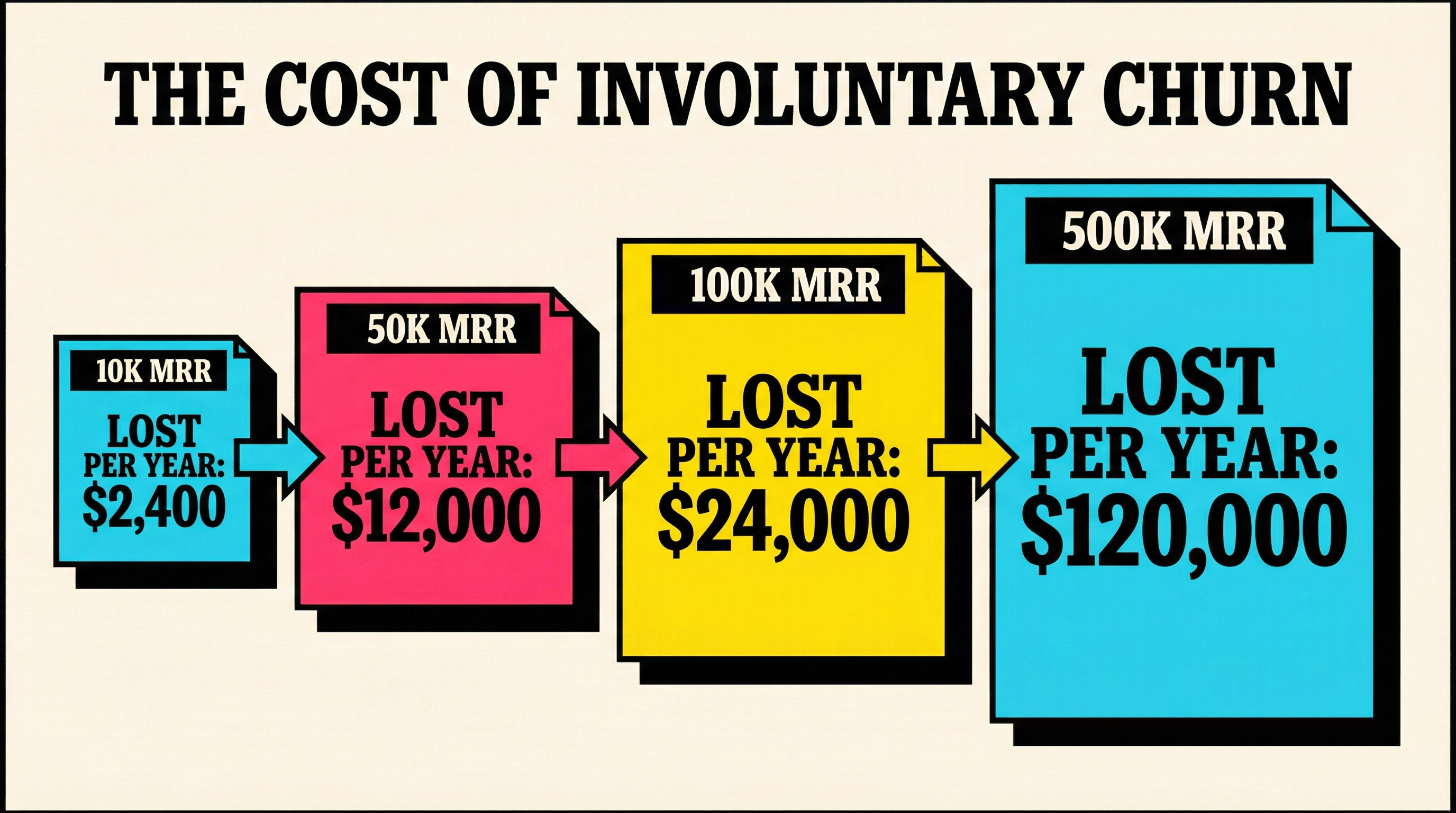
- $10K MRR: ~$150-200/month lost = $1,800-2,400/year
- $50K MRR: ~$750-1,000/month lost = $9,000-12,000/year
- $100K MRR: ~$1,500-2,000/month lost = $18,000-24,000/year
- $500K MRR: ~$7,500-10,000/month lost = $90,000-120,000/year
And these are customers who want to keep paying you. They didn't evaluate competitors. They didn't outgrow your product. Their credit card just expired, or their bank flagged the transaction as suspicious, or they simply didn't have enough funds on the day your billing cycle hit.
The Anatomy of a Failed Payment
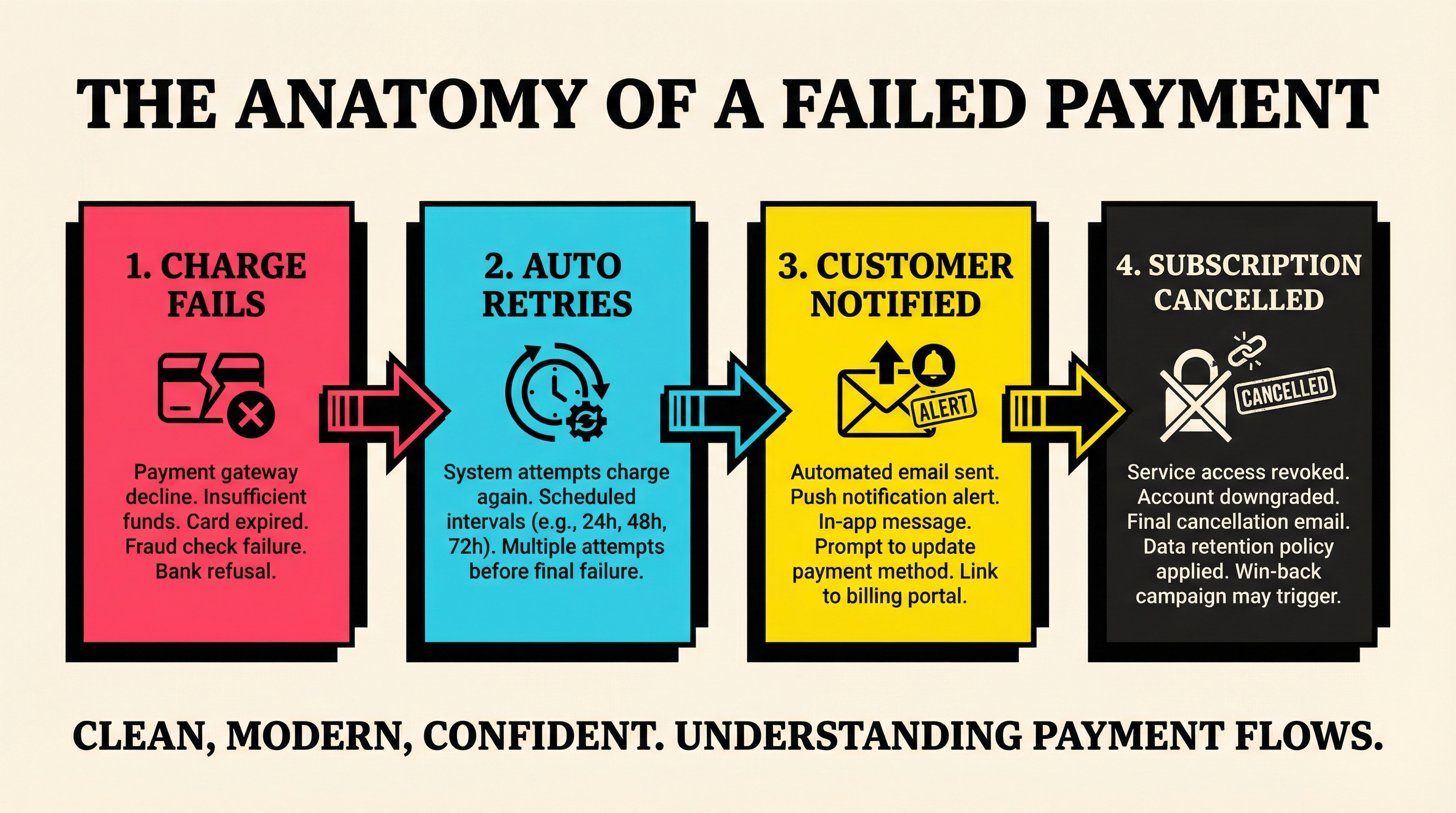
To fix involuntary churn, you need to understand what actually happens when a payment fails. It's not a single event — it's a chain of decisions (or non-decisions) that determines whether you keep or lose the customer.
Step 1: The Initial Charge Fails
The subscription renewal date arrives, and Stripe (or your payment processor) attempts to charge the customer's card. The charge fails. This happens for dozens of reasons, but they broadly fall into a few categories:
- Expired card: The card on file has passed its expiration date. This is the most common and most preventable reason.
- Insufficient funds: The customer doesn't have enough money in their account at the time of the charge.
- Bank decline: The issuing bank declines the transaction. This can happen for fraud prevention, unusual activity patterns, or internal bank policies.
- Card reported lost/stolen: The customer has reported the card, and the bank blocks all transactions.
- Network errors: Temporary issues between payment processors and banks. These usually resolve on retry.
Each of these failure types has a different recovery probability and requires a different strategy. Treating them all the same is one of the biggest mistakes SaaS companies make.
Step 2: Automatic Retries
Stripe retries the charge automatically based on its default schedule. Most processors retry 3-4 times over a period of days or weeks. But here's the problem: default retry logic is generic.
Stripe doesn't know your business. It doesn't know that your customers are mostly US-based and get paid on the 1st and 15th. It doesn't know that a decline code of "insufficient funds" has a 60% chance of succeeding if retried on Friday afternoon. It applies a one-size-fits-all retry schedule.
For some failure types (like expired cards), retrying is pointless — the charge will never succeed until the customer updates their payment method. For others (like insufficient funds), the timing of the retry matters enormously.
Step 3: Customer Notification (Maybe)
If you've set up dunning emails, the customer gets notified that their payment failed. But many SaaS companies either:
- Don't have dunning emails at all
- Have a single generic email that goes out once
- Send emails that look like spam and get ignored
- Bury the payment update link behind three clicks and a login
The notification step is where most of the recoverable revenue either gets saved or gets lost. A well-crafted dunning sequence can recover 50-70% of failed payments. A bad one (or no sequence at all) recovers almost nothing.
Step 4: Subscription Cancellation
After the retry period is exhausted and the customer hasn't updated their payment method, the subscription is cancelled. The customer might not even realize it happened until they try to use your product and find their account locked.
By this point, re-activation is significantly harder than recovery would have been. The customer has gone days or weeks without your product. They may have found an alternative. The psychological barrier to re-subscribing is much higher than simply updating a card.
What Smart Recovery Looks Like
The best subscription businesses don't treat payment recovery as an afterthought. They build it into their billing infrastructure as a core competency. Here's how.
1. Intelligent Retry Timing
Not all payment failures are equal. A decline due to insufficient funds might succeed on payday. An expired card won't succeed no matter how many times you retry. Smart retry logic considers:
- Failure reason codes: Each decline code has a different recovery profile. "Insufficient funds" retries should be timed around common paydays. "Do not honor" codes may need a different card entirely. "Expired card" retries are useless without a card update.
- Time of day and day of week: Some banks have batch processing windows. Charges attempted at 3 AM may be more likely to fail than those at 10 AM. Mid-week tends to have higher approval rates than weekends.
- Customer payment history: If a customer has successfully paid on the 1st of every month for the past year, and their payment fails on the 28th, retrying on the 1st is the smart move.
- Amount sensitivity: Higher-value charges fail more often than lower ones. Some recovery strategies involve splitting charges or offering temporary discounts to reduce the charge amount.
The difference between generic retry logic and intelligent retry logic can be a 20-30% improvement in recovery rates. That's real money.
2. Pre-Dunning Prevention
The best failed payment is the one that never happens. Pre-dunning strategies focus on preventing failures before the renewal date:
- Card expiry reminders: Send email notifications 30, 14, and 7 days before a card expires. Include a one-click link to update payment details. This single strategy can prevent 60-80% of expired card failures.
- Automatic card updater: Stripe and other processors can automatically update expired cards through the card network's Account Updater service. Enable this. It silently refreshes card details for a significant percentage of customers.
- Backup payment methods: Ask customers to add a secondary payment method. If the primary fails, the backup is charged automatically. This is increasingly common in consumer subscriptions and works just as well in B2B SaaS.
- Annual billing nudges: Customers on annual plans have 12x fewer opportunities for payment failure than monthly subscribers. Offering a discount for annual billing (common: 15-20% off) reduces your involuntary churn surface area dramatically.
Pre-dunning is criminally underused. Most SaaS companies invest zero effort in preventing failures and then scramble to recover them after the fact.
3. Customer Communication That Actually Works
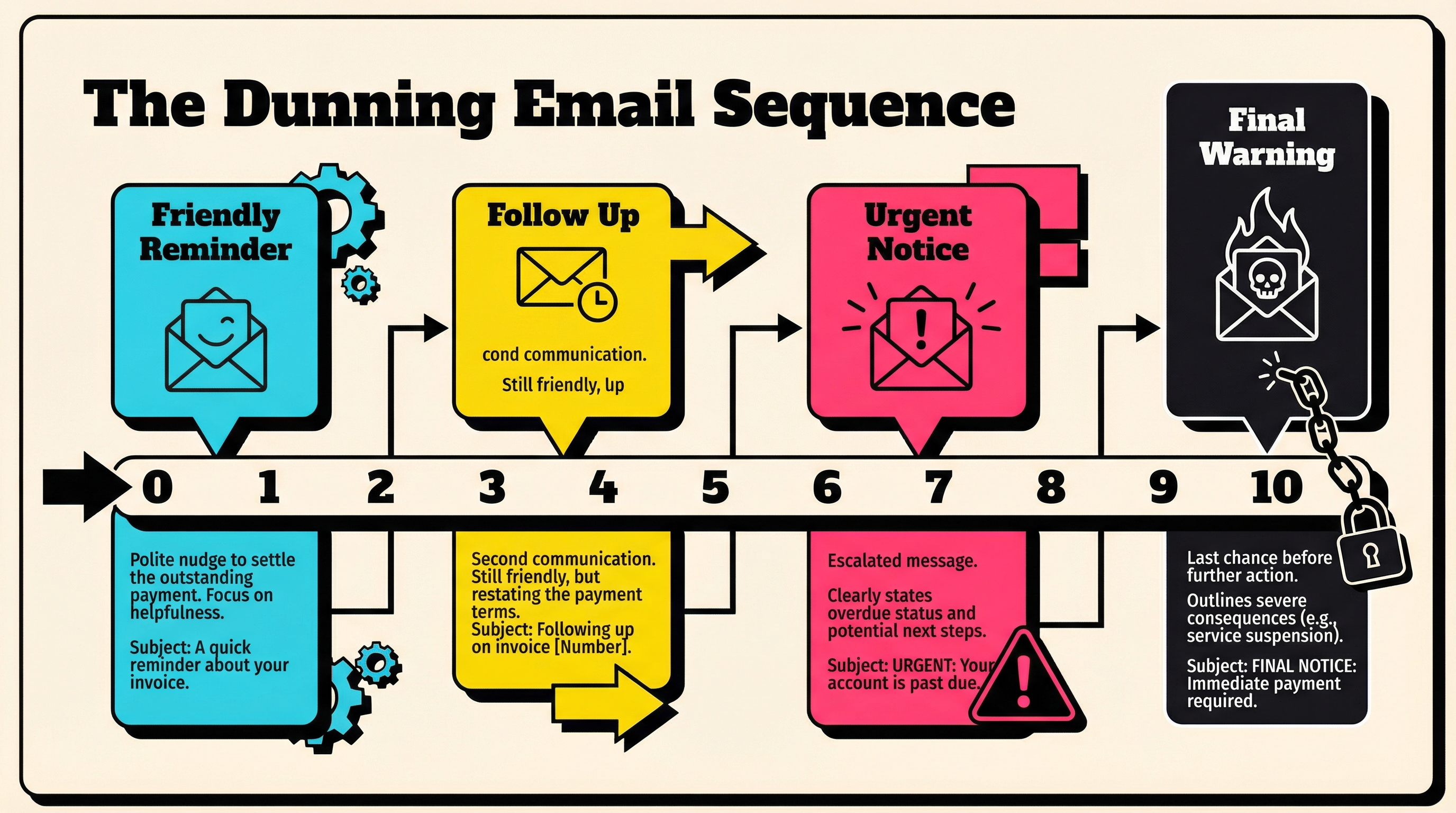
When a payment does fail, your dunning emails are your main recovery tool. Most dunning emails are terrible. Here's what works:
Be clear, not scary. "Your payment didn't go through" is better than "Your account will be terminated." Customers who feel threatened are less likely to act. Customers who feel helped are more likely to update their card.
Make it stupidly easy. One-click payment update links. Not a link to your login page. Not a link to your settings page. A direct, authenticated link that opens straight to the payment update form. Every additional click you add reduces recovery by 10-20%.
Escalate gradually. Your dunning sequence should start helpful and get more urgent over time:
- Day 1: "Hey, your payment didn't go through. Here's a quick link to fix it."
- Day 3: "Just a heads up — we're still trying to process your payment. Update your card to keep your account active."
- Day 7: "Your account will be paused in 3 days unless we can process payment. Here's the link."
- Day 10: "Last chance — your account will be paused tomorrow. We'd hate to see you go."
Include context. Remind the customer what they're paying for and what they'll lose. "Your Pro plan with 5 team members and 1,200 tracked keywords" is more motivating than "your subscription."
Test and iterate. Subject lines matter enormously. "Action required: payment failed" might work better than "Oops, we hit a snag." Or vice versa. Test both. Track open rates, click rates, and recovery rates per email in the sequence.
4. Data-Driven Analysis
You can't fix what you don't measure. Payment failure analysis should be part of your regular metrics review:
- Track recovery rates by failure reason: Know which decline codes are recoverable and which aren't. Invest your retry and dunning efforts proportionally.
- Benchmark against industry standards: SaaS companies with proper dunning typically recover 50-70% of failed payments. If you're below 40%, there's significant room for improvement.
- Monitor trends over time: Increasing failure rates might signal a deeper issue — a broken integration, a change in your customer base, or a problem with your payment processor.
- Segment by plan and customer type: Enterprise customers with corporate cards have different failure patterns than self-serve customers with personal cards. Your recovery strategy should account for this.
- Track time-to-recovery: How long does it take from initial failure to successful payment? If most recoveries happen within 48 hours, your day-7 and day-10 emails might need rethinking.
The Cost of Doing Nothing
Let's get concrete. Take a SaaS business at $50K MRR with a 3% involuntary churn rate:
- Monthly revenue lost: $1,500
- Annual revenue lost: $18,000
- With proper recovery (60% rate): $10,800 recovered
- Net annual savings: $10,800 — for what amounts to a few hours of setup
Now factor in the compounding effect. Each recovered customer continues paying in future months. A customer you save in January pays you for February, March, April, and beyond. The lifetime value of recovered customers often exceeds the simple arithmetic.
For a $50K MRR business growing at 10% monthly, the 3-year compounded impact of a 60% recovery rate versus no recovery is well over $100,000 in additional revenue.
And here's the kicker: this is the highest-ROI revenue work you can do. No acquisition cost. No sales cycle. No onboarding. These are customers who already chose you, already onboarded, already got value from your product. You're just making sure the payment goes through.
Common Mistakes to Avoid
Before you start optimizing, here are the pitfalls we see most often:
1. Treating All Failures the Same
An expired card and a fraud decline are completely different problems requiring completely different solutions. If your retry logic and dunning emails don't differentiate by failure reason, you're leaving money on the table and potentially annoying customers with irrelevant messages.
2. Giving Up Too Early
Many SaaS companies cancel subscriptions after 3-4 days of failed payments. Industry data shows that some payments recover up to 14-21 days after the initial failure. Extending your grace period (while clearly communicating with the customer) can recover an additional 10-15% of failures.
3. Sending Too Few Dunning Emails
One email is not a dunning strategy. The optimal number of dunning emails varies by business, but 4-6 emails over a 10-14 day period is a common best practice. Each email in the sequence recovers an incremental percentage.
4. Ignoring the Update Experience
You can write the perfect dunning email, but if the payment update page is broken, slow, or confusing, it doesn't matter. Test your payment update flow regularly. Make sure it works on mobile. Remove every unnecessary step.
5. Not Measuring
If you don't know your involuntary churn rate, your recovery rate, or your failure breakdown by reason code, you're flying blind. Measurement is step zero.
Start With Visibility
The first step isn't buying a dunning tool or configuring retry logic. It's understanding the current state of your payment failures.
Run an audit of your Stripe account:
- How many payments failed last month?
- What percentage were recovered vs. lost?
- What's the breakdown by failure reason code?
- How long does it take to recover a failed payment on average?
- How does your recovery rate compare to the 50-70% industry benchmark?
- What's the dollar impact of your unrecovered failures?
Once you see the numbers, the path forward becomes obvious. Most founders are genuinely shocked by how much revenue they're leaving on the table — and how straightforward the fix is.
Key Takeaways
- Involuntary churn is your biggest quick win. It's mechanical, measurable, and fixable — unlike the messy, emotional work of reducing voluntary churn.
- Default Stripe retry logic isn't enough. It's a starting point, not a strategy. Intelligent retries based on failure codes and customer patterns recover significantly more.
- Prevention beats recovery. Pre-dunning strategies like card expiry reminders and automatic card updaters prevent failures before they happen — and they're essentially free.
- Your dunning emails matter more than you think. Clear language, one-click update links, and a gradual escalation sequence can be the difference between 20% and 60% recovery rates.
- Measure first, then fix. You need visibility into your payment failure data before you can improve it. Start with an audit.
- The ROI is immediate. Every recovered payment goes straight to your bottom line with zero acquisition cost.
Stop losing customers who want to stay. Start with a free churn audit and see exactly where your revenue is leaking.
Related Posts

7 Failed Payment Segments Every Stripe Team Should Track
How to Analyze Your Payment Recovery Funnel
The Complete Toolkit for Managing Failed Payments
How healthy is your Stripe account?
Get a free churn health report. Find pending cancellations, failed payments, and expiring cards putting your MRR at risk.
Run Free Audit