How AI Is Changing Payment Recovery in 2026
Every subscription business bleeds revenue through failed payments. The numbers are brutal: industry data suggests that 20-40% of churn in SaaS companies is involuntary, driven by expired cards, insufficient funds, and bank declines rather than deliberate cancellations. For years, the standard playbook was simple retry logic and templated dunning emails. That playbook is getting rewritten.
AI payment recovery is shifting from a nice-to-have experiment to a core part of how subscription businesses protect their revenue. Here's what's actually changing, what's working, and where the hype outpaces reality.
The Problem With Traditional Payment Recovery
Before we talk about what AI brings to the table, it's worth understanding why legacy approaches fall short.
Most SaaS companies handle failed payments with one of two approaches:
- Stripe's built-in Smart Retries. Stripe automatically retries failed charges based on aggregate network signals. It works reasonably well for straightforward declines, but it treats every subscriber the same.
- Fixed retry schedules. Retry on day 1, day 3, day 7, send an email at each step. Maybe cancel after day 14. This is the default for most billing systems.
Both approaches share the same fundamental flaw: they're static. They don't adapt to individual subscriber behavior, payment history, or the specific reason the payment failed.
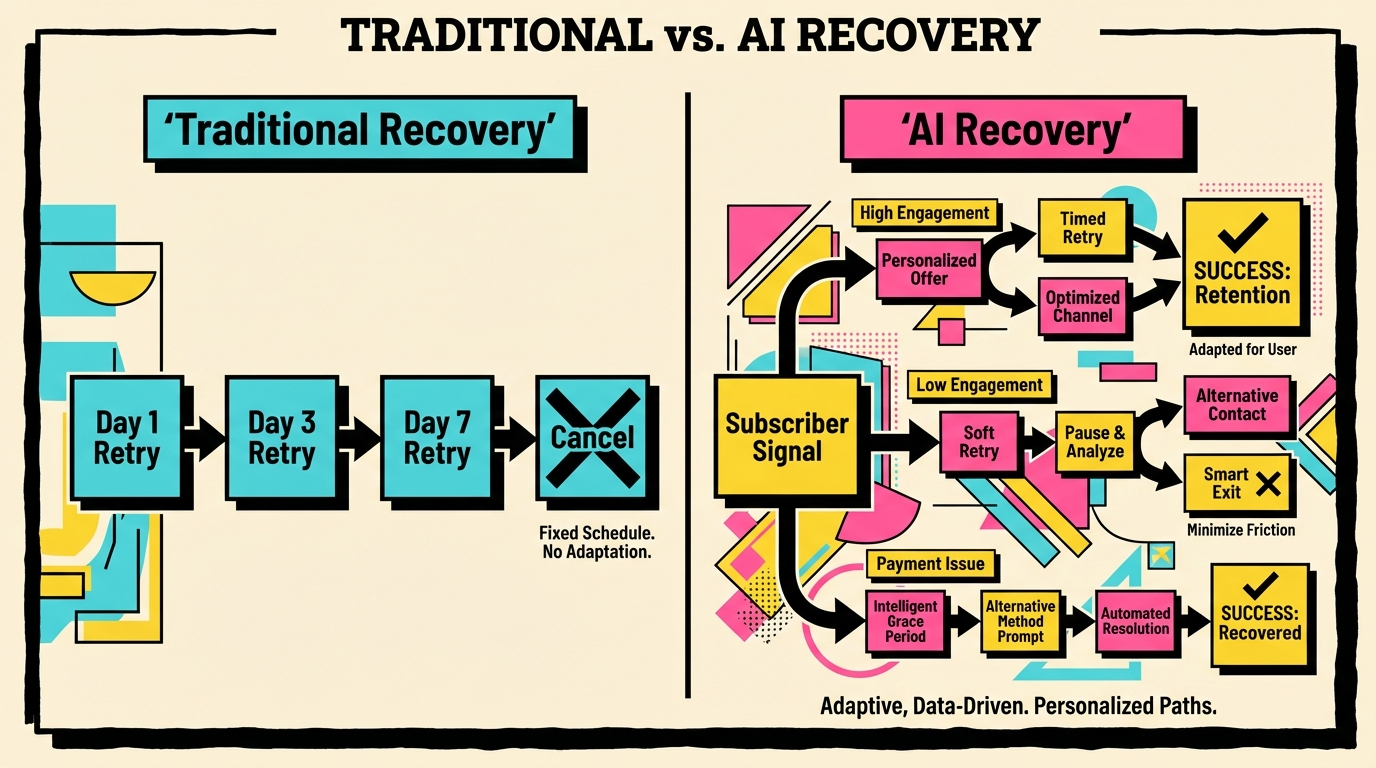
Consider two subscribers whose payments fail on the same day:
- Subscriber A has been a customer for 3 years, always pays on time, and their card was declined due to a temporary bank hold. Retrying in 6 hours would probably succeed.
- Subscriber B is on month 2 of a trial-to-paid conversion, their card shows an insufficient funds decline, and they haven't logged into your product in 3 weeks. Retrying aggressively just racks up decline attempts.
Static systems treat these identically. AI doesn't.
What AI Actually Does Differently
Let's cut through the marketing language. When we talk about AI in payment recovery, we're talking about a few specific capabilities:
1. Predictive Retry Timing
The most impactful application of AI in payment recovery is figuring out when to retry a failed charge. This isn't about retrying more frequently. It's about retrying at the moment most likely to succeed.
AI models analyze patterns across millions of transactions to identify signals like:
- Day-of-month patterns. Many consumers get paid on the 1st and 15th. An insufficient funds decline on the 28th is more likely to succeed if retried on the 1st.
- Time-of-day signals. Bank processing windows, authorization rates by hour, and issuer-specific behaviors all affect success rates.
- Historical subscriber patterns. If a subscriber's card has failed and recovered before, the model learns their specific pattern.
The result: recovery rates that are 10-25% higher than fixed schedules, according to data published by payment processors and recovery platforms. That translates directly to retained MRR.
2. Intelligent Decline Code Routing
Not all decline codes are equal, and AI systems are getting better at routing recovery actions based on the specific reason a payment failed.
Here's how this works in practice:
- Soft declines (insufficient funds, temporary holds): Retry with optimized timing.
- Hard declines (expired card, invalid number): Skip retries entirely, trigger card update flow immediately.
- Issuer-specific declines (do_not_honor, generic_decline): Apply issuer-specific retry strategies that the model has learned from historical success patterns.
This matters because every failed retry attempt has a cost. Too many declines on a card can trigger fraud flags, making future recovery harder. AI systems minimize wasted attempts by routing each decline to the right recovery action.
3. Personalized Dunning Communication
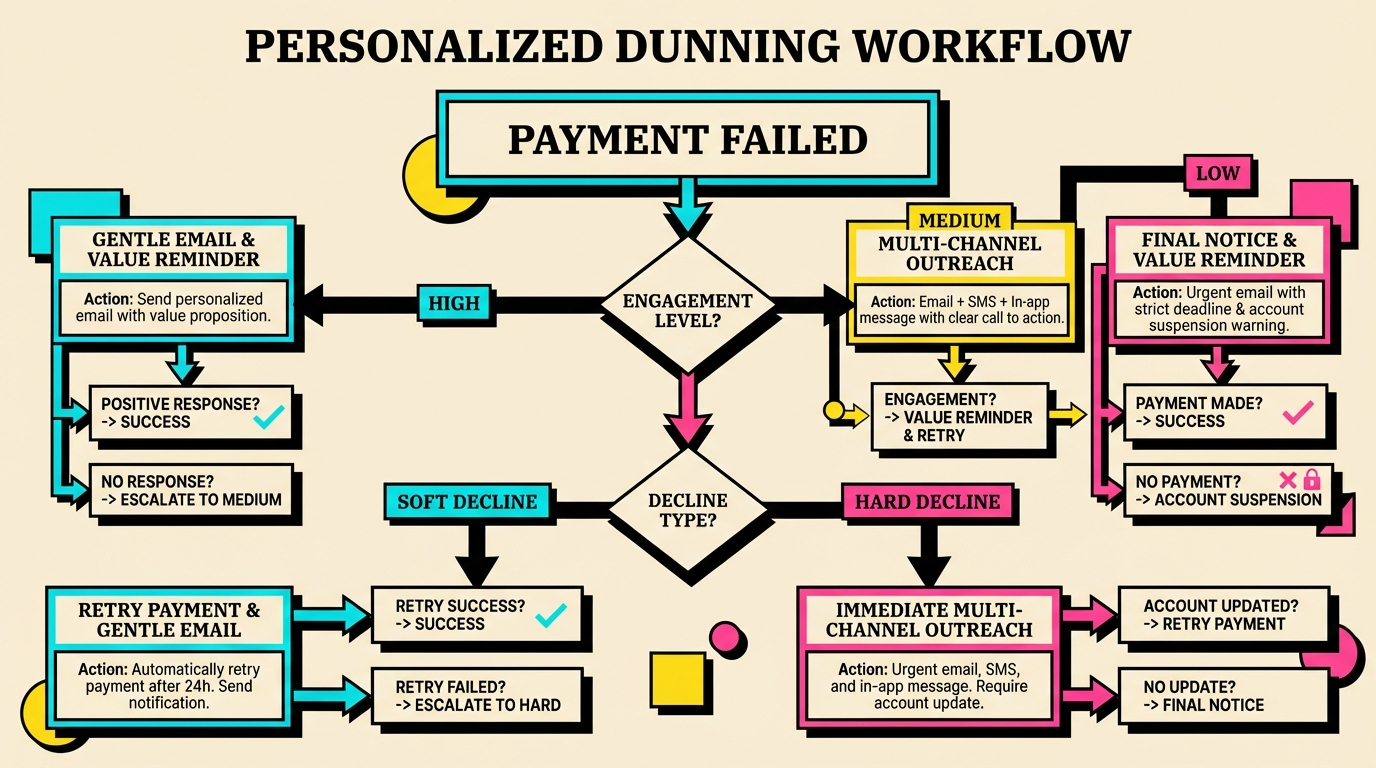
Dunning emails are the other half of payment recovery, and they're ripe for AI optimization. Traditional dunning sends the same sequence to everyone: "Your payment failed. Update your card. Last chance."
AI-driven dunning can customize:
- Timing. When to send the first email, how long to wait between follow-ups, and when to escalate.
- Channel. Some subscribers respond better to email, others to in-app notifications, others to SMS.
- Tone and urgency. A long-time customer who missed one payment gets a gentle nudge. A subscriber showing signs of disengagement gets a different approach entirely.
- Content. Highlighting product value, offering payment plan options, or simply making the card update process as frictionless as possible.
The key insight: the best dunning message isn't just about recovering the payment. It's about retaining the relationship.
4. Pre-Dunning and Failure Prevention
Perhaps the most promising application of AI in this space is preventing failures before they happen. This includes:
- Card expiry prediction. Identifying cards that will expire before the next billing cycle and proactively prompting updates.
- Risk scoring. Flagging subscribers whose payment is likely to fail based on behavioral signals (reduced product usage, previous decline patterns, card age).
- Account updater optimization. Prioritizing which expired cards to send through Visa Account Updater or Mastercard ABU based on likelihood of having a replacement card on file.
Preventing a failure is always cheaper than recovering from one. The industry is moving toward a model where the best recovery strategy is making recovery unnecessary.
7 Tips for Using AI Payment Recovery Effectively
AI isn't a magic switch you flip. Here's how to get real results:
Tip 1: Start With Your Data
AI models are only as good as their training data. Before investing in any AI recovery tool, make sure you have clean, comprehensive data on:
- Historical payment attempts and outcomes
- Decline codes and their resolution patterns
- Subscriber lifecycle data (tenure, plan, usage)
- Previous dunning interactions and their results
If your Stripe account has thousands of transactions, you likely have enough data for pattern recognition. If you're earlier stage, you might benefit more from aggregate models that learn across many accounts.
The first step is understanding your current baseline. You can't improve what you don't measure. Running a free churn audit gives you visibility into exactly where your failed payments are concentrated and what's recoverable.
Tip 2: Don't Abandon Simple Retry Logic Entirely
AI retry timing works best as a layer on top of basic retry infrastructure, not a replacement. Stripe's Smart Retries handle the simple cases well. AI adds the most value on the marginal cases where timing optimization makes the difference.
A practical approach:
- Let Stripe handle the initial automatic retry
- Use AI-optimized timing for subsequent retry attempts
- Set hard limits on total retry attempts per billing cycle to avoid issuer flags
Tip 3: Segment Your Recovery Strategy by Decline Type
This is where data-driven approaches shine over one-size-fits-all. Build different recovery workflows for:
| Decline Category | Recovery Strategy | AI Application |
|---|---|---|
| Insufficient funds | Delayed retry + timing optimization | Predict optimal retry window based on pay-cycle patterns |
| Expired card | Card update prompt (skip retries) | Predict card update likelihood, optimize channel/timing |
| Bank decline (soft) | Graduated retry with backoff | Learn issuer-specific success patterns |
| Fraud flag | Manual review | Anomaly detection to separate real fraud from false positives |
Check your payment health benchmarks to see how your decline distribution compares to industry averages.
Tip 4: Measure Recovery Rate, Not Just Retry Success
The metric that matters is recovery rate: of all payments that initially fail, what percentage are eventually collected? This includes retries, card updates, and dunning-prompted manual payments.
Many teams focus narrowly on retry success rate, which misses the bigger picture. A subscriber who updates their card after a dunning email is a recovery win, even though the retry itself didn't "work."
Track these together:
- Automatic retry recovery rate (no human intervention)
- Dunning-prompted recovery rate (subscriber took action after communication)
- Total recovery rate (all methods combined)
- Time to recovery (how many days from initial failure to successful charge)
- Recovery-to-churn ratio (what percentage of failed payments end in cancellation vs. recovery)
Tip 5: Optimize the Card Update Experience
For expired card and hard declines, no amount of retry optimization helps. The subscriber needs to provide new payment details. AI can help here by:
- Predicting the best time to send card update requests. Sending at 2 AM versus 10 AM makes a significant difference in action rates.
- A/B testing update flows. Direct link to billing portal vs. in-app prompt vs. hosted payment page. Let the model learn which converts best for different segments.
- Reducing friction. Pre-filling known details, supporting Apple Pay / Google Pay for quick updates, and making the process as few-clicks-as-possible.
The biggest single improvement most SaaS companies can make to their payment recovery isn't better retries. It's making it dead simple to update a card.
Tip 6: Watch for AI Recovery Pitfalls
AI payment recovery isn't without risks:
- Over-retrying. Some AI systems optimize aggressively for recovery, racking up decline attempts that damage your reputation with card networks. Set hard caps.
- Ignoring churn signals. Recovering a payment from a subscriber who was trying to leave creates a worse experience than letting them go gracefully. Monitor for cancel-intent signals.
- Black box decisions. If you can't explain why the system retried at a specific time or sent a specific message, you can't debug when things go wrong. Demand transparency from your tools.
- Compliance gaps. PSD2 / SCA requirements in Europe, card network rules on retry limits, and regional data regulations all constrain what's permissible. AI systems need guardrails.
Tip 7: Combine AI With Human Judgment for High-Value Accounts
For your top accounts (enterprise contracts, high-MRR subscribers), don't fully automate the recovery process. Use AI to flag at-risk payments and optimize timing, but have a human make the final call on communication.
A personal email from your customer success team will always outperform an automated dunning sequence for a $10K/month account. AI's role here is making sure that email gets sent at the right time with the right context.
What's Actually Working in 2026
Let's be specific about what's delivering results today versus what's still theoretical:
Proven and delivering ROI:
- Predictive retry timing (10-25% improvement over fixed schedules)
- Decline code routing (reducing wasted retry attempts by 30-50%)
- Card expiry pre-dunning (preventing 15-25% of expiry-related failures)
- Send-time optimization for dunning emails (20-40% higher open rates)
Promising but early:
- Multi-channel dunning optimization (email + SMS + in-app)
- Churn risk scoring integrated with payment recovery
- Real-time payment method switching (prompting alternative payment methods when primary fails)
Overhyped:
- "Fully autonomous" recovery that requires zero configuration
- AI that eliminates involuntary churn entirely
- Generic chatbots handling payment recovery conversations
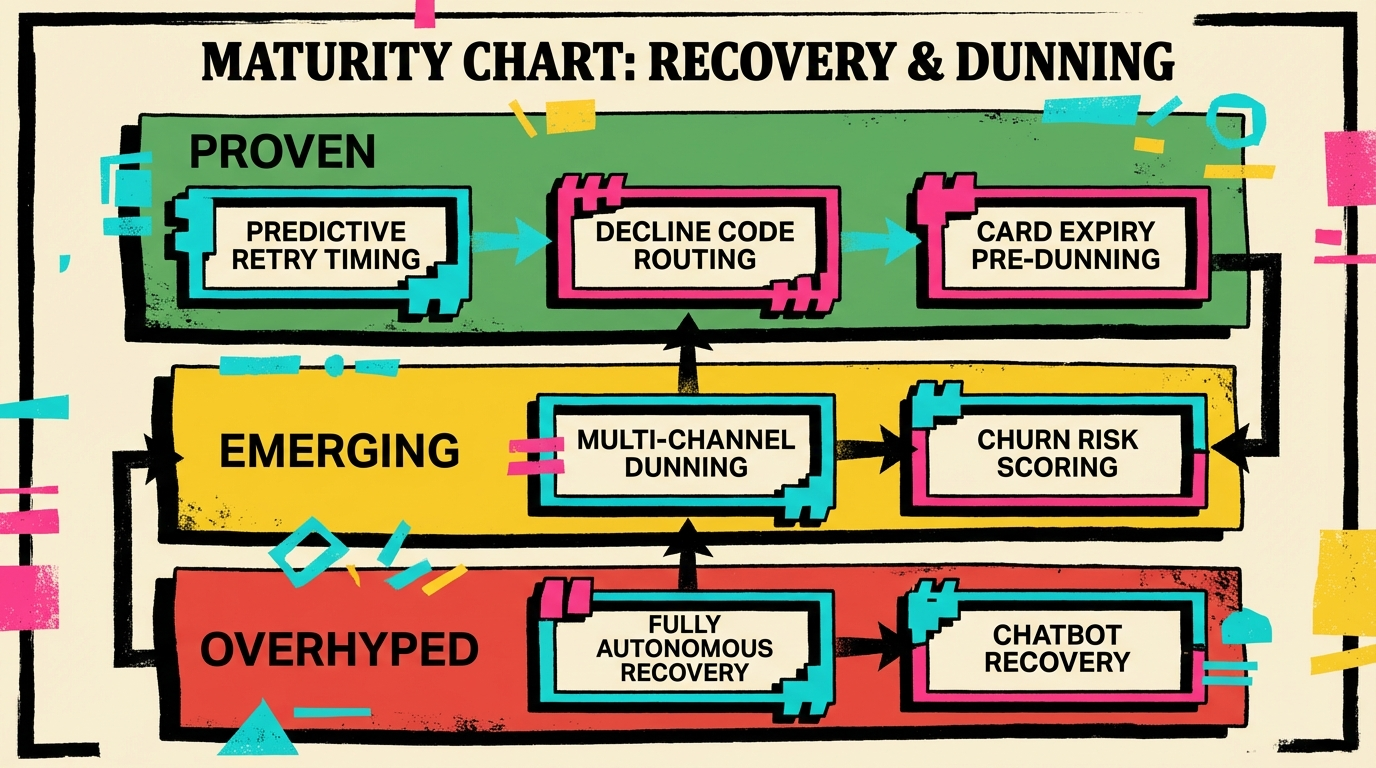
The honest truth: AI payment recovery in 2026 is powerful but incremental. It's not replacing your recovery infrastructure. It's making each component 15-30% more effective. Across your entire subscriber base, that compounds into significant revenue.
The Build vs. Buy Decision
If you're considering AI payment recovery, you have three paths:
1. Rely on Stripe's built-in intelligence. Smart Retries and the Revenue Recovery suite handle the basics. If you're under $50K MRR and have standard payment patterns, this might be sufficient.
2. Add a specialized recovery layer. Tools like Butter, Churnkey, or Gravy add AI-optimized retries and dunning on top of Stripe. These make sense when your involuntary churn rate exceeds 3-4% and the potential recovery revenue justifies the cost.
3. Build custom. If you have unique payment patterns (annual billing, usage-based pricing, multi-currency), you might need custom retry logic. This is expensive to build and maintain, but gives you full control.
For most SaaS companies between $10K and $500K MRR, the sweet spot is option 1 + good dunning practices + regular auditing of your payment health. You don't need a $500/month AI tool when the basics aren't optimized.
Getting Started: A Practical Roadmap
If you want to start leveraging AI for payment recovery without overcomplicating things:
Week 1: Audit. Understand your current involuntary churn rate, top decline codes, and recovery rate. A free churn audit can surface these numbers in minutes.
Week 2: Fix the basics. Enable Stripe Smart Retries if you haven't. Set up basic dunning emails. Make sure your card update flow works smoothly on mobile.
Week 3: Instrument. Add tracking for recovery metrics: retry success rate, dunning conversion rate, time to recovery. You need this data before any AI layer can help.
Week 4: Optimize. Start with the highest-impact, lowest-effort change: send-time optimization for your dunning emails. Even a simple A/B test of morning vs. evening sends can move the needle.
Month 2+: Evaluate whether a specialized recovery tool makes financial sense given your involuntary churn rate and average revenue per account.
The Bottom Line
AI payment recovery is real, and it's making a measurable difference for subscription businesses. But it's not a silver bullet. The companies seeing the best results are the ones that:
- Understand their baseline metrics first
- Fix basic retry and dunning infrastructure before adding AI
- Use AI for specific, high-impact optimizations (timing, routing, personalization)
- Maintain human oversight for high-value accounts and edge cases
- Measure recovery holistically, not just retry success
The future of payment recovery isn't fully autonomous AI. It's intelligent systems that handle the routine cases perfectly, surface the edge cases that need attention, and continuously learn from outcomes. The subscription businesses that embrace this approach will retain more revenue, reduce involuntary churn, and build more predictable recurring revenue.
Want to see where your failed payments stand today? Run a free churn audit and get a clear picture of what's recoverable in your Stripe account.
Related Posts

How to Analyze Your Payment Recovery Funnel

7 Failed Payment Segments Every Stripe Team Should Track
9 Strategies to Stop Losing Customers to Payment Failures
How healthy is your Stripe account?
Get a free churn health report. Find pending cancellations, failed payments, and expiring cards putting your MRR at risk.
Run Free Audit