Immediate vs Gradual Dunning: Which Preserves More Customers

Every SaaS founder running subscriptions on Stripe eventually faces the same question: when a payment fails, should you go hard and fast with recovery efforts, or ease into it gradually? The answer shapes not just how much revenue you recover, but how many customers stick around after the dust settles.
The dunning timing strategy you choose affects everything from your recovery rate to your brand perception to your long-term retention numbers. Get it wrong, and you either scare off customers who would have paid eventually, or wait so long that they forget they even had an account.
This post breaks down both approaches with real numbers, practical frameworks, and a clear decision model so you can pick the right strategy for your business.
What "Immediate" and "Gradual" Dunning Actually Mean
Before comparing, let's define terms clearly.
Immediate dunning means contacting the customer right away (within 0-24 hours) after a payment fails. The first email goes out the same day. Retry attempts happen within hours. The tone is direct: "Your payment failed. Update your card now." Grace periods are short (3-7 days), and account restrictions kick in quickly.
Gradual dunning spaces out communications over a longer window (typically 14-28 days). The first email might not mention the word "failed" at all. Retries are spread across different days and times. The tone escalates slowly from gentle reminder to urgent notice. Grace periods are generous, and account access stays intact longer.
Most SaaS companies land somewhere on this spectrum rather than at the extremes. But understanding where you sit, and whether you should shift, matters more than most founders realize.
The Numbers: Recovery Rates by Approach
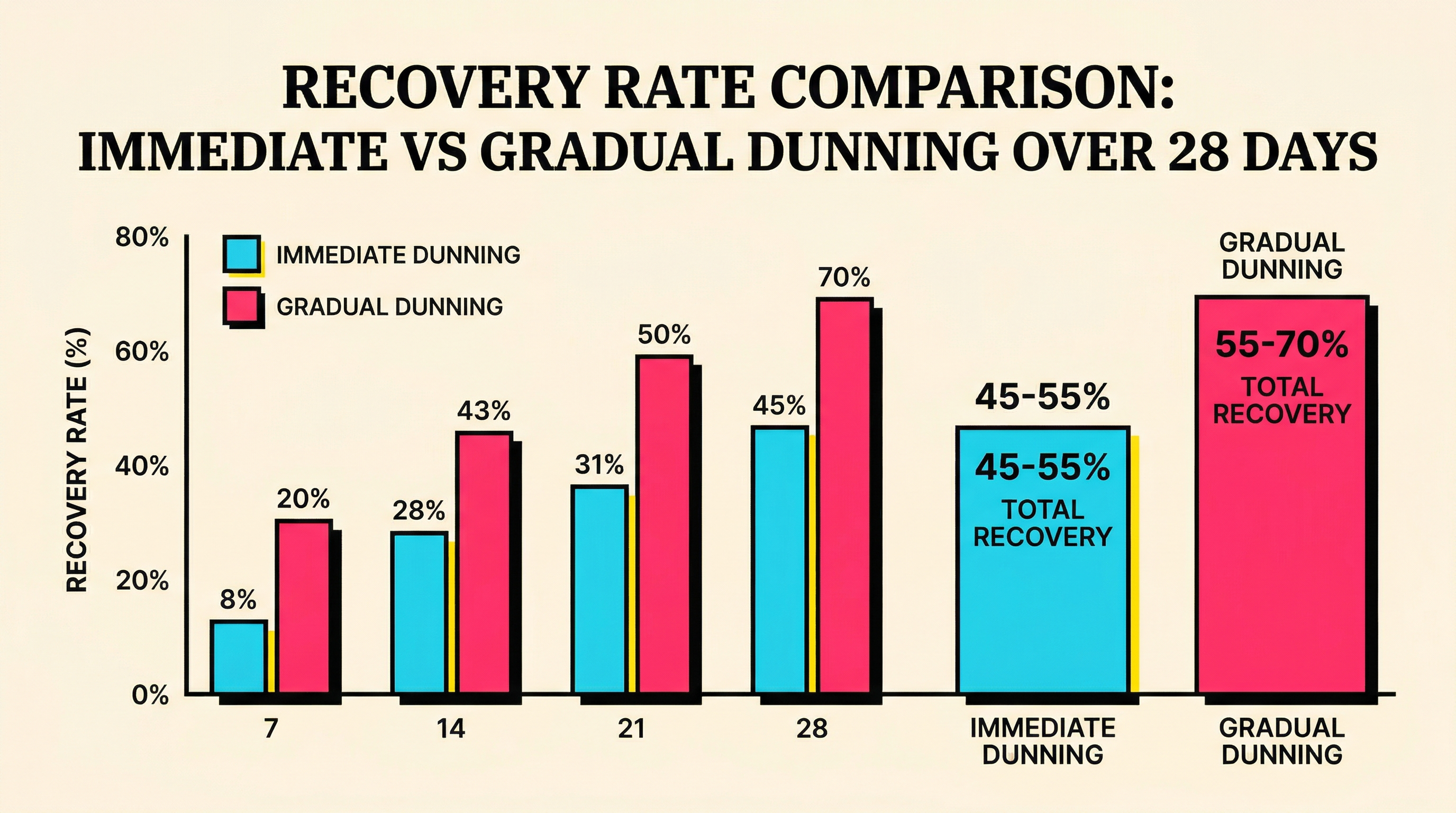
Let's look at what the data says about each approach.
Immediate dunning recovery rates:
- First retry within 4 hours: 15-25% recovery on the initial attempt
- Full sequence (3-7 days): 45-55% total recovery
- Customer complaints: Higher (2-3x more support tickets about billing)
- Involuntary churn reduction: Moderate
Gradual dunning recovery rates:
- First retry after 24-48 hours: 20-30% recovery on the initial attempt
- Full sequence (14-28 days): 55-70% total recovery
- Customer complaints: Lower
- Involuntary churn reduction: Higher
The gap in total recovery rates is significant. Gradual dunning typically recovers 10-20% more failed payments over the full cycle. The reason is simple: many payment failures are temporary. Insufficient funds on a Tuesday might clear by Friday. A bank's fraud hold might release in 48 hours. An expired card might get auto-updated by the issuer within a week.
When you retry too quickly, you burn through your retry budget on the same temporary problem. When you space retries out, each attempt hits a different window, which increases the odds that the underlying issue has resolved itself.
Why Immediate Dunning Loses Customers
The biggest risk with aggressive dunning timing isn't lower recovery rates. It's the customers you lose who would have paid.
Here's the scenario: A customer's payment fails on Monday because their bank flagged the charge. Your system fires off an email within the hour saying "Your payment failed. Update your payment method to continue using [Product]." The customer sees this as aggressive. They think: "I've been paying you for 18 months and one hiccup and you're threatening to cut me off?"
That emotional response matters. Research on subscription churn prevention consistently shows that customer perception of how billing issues are handled directly impacts voluntary churn. A customer who feels punished for a payment failure they didn't cause is more likely to cancel deliberately on the next renewal, even if the immediate issue gets resolved.
The numbers bear this out. SaaS companies using aggressive immediate dunning see 15-25% higher voluntary churn in the 90 days following a payment failure event compared to those using gradual approaches. The payment gets recovered, but the customer relationship takes damage.
Where Immediate Dunning Wins
That said, immediate dunning has legitimate advantages in specific scenarios:
1. Low-ARPU, high-volume businesses. If your average customer pays $9/month and you have 50,000 subscribers, the math changes. Individual customer relationships matter less than aggregate recovery speed. Every day a payment sits unresolved costs you more in operational overhead than the relationship risk.
2. Free trial to paid conversions. When someone's first payment fails right after converting from a free trial, speed matters. These customers have the weakest commitment. Wait too long and they've already moved on to a competitor. Getting a card update within 24 hours dramatically outperforms waiting a week.
3. High-fraud-risk verticals. Some industries see payment failures that correlate with fraud or abuse. Digital goods, gaming, and certain marketplace models benefit from quick action because a portion of "failed payments" are actually customers who never intended to pay.
4. Prepaid/debit card heavy customer bases. Prepaid cards don't get auto-updated by issuers. If your customers primarily use prepaid or debit cards, waiting for automatic card updates is pointless. Direct, fast communication to prompt manual updates is the better play.
The Gradual Dunning Playbook
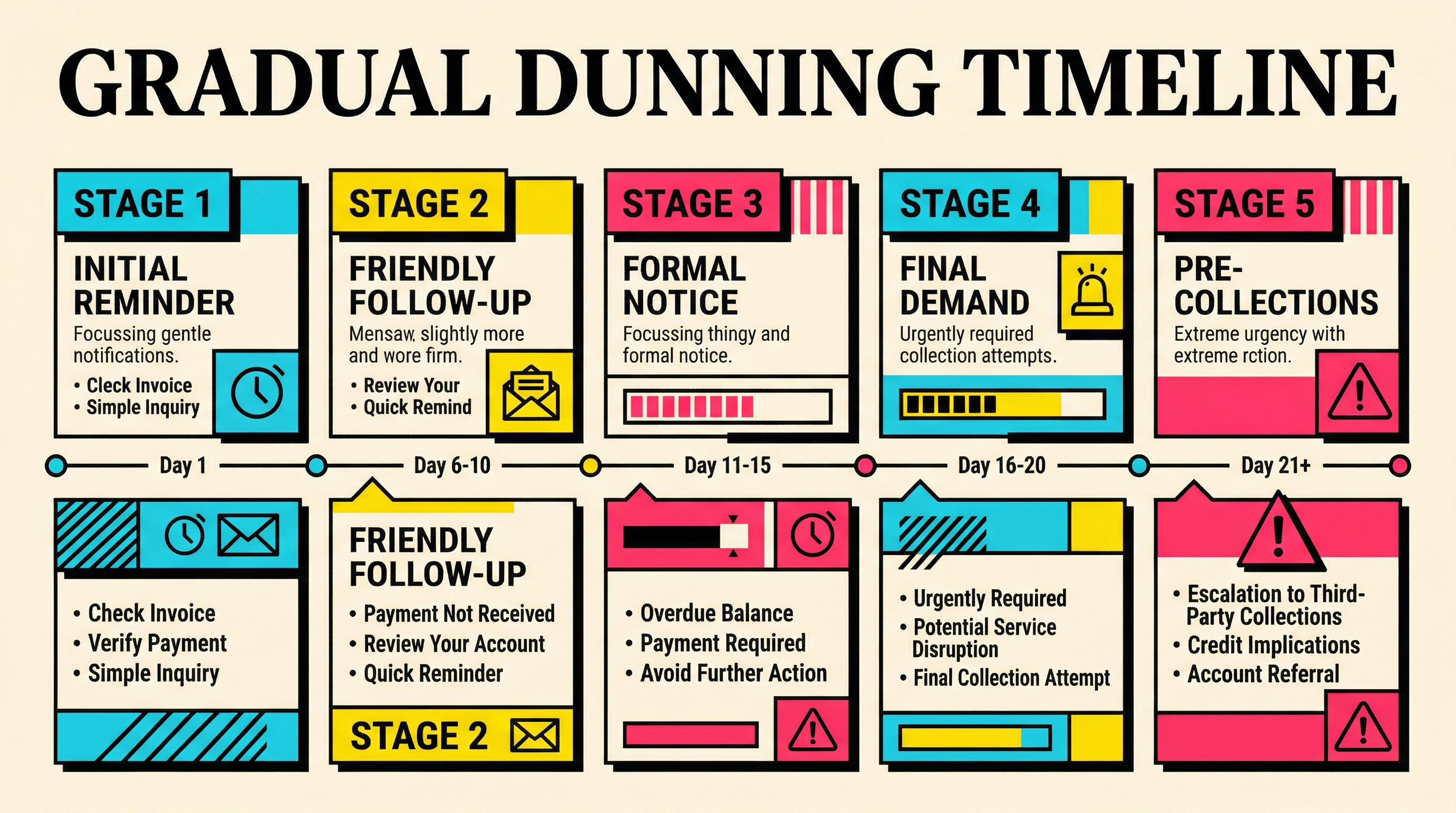
A well-structured gradual dunning sequence looks something like this:
Day 0 (Payment fails):
- Automatic retry via Stripe Smart Retries
- No customer communication yet
Day 1:
- Soft email: "Heads up, we had trouble processing your payment"
- Tone: informational, not urgent
- Include one-click payment update link
Day 3:
- Second retry attempt (different time of day)
- No additional email unless retry fails again
Day 5:
- Second email: "Quick reminder about your payment"
- Tone: friendly, mention their account is still fully active
- Include payment update link and support contact
Day 7:
- Third retry attempt
Day 10:
- Third email: "Action needed on your account"
- Tone: slightly more urgent, mention specific date when access will be affected
- Highlight what they'll lose (specific features, data, integrations)
Day 14:
- Fourth retry attempt
- Final email: "Last chance to keep your account active"
- Tone: direct and clear about consequences
- Mention the exact date of account restriction
Day 21:
- Account downgraded to free tier or paused (not deleted)
- "We've paused your account" email with easy reactivation link
This 21-day sequence gives the payment infrastructure time to resolve temporary issues while gradually escalating urgency. The key insight: most recoveries happen in the first 7 days without any customer action at all, just through automatic retries hitting a resolved issue.
Retry Timing: The Hidden Variable
Most discussions about dunning focus on emails, but the retry schedule matters more. Your payment recovery strategy is only as good as your retry timing.
Here's why: roughly 40-50% of failed payments that eventually recover do so through automatic retries alone, with zero customer action. The customer never sees an email, never updates their card. The retry just works because the temporary issue cleared.
Optimal retry timing based on aggregate SaaS data:
- Retry 1: 4-6 hours after initial failure (catches bank processing delays)
- Retry 2: 24-48 hours later (catches next-day balance replenishment)
- Retry 3: 3-5 days later (catches weekly pay cycle deposits)
- Retry 4: 7-10 days later (catches biweekly pay cycles)
- Retry 5: 14+ days later (catches monthly statement cycles)
Each retry targets a different financial cycle. This is where gradual dunning gets its edge: more retries spread across more windows means more chances to catch the customer's account in a good state.
Stripe Smart Retries handles some of this automatically using machine learning. But it's worth understanding the mechanics so you can configure your own retry logic or evaluate whether the default is working for your specific customer base.
The Emotional Escalation Framework
The best gradual dunning sequences don't just space out emails. They escalate emotionally in a deliberate pattern:
Stage 1: Helpful (Day 0-3)
- "We noticed an issue with your payment"
- Framing: we're on your side, helping you fix a problem
- No mention of consequences
Stage 2: Reminder (Day 4-7)
- "Quick reminder about your billing"
- Framing: just making sure you saw the first note
- Brief mention that service continues uninterrupted
Stage 3: Urgency (Day 8-14)
- "Action needed to keep your account active"
- Framing: specific deadline, specific consequences
- Loss aversion: highlight what they'll lose access to
Stage 4: Final notice (Day 15-21)
- "Your account will be paused on [date]"
- Framing: last chance, clear consequences, easy fix
- Include phone/chat support option for customers who need help
This progression respects the customer relationship while still driving action. The critical principle: never threaten before you've been helpful first.
Comparing Both Approaches: Decision Matrix
Not every SaaS needs the same approach. Here's a framework for choosing:
Choose immediate dunning if:
- ARPU is under $20/month
- Customer base skews toward prepaid/debit cards
- Free-trial-to-paid conversion failures are your biggest loss
- You're in a high-fraud vertical
- Customer lifetime is typically short (under 6 months)
Choose gradual dunning if:
- ARPU is over $50/month
- Enterprise or prosumer customer base
- Long customer lifetimes (12+ months average)
- Brand reputation matters for referrals and word-of-mouth
- You already have strong voluntary retention
Choose a hybrid approach if:
- Mixed customer base with varying ARPU
- You can segment by customer value or tenure
- You have the engineering resources to build dynamic dunning
The hybrid approach is where most mature SaaS companies end up. Segment your customers and run different dunning sequences for different groups. A $9/month customer who signed up last week gets a different flow than a $499/month customer who's been paying for three years.
Building a Hybrid Dunning System
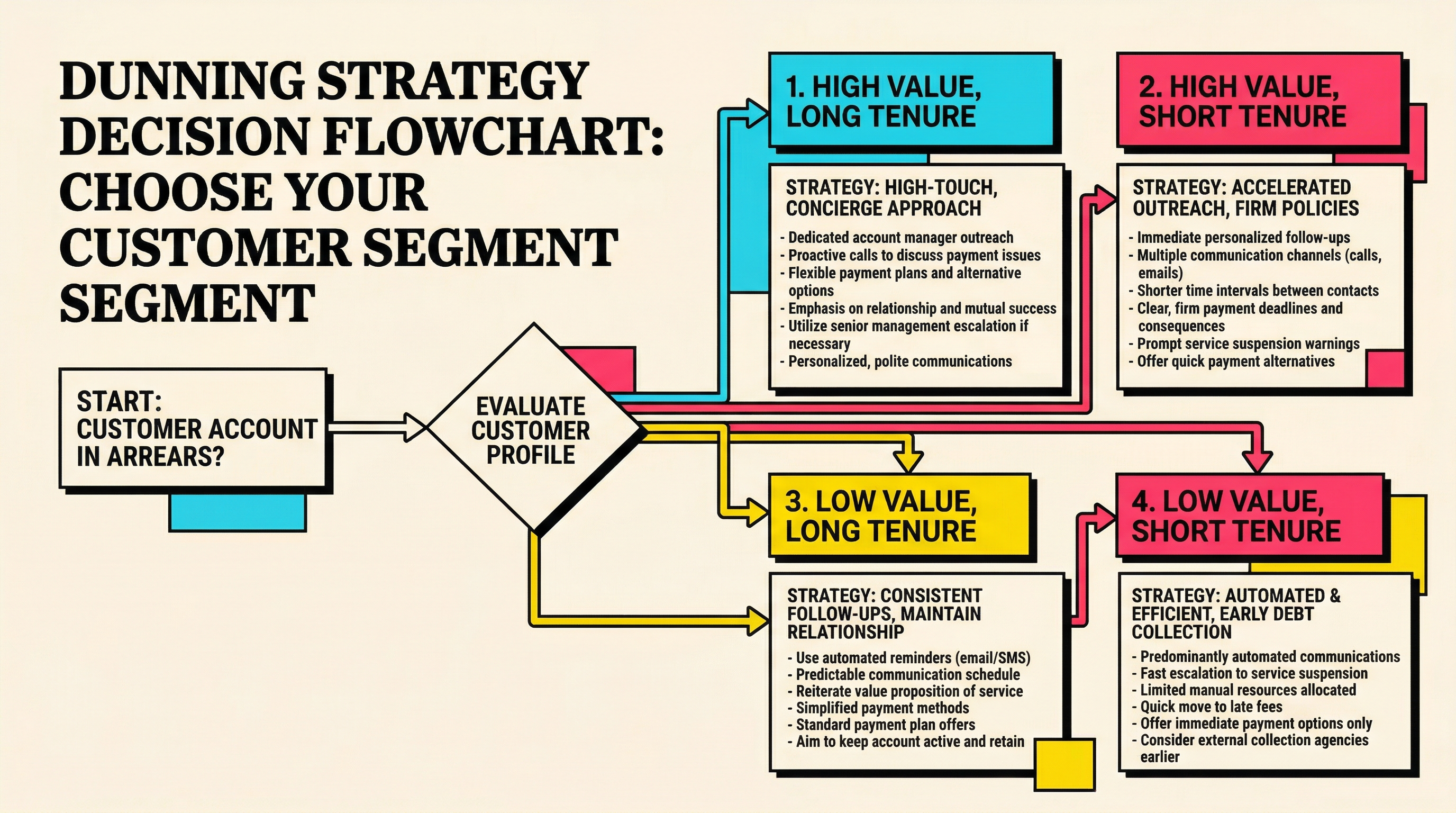
A practical hybrid system segments customers on two axes: value (ARPU or LTV) and tenure (how long they've been a customer).
High value, long tenure → Maximum patience
- 28-day gradual sequence
- Personal outreach from account manager at day 7
- Never restrict access before day 21
- Recovery target: 75%+
High value, short tenure → Attentive but measured
- 14-day gradual sequence
- Personal email (not automated) at day 5
- Feature restriction at day 14, full pause at day 21
- Recovery target: 65%+
Low value, long tenure → Standard gradual
- 14-day sequence
- All automated
- Feature restriction at day 10, pause at day 14
- Recovery target: 55%+
Low value, short tenure → Faster cycle
- 7-day sequence
- Direct, clear communication
- Restriction at day 5, pause at day 7
- Recovery target: 40%+
This segmentation acknowledges a basic truth: not all customer relationships are equal, and your dunning should reflect that.
Implementation Tips for Stripe Users
If you're running subscriptions on Stripe, here's how to put this into practice:
1. Configure Stripe's built-in retry schedule. Go to Settings → Billing → Subscriptions and failed payments. You can customize retry attempts and timing. Start with the Stripe Smart Retries option, which uses ML to optimize retry timing.
2. Use Stripe webhooks for custom logic. Listen for `invoice.payment_failed` events to trigger your own dunning emails. The webhook payload includes the failure reason, which you can use to customize messaging. A card-declined failure needs different copy than an insufficient funds decline.
3. Set up customer portal links. Stripe's customer portal lets customers update their payment method with one click. Include this link in every dunning email. Remove friction from the recovery path.
4. Use subscription statuses wisely. Stripe lets you configure what happens to subscriptions during the retry period: keep them active, mark as past due, or cancel. For gradual dunning, keep subscriptions active during the grace period. Only move to past due after your grace window expires.
5. Track recovery metrics. Measure: recovery rate by day, recovery rate by email touch, recovery rate by decline code, and post-recovery voluntary churn rate (the hidden metric most companies miss).
Measuring What Matters
Recovery rate alone doesn't tell the full story. Track these metrics to evaluate your dunning strategy:
Primary metrics:
- Overall recovery rate (% of failed payments eventually collected)
- Time to recovery (median days from failure to successful payment)
- Recovery rate by attempt number (which retry or email drives the most recoveries)
Secondary metrics:
- Post-recovery churn rate (do recovered customers cancel within 90 days?)
- Support ticket volume during dunning (are you generating complaints?)
- Customer satisfaction score changes after payment failure events
- Revenue recovered per dollar spent on dunning infrastructure
The post-recovery churn rate is the metric that separates good dunning from great dunning. If you're recovering 70% of failed payments but 30% of those recovered customers cancel within 90 days, your effective recovery rate is closer to 49%. A gentler approach that recovers 60% but retains 90% of them gives you an effective rate of 54%.
Common Mistakes in Both Approaches
Immediate dunning mistakes:
- Sending the first email before the first automatic retry even happens
- Using threatening language in the very first communication
- Restricting account access within 24 hours of failure
- Not differentiating between first-time and repeat failures
Gradual dunning mistakes:
- Waiting so long that customers forget about your product
- Not escalating urgency at all (every email sounds the same)
- Running a 30+ day sequence when your product has low switching costs
- Not including a clear, one-click payment update link in every email
Mistakes both approaches make:
- Treating all decline codes the same (a fraud decline and an insufficient funds decline need completely different handling)
- Not A/B testing dunning sequences
- Ignoring the retry schedule and focusing only on emails
- Failing to track post-recovery retention
The Bottom Line
For most SaaS businesses with moderate-to-high ARPU and customers who stick around longer than a few months, gradual dunning preserves more customers and recovers more revenue over time. The data consistently shows that patience pays in subscription billing.
But "gradual" doesn't mean "passive." The best dunning sequences are carefully designed, well-timed, and emotionally calibrated. They give temporary issues time to resolve while progressively creating urgency for issues that require customer action.
If you're not sure where your current dunning stands, start by checking the data. How many failed payments are you recovering? How long does it take? And critically, what happens to those customers afterward?
Want to see how your Stripe account's payment health compares? Run a free churn audit to get a breakdown of your failed payments, decline patterns, and recovery opportunities.
Related Posts
Stripe Insufficient Funds Recovery: A Playbook for SaaS Teams
Stripe Do Not Honor Recovery: What SaaS Teams Should Do Next

7 Failed Payment Segments Every Stripe Team Should Track
How healthy is your Stripe account?
Get a free churn health report. Find pending cancellations, failed payments, and expiring cards putting your MRR at risk.
Run Free Audit