The Subscription Economy's Dirty Secret: Preventable Churn

The subscription economy is worth over $275 billion in 2026. SaaS companies pour millions into acquisition, spend fortunes on onboarding flows, and obsess over product-market fit. But there's an uncomfortable truth most founders never confront: a significant chunk of their churn is entirely preventable.
Not “reduce with better features” preventable. Not “fix with a better cancellation flow” preventable. Literally preventable. As in, customers who wanted to keep paying you were silently removed from your revenue because their payment failed and nobody did anything about it.
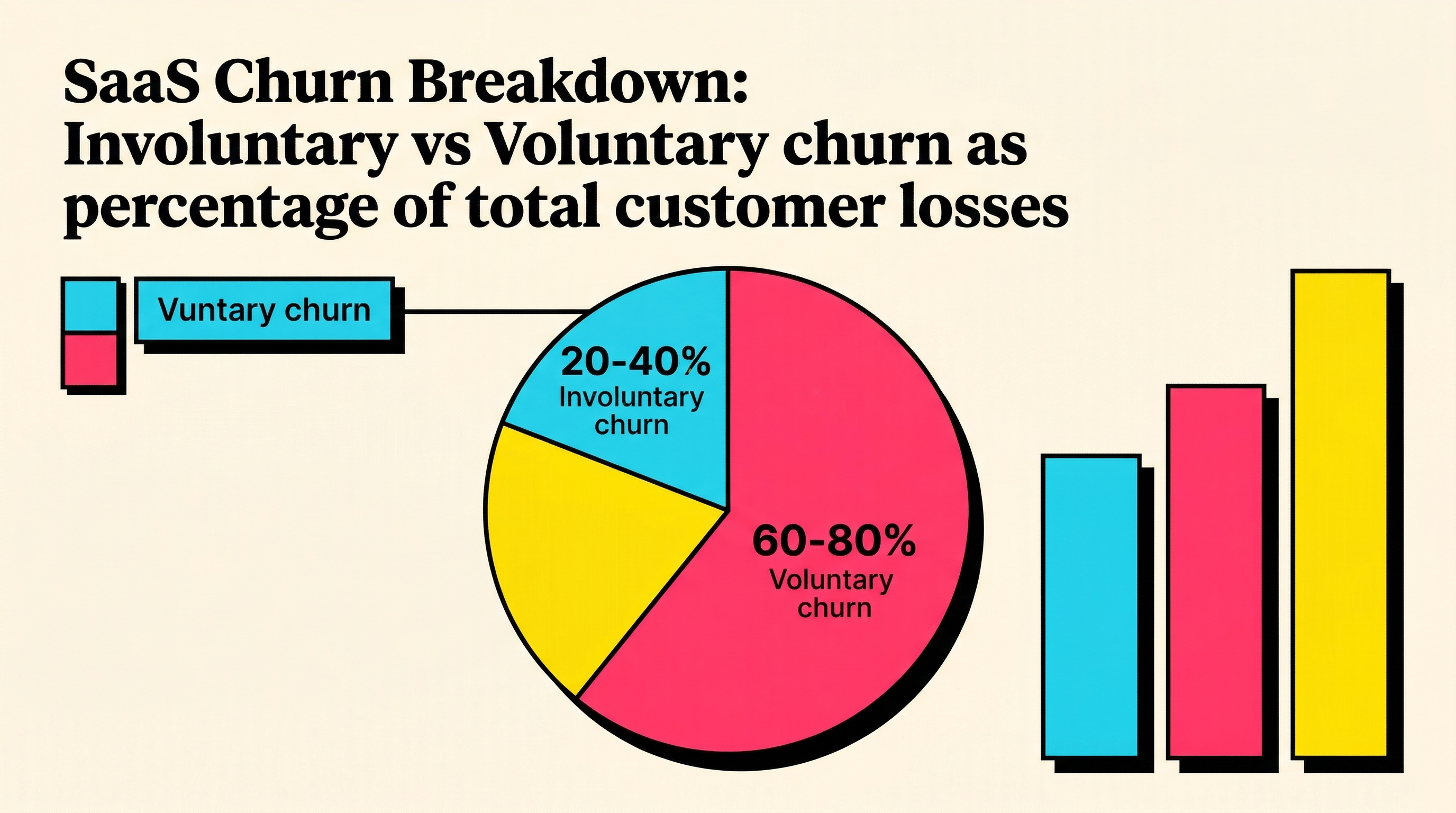
This is involuntary churn. And for most SaaS businesses, it accounts for 20-40% of all churn. That’s revenue walking out the back door while you’re busy trying to drag new customers in through the front.
The Scale of the Problem
Let’s put some numbers on this. The average SaaS company running on Stripe sees a payment failure rate between 5% and 10% of all renewal attempts. For companies billing monthly, that means every single month, somewhere between 1 in 20 and 1 in 10 of your customers hit a payment wall.
Not all of those fail permanently. Stripe’s automatic retries recover some. But here’s where it gets ugly: the average recovery rate without any intervention beyond basic retries sits around 50-60%. That means 40-50% of failed payments become permanent losses.
Do the math on a $50K MRR business with 1,000 customers at $50/month. If 7% of payments fail monthly (70 customers) and you recover 55% automatically (38 customers), you’re losing 32 customers every single month to preventable churn. That’s $1,600/month, or $19,200/year, just evaporating.
And that’s a conservative estimate.
Why Payment Failures Happen (And Why They're Not Your Customer's Fault)
Most founders assume payment failures mean the customer can’t afford the service. That’s almost never the case. The reality is far more mundane.
Expired Cards
Cards expire. It’s that simple. The average credit card has a 3-year lifespan, which means roughly 2.8% of your customer base has a card expiring every single month. If your customers don’t proactively update their payment details (spoiler: they won’t), those renewals fail.
Banks are getting better at issuing Account Updater notifications that automatically push new card details to merchants, but coverage is inconsistent. Visa and Mastercard support it widely in the US, but international coverage drops significantly. If you have a global customer base, expired cards are a bigger problem than you think.
Insufficient Funds
This sounds like a customer problem, but it’s usually a timing problem. Many businesses and individuals have cash flow cycles. A charge that hits on the 28th might fail because the customer’s payroll deposits on the 1st. The same charge three days later would succeed without issue.
Bank-Side Declines
Banks decline transactions for dozens of reasons that have nothing to do with your customer’s ability or willingness to pay. Fraud detection algorithms flag unusual patterns. Do-not-honor codes get thrown for opaque internal reasons. Cross-border transactions get blocked by default in some markets.
The common thread: your customer has no idea their payment failed. They didn’t choose to stop paying. They might not even know there’s a problem until they try to log in and find their account suspended.
Network and Processor Issues
Sometimes the payment infrastructure itself hiccups. Stripe connects to card networks through acquiring banks, and any link in that chain can have transient failures. A payment that fails at 2:00 AM might succeed perfectly at 2:15 AM. These are entirely recoverable with proper retry logic, but if you’re relying on a single attempt, you’re leaving money on the table.
The Compound Cost of Doing Nothing
Here’s what most SaaS founders miss about subscription churn prevention: the cost of involuntary churn compounds in ways that voluntary churn doesn’t.
When a customer actively cancels, you had a chance to intervene. You could have offered a discount, asked for feedback, addressed their concerns. The loss, while painful, was visible.
Involuntary churn is invisible. There’s no cancellation survey to fill out, no support ticket to flag the issue, no exit interview to learn from. The customer is simply gone, often without even realizing it.
The Reactivation Problem
Here’s the kicker: reactivating a churned customer costs 5-7x more than retaining them in the first place. Once someone’s subscription lapses due to a failed payment, getting them back requires:
- Noticing they’re gone (which can take weeks if your monitoring is poor)
- Reaching out to explain what happened
- Getting them to update their payment method
- Hoping they haven’t found an alternative in the meantime
Every day between the payment failure and reactivation is a day your customer might discover a competitor, forget about your product, or simply not care enough to re-enter their credit card details.
The LTV Destruction
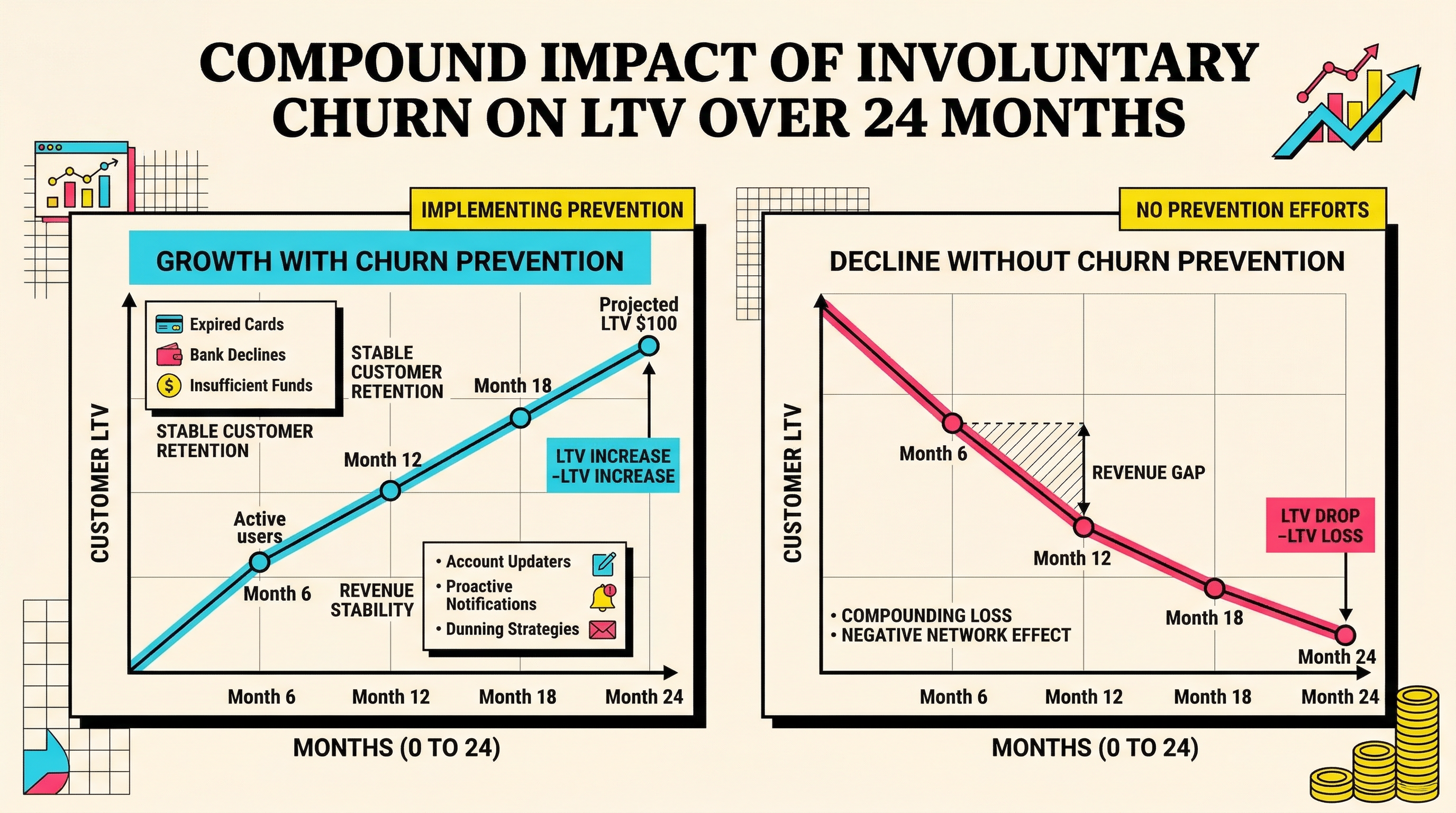
A customer who was on track for a 24-month lifetime gets cut short at month 8 because their card expired. That’s not a billing issue. That’s a 67% reduction in lifetime value from a single preventable event.
Across your entire customer base, involuntary churn can reduce average LTV by 15-25%. For a business optimizing acquisition costs against LTV, that’s the difference between a healthy unit economics model and one that’s underwater.
What Effective Subscription Churn Prevention Actually Looks Like
Preventing involuntary churn isn’t complicated. It’s not a hard engineering problem. It’s an awareness and prioritization problem. Here’s what actually works.
Pre-Dunning: Stop Failures Before They Happen
The most cost-effective approach to subscription churn prevention is stopping payment failures before they occur. This means:
Card expiry monitoring. You know when every card in your system expires. It’s right there in the data. Send a friendly email 30 days before expiry asking customers to update their payment method. Send another at 14 days. And another at 7 days. This single tactic can prevent 30-40% of card expiry related churn.
Payment method health checks. Some payment processors let you run zero-dollar authorizations to verify a card is still valid without actually charging it. This lets you proactively identify cards that will fail before the actual billing date.
Account Updater integration. If you’re on Stripe, you already have access to Visa Account Updater and Mastercard Automatic Billing Updater. These services automatically push new card details when a customer’s card is replaced. Make sure this is enabled and working correctly in your Stripe settings.
Smart Retry Logic
When a payment does fail, how and when you retry matters enormously. The default retry schedule most companies use (retry immediately, then again in a few days) is suboptimal.
Time-of-day optimization. Payment success rates vary by time of day. For consumer SaaS, retries at 10:00 AM local time tend to outperform retries at 3:00 AM. For B2B, mid-week retries beat weekend retries. Understanding your customer demographics helps you time retries for maximum success.
Decline code routing. Not all failures are the same. An insufficient funds decline should be retried differently than an expired card decline. Insufficient funds? Retry in 3-5 days when the customer might have been paid. Expired card? Don’t retry at all. Instead, contact the customer to update their card.
Exponential backoff with jitter. If your first retry fails, don’t hammer the payment processor with attempts. Space them out: 2 days, then 5 days, then 10 days. Add some randomness (jitter) to avoid thundering herd problems when multiple customers’ retries align.
Amount adjustments. For insufficient funds declines on invoices with multiple line items, some recovery systems try charging a smaller amount first (like just the base subscription without add-ons) to at least recover partial revenue.
Dunning Communication
Dunning emails, the messages you send when a payment fails, are your last line of defense. Most companies either don’t send them or send terrible ones.
What good dunning looks like:
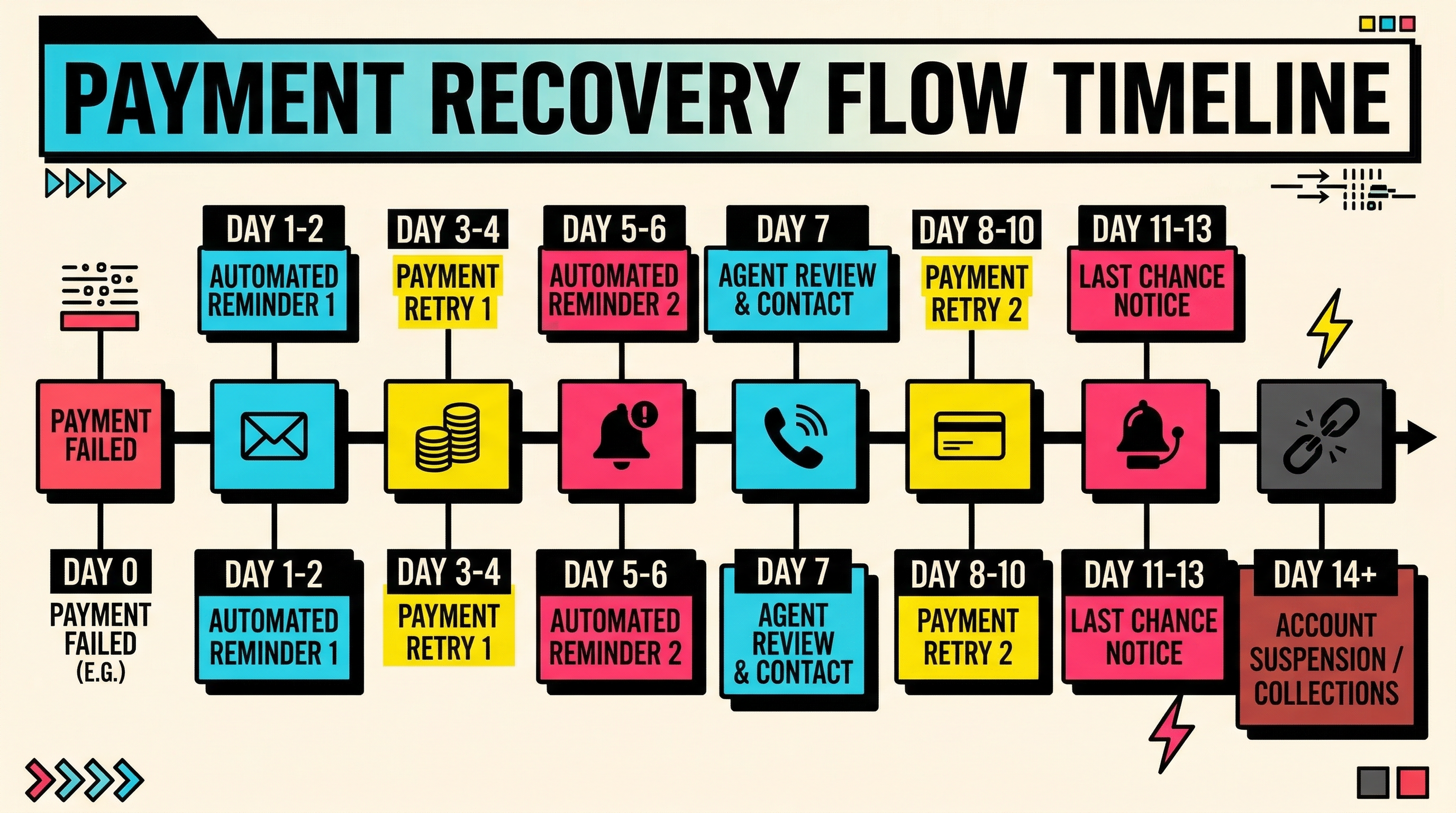
Email 1 (Day 0, payment fails): Friendly heads-up. “Hey, your payment didn’t go through. This happens all the time. Here’s a one-click link to update your card.” No drama. No threatening language.
Email 2 (Day 3): Slightly more urgent. Mention what they’ll lose access to. Include a direct link to the payment update page. Keep it human.
Email 3 (Day 7): Clear stakes. “Your account will be paused in 3 days if we can’t process payment.” Still respectful, but clear about consequences.
Email 4 (Day 10): Final notice. “We’re going to have to pause your account tomorrow. We’d hate to see you go.” One last payment link.
The key principles: be direct, be human, make it easy to fix, and escalate urgency gradually.
Channel diversity. Email open rates for dunning messages average 20-25%. That means 75-80% of your failed-payment customers never even see your recovery attempt. Smart subscription churn prevention uses multiple channels: in-app banners, SMS, push notifications, even direct outreach for high-value accounts.
Grace Periods
Don’t cancel a subscription the moment a payment fails. Give your customers a grace period, typically 7-14 days. During this window:
- The subscription stays active (the customer keeps getting value)
- Retry attempts continue in the background
- Dunning emails go out on schedule
- In-app notifications remind them to update payment
This grace period is critical because it keeps the customer engaged with your product while you work on recovering the payment. A customer who’s been locked out for a week has far less motivation to update their card than one who’s still actively using your service.
The Numbers: What Recovery Rates Are Actually Achievable
Most SaaS companies without any recovery process beyond Stripe’s default retries recover about 50-55% of failed payments. With a solid recovery stack, that number jumps to 70-85%.
Let’s see what that means for different business sizes:
$50K MRR, 7% failure rate:
- Without recovery: lose ~32 customers/month ($19.2K/year)
- With recovery (80% rate): lose ~14 customers/month ($8.4K/year)
- Annual savings: $10,800
$200K MRR, 7% failure rate:
- Without recovery: lose ~128 customers/month ($76.8K/year)
- With recovery (80% rate): lose ~56 customers/month ($33.6K/year)
- Annual savings: $43,200
$1M MRR, 7% failure rate:
- Without recovery: lose ~640 customers/month ($384K/year)
- With recovery (80% rate): lose ~280 customers/month ($168K/year)
- Annual savings: $216,000
These aren’t hypothetical numbers. They’re straightforward math based on industry payment recovery benchmarks. The revenue is sitting there waiting to be recovered.
Why Most Founders Ignore This
If the math is so clear, why do most SaaS founders neglect subscription churn prevention?
“It’s not that much revenue”
It never looks like much on any single day. Losing 1-2 customers per day to failed payments feels like noise. But across a year, it’s 365-730 customers. At $50 ARPU, that’s $18,250 to $36,500. For an early-stage startup, that might be 6-12 months of additional runway.
“Stripe handles retries”
Stripe does retry failed payments automatically. But Stripe’s default retry logic is generic. It doesn’t know your customers’ payment patterns, doesn’t send dunning emails, doesn’t adjust retry timing based on decline codes, and doesn’t alert you when high-value accounts are at risk.
Stripe Smart Retries are better than nothing, but they’re a baseline, not a solution.
“We’ll build it later”
This is the most common response. Payment recovery always feels like a “nice to have” compared to building new features or fixing bugs. But here’s the thing: every month you delay is another month of preventable revenue loss. If you’re losing $1,500/month to involuntary churn and you wait 6 months to address it, that’s $9,000 gone permanently.
You don’t need to build a custom system from scratch. The ecosystem has tools and services that can get you from zero to effective recovery in days, not months.
“Our churn is all voluntary”
Unless you’ve specifically segmented your churn data by cause, you don’t actually know this. Most analytics dashboards show churn as a single number without distinguishing between voluntary (customer chose to leave) and involuntary (payment failed). You might be surprised how much of your “churn problem” is actually a “billing problem.”
The Subscription Economy’s Real Competitive Advantage
Here’s the dirty secret flipped into an opportunity: if most of your competitors are ignoring involuntary churn, and you’re not, you have a structural advantage.
Two companies with identical acquisition funnels and identical products will have dramatically different growth trajectories if one recovers 80% of failed payments and the other recovers 50%. Over time, the company with better retention compounds faster, has better unit economics, and can afford to spend more on acquisition.
This is especially true at scale. A 1% improvement in monthly retention rate translates to a 12.7% improvement in annual retention. For a $1M ARR business, that’s $127K in additional retained revenue per year from a single percentage point.
Subscription churn prevention isn’t a billing ops task. It’s a growth strategy. The companies that understand this are the ones that win in the subscription economy.
Getting Started: The Minimum Viable Recovery Stack
You don’t need to boil the ocean. Here’s the minimum setup that will capture most of the recoverable revenue:
- Monitor your decline codes. Know which failures are happening and why. Stripe’s dashboard shows this, but consider a dedicated decline code analysis to understand patterns.
- Set up card expiry notifications. This is the single highest-ROI action. Email customers 30, 14, and 7 days before their card expires. Automate it once and forget about it.
- Configure smart retries. If you’re on Stripe, enable Smart Retries at minimum. If you want better results, set up decline-code-specific retry schedules.
- Create a dunning email sequence. Four emails over 10-14 days, escalating urgency. Include a direct link to update payment. Test different subject lines.
- Add an in-app payment banner. When a customer’s payment has failed, show a persistent but non-blocking banner in your app. This catches customers who don’t read email.
- Set a grace period. Don’t cancel immediately. Give customers 7-14 days to fix their payment while keeping their account active.
- Track and measure. Segment your churn by cause. Track recovery rates over time. Know which dunning emails perform best.
This stack takes a week to implement and will start recovering revenue immediately.
The Bottom Line
The subscription economy rewards retention above almost everything else. Customer acquisition costs keep rising, competition keeps intensifying, and the companies that thrive are the ones that keep the customers they’ve already won.
Involuntary churn is the lowest-hanging fruit in the entire retention stack. These are customers who want to pay you. They chose your product. They’re getting value from it. The only thing standing between you and their continued revenue is a billing failure that’s entirely within your power to fix.
Every month you ignore this problem is a month of revenue you’ll never get back. The customers who churned involuntarily six months ago have moved on. But the ones who will fail next month? Those you can still save.
If you’re not sure where your Stripe account stands on involuntary churn, run a free churn audit. It takes two minutes and shows you exactly how much recoverable revenue is sitting in your failed payments.
Stop letting preventable churn be your subscription economy’s dirty secret. The fix is simpler than you think.
Related Posts

7 Failed Payment Segments Every Stripe Team Should Track
The Complete Toolkit for Managing Failed Payments
Stripe Do Not Honor Recovery: What SaaS Teams Should Do Next
How healthy is your Stripe account?
Get a free churn health report. Find pending cancellations, failed payments, and expiring cards putting your MRR at risk.
Run Free Audit