4 Payment Recovery Mistakes That Hurt Retention
Most SaaS founders treat payment recovery as an afterthought. A failed payment hits, they fire off a generic email, retry a few times, and hope for the best. When nothing works, they chalk it up to churn and move on.
The problem? That approach actively pushes recoverable customers out the door. The data is clear: companies that fix their payment recovery mistakes recover 30-50% more failed payments than those running default flows. That gap compounds every single month.
Here are four payment recovery mistakes that silently destroy your retention numbers, and what to do instead.
Mistake 1: Treating Every Failed Payment the Same Way
This is the most common payment recovery mistake, and it costs SaaS businesses the most revenue.
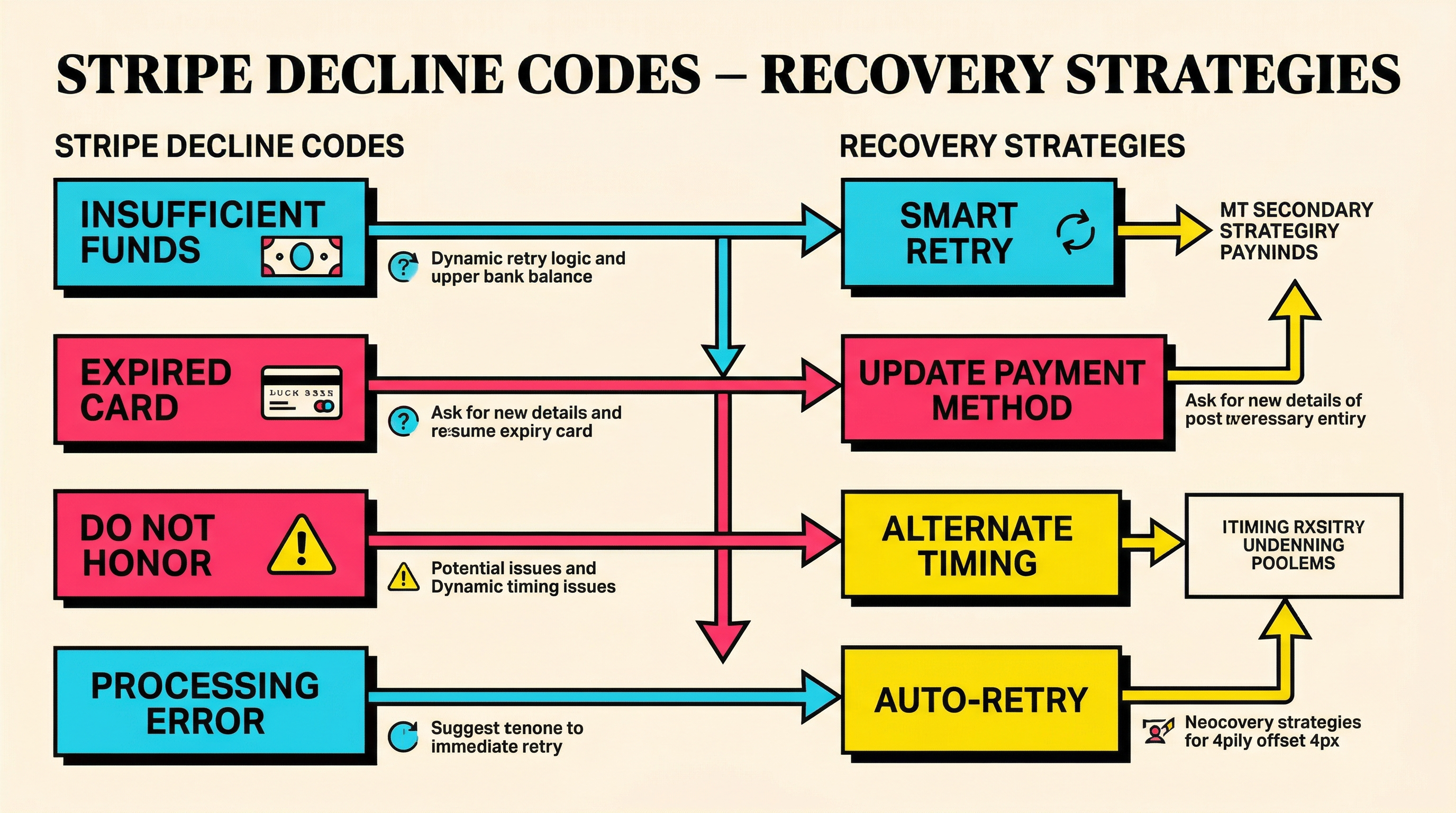
When a payment fails, Stripe returns a decline code that tells you exactly why it failed. "Insufficient funds" is a completely different problem from "expired card," which is a completely different problem from "do not honor." Each one requires a different recovery approach.
But most founders set up a single retry schedule and a single dunning email sequence for all failures. That is like prescribing the same medicine for every illness. Sometimes it works by accident. Usually it does not.
What the decline codes actually tell you
Insufficient funds means the customer wants to pay but cannot right now. Retrying in a few days (especially around common payday dates like the 1st and 15th) has a high success rate. Aggressive dunning emails here feel tone-deaf because the customer already knows there is an issue.
Expired card means the customer's card details are outdated. No amount of retrying will fix this. You need the customer to update their payment method, and you need to make that process as frictionless as possible.
Do not honor is the bank saying no without explaining why. These are harder to recover, but switching to a different retry time or amount (partial payments, if your billing supports it) can sometimes get through.
Processing errors are temporary glitches. A simple retry within 24 hours recovers the vast majority of these without any customer communication needed.
The fix
Segment your failed payments by decline code category and build separate recovery flows for each. At minimum, separate "card needs updating" failures from "retry might work" failures. The former needs a customer action. The latter needs patience and smart timing.
Mistake 2: Sending Dunning Emails That Sound Like Debt Collection
Open your dunning email templates right now. If they read anything like "Your payment has failed. Please update your billing information immediately to avoid service interruption," you have a retention problem disguised as a recovery problem.
That kind of language triggers the same emotional response as a collections notice. Your customer feels accused, pressured, and annoyed. Not exactly the mindset that leads to "let me go fix my payment details right now."
The psychology behind dunning communication matters more than most founders realize. Tone directly impacts whether a customer updates their payment method or decides the interruption is a convenient excuse to cancel.
What actually works
The best dunning emails share three characteristics:
1. They lead with empathy, not urgency. "Looks like your last payment didn't go through" lands differently than "Payment failed." One acknowledges a situation. The other assigns blame.
2. They make the fix dead simple. One button. One link. Straight to the payment update page. Every extra click between the email and the fix is a percentage of customers who give up.
3. They remind customers what they are losing. Not in a threatening way. In a "here's what you've built with us" way. Usage stats, saved data, team members on the account. Make the value concrete.
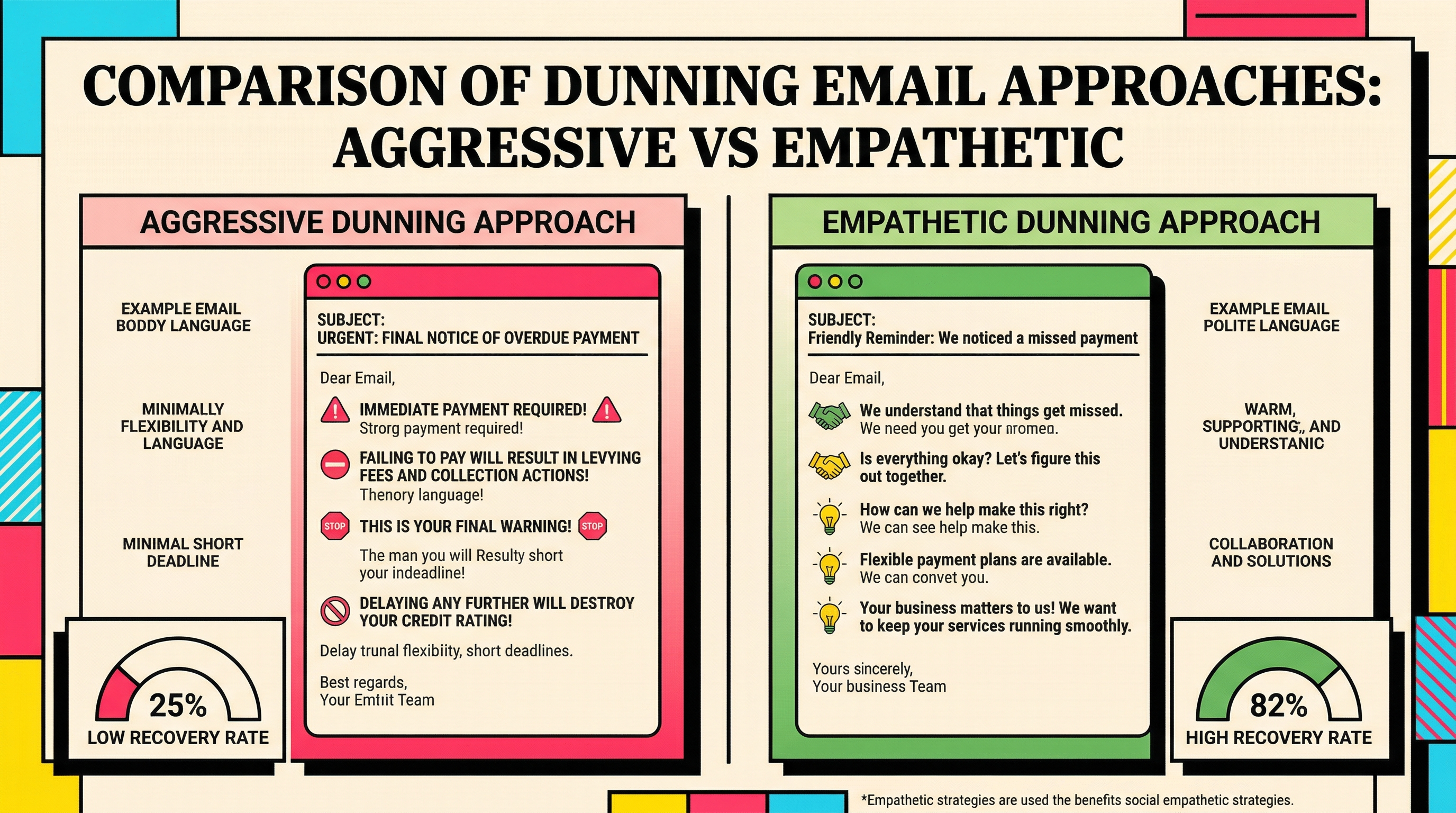
Here is a real pattern that works: First email (day 1) is warm and helpful. Second email (day 3) adds light urgency with a reminder of what is at stake. Third email (day 7) is direct but respectful. If you are struggling with dunning email open rates, start by fixing the subject lines before touching the body copy.
The difference between good and bad dunning is not just recovery rates. It is the relationship you have with the customer after recovery. A customer who felt respected during the process stays longer. A customer who felt threatened starts evaluating alternatives.
Mistake 3: Giving Up After the Default Retry Schedule
Stripe's default retry schedule runs for about 3-4 weeks before marking a subscription as canceled. Most founders treat that as the boundary of their recovery window. Payment failed, retries exhausted, customer gone.
That is leaving money on the table.
The default retry schedule is designed to be broadly acceptable. It is not optimized for your business, your customers, or your billing patterns. And it certainly does not account for the fact that some customers will update their payment method on day 30 if you make it easy enough.
The real recovery window
Industry payment recovery benchmarks show that 10-15% of payments that fail the initial retry sequence can still be recovered with extended outreach. Some of those recoveries happen weeks after the last automated retry.
Why? Because life is messy. The customer got a new card and forgot to update it everywhere. They were traveling and missed the emails. They hit a temporary financial rough patch that resolved itself. The reasons are human, and the recovery timeline should account for that.
What to do instead
Extend your recovery efforts beyond the automated retry window:
Week 1-3: Automated retries plus dunning email sequence. This is your standard flow.
Week 4-6: Switch to a "win-back" approach. Stop retrying (no point burning through attempts on the same failed card). Instead, send a periodic check-in email offering a direct link to update payment details. Frame it as "we saved your account, come back when you are ready."
Week 7-12: One final outreach. A simple, personal-feeling email. "We noticed your subscription lapsed. Your data is still here. Just update your payment method and pick up where you left off." You would be surprised how many people respond to this.
The key insight: pausing your account (instead of canceling it) during extended recovery keeps the door open. Cancellation feels permanent. A paused account feels temporary.
Mistake 4: Not Measuring What Your Recovery Flow Actually Produces
You cannot fix what you do not measure. And most SaaS founders have no idea what their actual payment recovery rate is.
They might know their overall churn rate. They might know how many payments failed last month. But ask them "what percentage of failed payments did you recover?" and you get a blank stare.
This is a payment recovery mistake that perpetuates all the others. Without measurement, you have no feedback loop. You do not know if your dunning emails are working. You do not know if your retry schedule is optimal. You do not know if segmenting by decline code would make a difference. You are guessing.
The metrics that matter
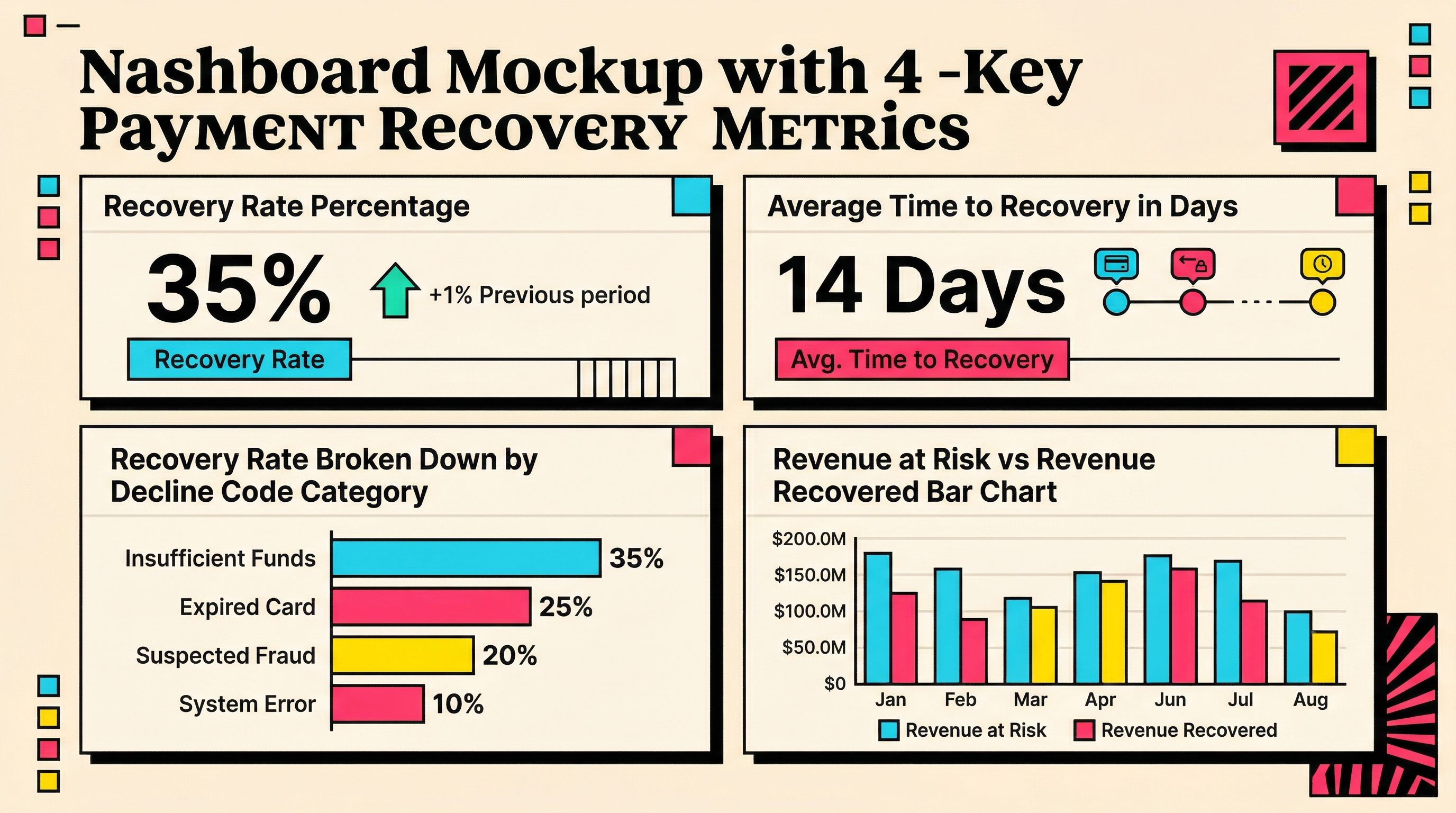
Recovery rate: Failed payments recovered divided by total failed payments. This is your north star. Industry average is around 50-60% for involuntary churn specifically. If you are below that, you have clear room to improve.
Time to recovery: How many days between the first failure and successful payment. This tells you if your retry timing is right. If most recoveries happen on day 14 but your retries stop on day 10, you are quitting too early.
Recovery by decline code: Break your recovery rate down by decline code category. This reveals which failure types your current flow handles well and which it misses entirely.
Revenue at risk vs revenue recovered: Raw payment counts are useful, but dollar amounts tell the full story. A single enterprise customer's failed payment might be worth more than 50 self-serve failures combined.
Building the feedback loop
Once you are tracking these metrics, the improvement path becomes obvious. Low recovery rate on expired cards? Your payment update flow has too much friction. High recovery on insufficient funds but only after day 7? Move your retries to align with payday cycles. Zero recoveries after week 3? Your extended outreach is not reaching inboxes (or not compelling enough).
The measurement does not need to be fancy. A weekly export from Stripe filtered by failed invoices, cross-referenced with which ones eventually succeeded, gives you everything you need to start.
The Compounding Cost of Getting Recovery Wrong
Each of these mistakes is expensive on its own. Together, they compound.
Treating all failures the same means you are sending the wrong message to half your failed customers. Those wrong messages damage the relationship. The damaged relationship means fewer customers bother updating their payment details. And because you are not measuring any of it, you never see the pattern.
The math works in reverse too. Fix one mistake and the others become easier to solve. Segment your failures and your dunning emails naturally become more relevant. Improve your dunning tone and more customers update their payment methods, even outside the retry window. Measure the results and you see exactly where to focus next.
For SaaS businesses doing $10K-$100K MRR, fixing payment recovery mistakes typically saves $500-$2,000 per month. That is $6K-$24K per year in revenue that was already earned but being lost to preventable process failures.
Start With What You Have
You do not need to overhaul everything at once. Pick one mistake from this list and fix it this week.
If you are not sure where your biggest gap is, start with measurement. Run a free churn audit to see exactly where your failed payments are falling through the cracks. Once you can see the problem, the fixes become obvious.
Payment recovery is not glamorous. It is not a growth hack. But it is one of the highest-ROI improvements you can make to your subscription business. Every recovered payment is a customer who stays, pays, and continues compounding your revenue.
Related Posts

7 Failed Payment Segments Every Stripe Team Should Track

Stripe vs Chargebee: Which Handles Failed Payments Better
The Complete Toolkit for Managing Failed Payments
How healthy is your Stripe account?
Get a free churn health report. Find pending cancellations, failed payments, and expiring cards putting your MRR at risk.
Run Free Audit