Stripe vs Chargebee: Which Handles Failed Payments Better

Failed payments are one of those annoying SaaS problems that look smaller than they are. A card gets declined. An invoice stays open. A retry happens later. Easy, right?
Not really.
If you run subscriptions, failed payments sit right on the line between recoverable revenue and churn. Handle them well and you rescue customers who still want your product. Handle them badly and you create involuntary churn out of customers who were perfectly salvageable.

That makes the Stripe vs Chargebee question worth taking seriously. Both can process recurring billing. Both can support a SaaS business. But they approach failed payments from different starting points. Stripe is a payments platform with billing layered on top. Chargebee is a subscription billing platform built to orchestrate billing logic across payments, dunning, and finance workflows.
So which handles failed payments better?
Short answer: Chargebee usually gives ops-heavy teams more control over failed-payment workflows, while Stripe gives product-focused teams a cleaner native path with less tooling overhead. If you want the blunt version, Stripe is simpler. Chargebee is more operationally opinionated. Better depends on whether your problem is missing billing controls or drowning in billing complexity.
What “handles failed payments better” actually means
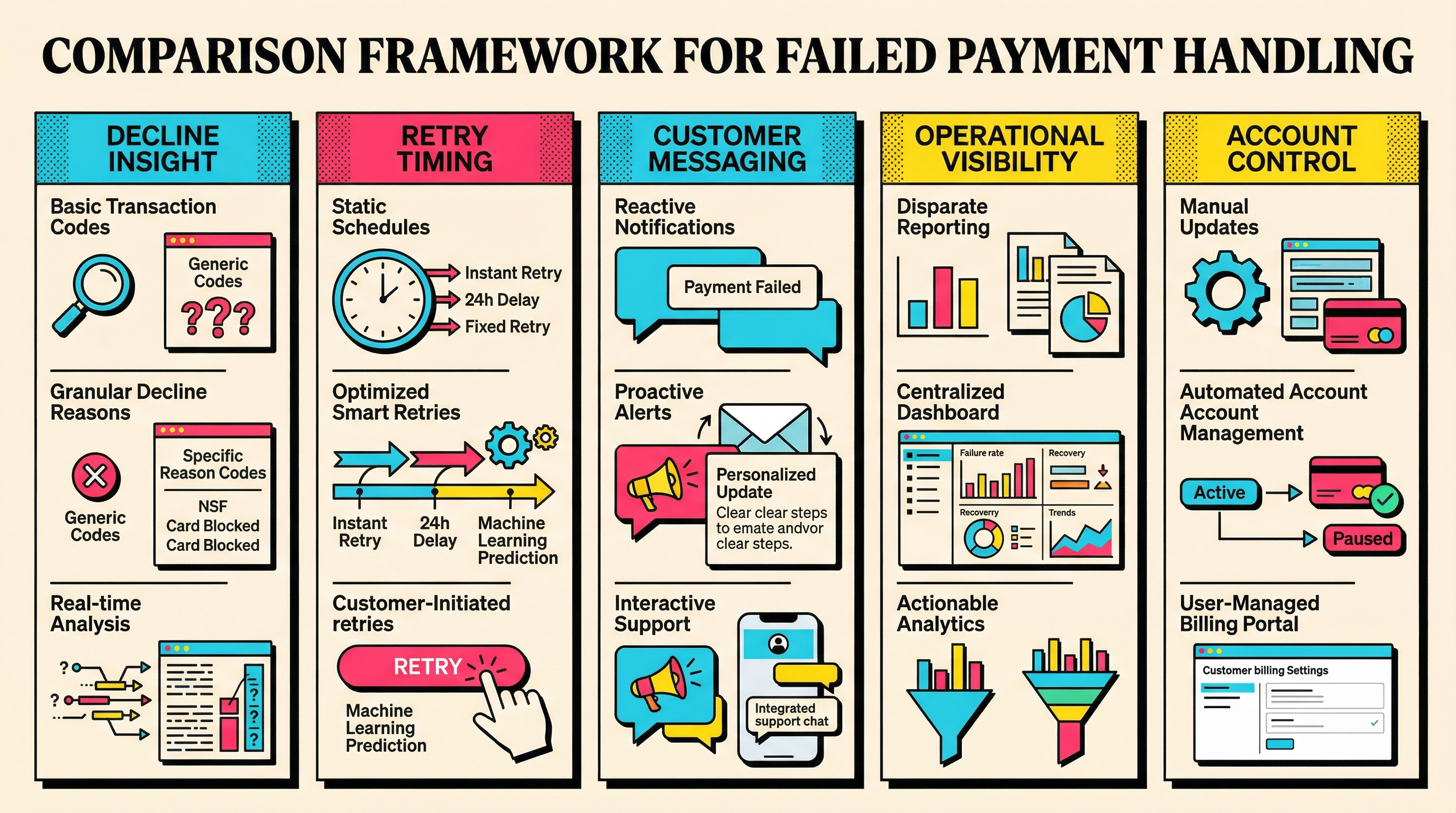
A lot of comparisons on this topic are useless because they stop at feature checklists. Failed payments are not about whether a dashboard has a button called dunning. They are about whether the whole recovery system works when a renewal fails at 2:13 a.m. on a Sunday.
A billing stack handles failed payments well when it does five things reliably:
- identifies why the payment failed
- decides whether the failure is likely temporary or needs customer action
- retries at sensible times
- communicates clearly with the customer
- keeps finance, support, and product access rules aligned
That is the real benchmark.
If you care about the mechanics behind the decline itself, the Stripe decline codes guide is useful because decline-code quality changes the whole recovery strategy. If the issue is insufficient funds, retries matter. If the card is expired, retries alone are mostly wishful thinking.
Stripe: the native path is cleaner than most teams admit
Stripe gets underestimated here because people confuse “less layered” with “less capable.” For a lot of SaaS companies, Stripe handles failed payments well precisely because it keeps the stack tighter.
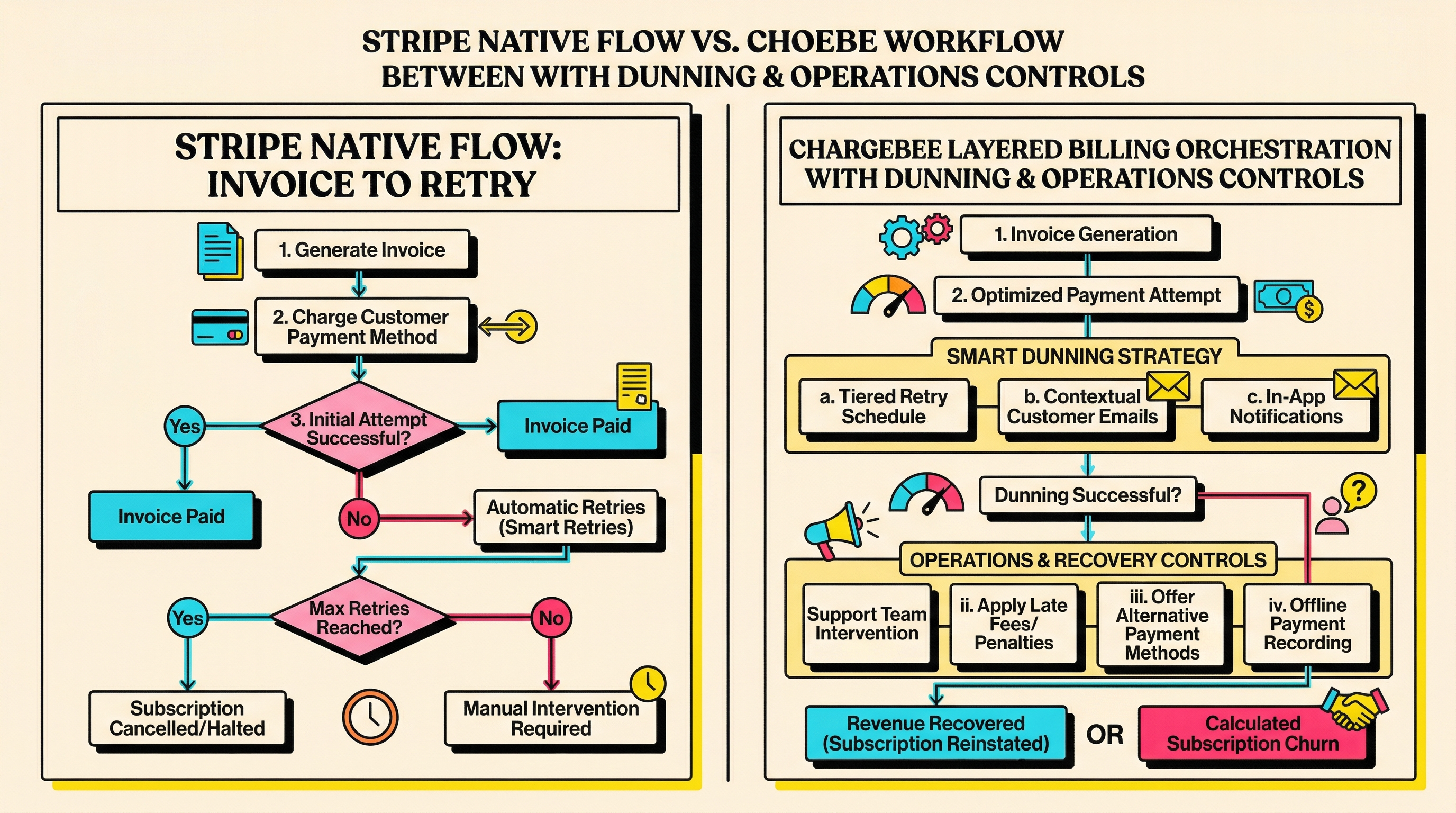
With Stripe Billing, the core failed-payment flow is straightforward:
- a renewal invoice is generated
- payment is attempted against the saved payment method
- invoice and subscription states update
- Smart Retries or custom retry logic can kick in
- customer emails and webhooks can trigger downstream workflows
That native path matters. Fewer moving parts means fewer weird sync bugs between billing state, subscription state, and customer messaging.
Stripe’s advantages in failed-payment handling usually come down to three things.
1. Native payment context
Stripe owns the payment attempt itself. That sounds obvious, but it matters. The same system that stores the subscription, invoice, payment method, and decline result also runs the authorization attempt. That means less translation between systems and less chance of losing nuance in the handoff.
When a failed payment happens, Stripe is close to the metal. It knows the invoice, the payment intent, the retry timing, and the payment-method state. For teams that want to keep recovery logic lean, that is a strong default.
2. Smart Retries are good enough for many SaaS companies
Founders love to sneer at “good enough,” but good enough beats overengineered nonsense most days.
Stripe Smart Retries can recover a meaningful chunk of failed payments without a team building custom retry rules from scratch. That is especially helpful for smaller SaaS businesses that do not have a revenue-ops person obsessing over billing states all week.
No, Smart Retries are not magic. They do not solve expired cards, closed accounts, or every authentication problem. But for temporary failures, a decent native retry engine is a solid baseline.
3. Webhook flexibility
Stripe is strong when you want to build your own recovery stack around events. Product-led teams tend to like this. They can react to failed invoices, past-due subscriptions, and payment-method changes using their own rules.
That flexibility is also why Stripe works well if you want a custom revenue-recovery workflow instead of a heavily opinionated one.
The catch is obvious: flexibility becomes work. If your team does not have the appetite to think carefully about retries, grace periods, access policy, and dunning copy, Stripe can leave too much on your plate.
Where Stripe gets messy
Stripe starts to wobble when the billing problem is not just payment collection but billing operations at scale.
That usually shows up when teams need:
- more complex dunning logic across segments or geographies
- finance-friendly workflows for invoices, credits, and subscription changes
- deeper auditability around subscription state transitions
- less engineering effort spent stitching billing logic into the app
Stripe gives you building blocks. That is great until you realise you are the one building the building.
If you are already spending time debating retry ladders, grace windows, account holds, and finance exceptions, Stripe’s simplicity can become deceptive. The product looks simple because the work moved into your implementation.
Chargebee: stronger billing operations, heavier stack
Chargebee’s pitch is not “we process payments better than Stripe.” That would be silly. Its pitch is closer to: “we help subscription businesses manage billing complexity better than Stripe alone.”
That changes the failed-payment story immediately.
Chargebee sits above payment processors and focuses on subscription logic, dunning configuration, invoicing, finance workflows, and billing orchestration. In practice, that means failed payments are treated less like isolated payment events and more like part of a larger revenue-operations system.
That is useful if your SaaS business is past the stage where “send an email and retry in three days” counts as a strategy.
1. More explicit dunning and recovery controls
Chargebee tends to be better when you want billing ops people, not just engineers, to control recovery behavior. Teams can usually define dunning schedules, communication stages, grace-period logic, and account actions with less custom code.
That matters in the real world because failed-payment recovery is rarely just a technical workflow. It is part customer comms, part finance policy, part retention strategy.
If your finance or customer-success teams need visibility and control, Chargebee usually feels more mature than raw Stripe Billing.
2. Better fit for operational complexity
Chargebee starts to make more sense when the business has multiple plans, invoicing exceptions, contract edge cases, or more complex subscription lifecycle rules.
In those environments, failed payments are not just “card declined, retry later.” They interact with contract terms, sales-led renewals, credit balances, paused subscriptions, tax, approval workflows, and ERP headaches.
Chargebee is better designed for those realities.
3. Less custom glue for billing teams
Stripe often assumes engineering will bridge the gaps. Chargebee is more likely to package billing controls so ops teams can work without filing a ticket every time they want to tweak dunning timing or recovery messaging.
That reduction in glue work is the strongest case for Chargebee.
Where Chargebee gets annoying
Chargebee is not free power. It comes with tradeoffs, and pretending otherwise is how teams end up with a stack they secretly hate.
First, it adds another layer. More layers mean more places for state mismatches, sync lag, or workflow confusion. The moment a failed payment involves both a processor and a billing orchestration tool, your debugging surface area gets bigger.
Second, it can feel heavy for straightforward SaaS setups. If you are a lean SaaS on standard monthly plans with relatively normal billing logic, Chargebee can be a lot of machinery to solve a problem Stripe already handles reasonably well.
Third, it changes the ownership model. Stripe-native teams often feel like they fully own the payment flow. Chargebee teams get more packaged control, but they also inherit the conventions and abstractions of another platform.
That can be worth it. It can also be a pain in the ass.
Stripe vs Chargebee on the things that actually matter
Here is the practical comparison.
Retry intelligence
Stripe wins for native simplicity. Smart Retries give many SaaS businesses a strong baseline without much setup.
Chargebee wins if you need recovery policy to be more explicitly configurable inside a wider billing workflow.
If your retry needs are basic, Stripe is enough. If your retry logic needs to vary by customer type, account state, or finance process, Chargebee has the edge.
Dunning control
Chargebee usually wins.
Stripe can absolutely support dunning, especially if you build around it. But Chargebee is generally better when the business wants richer billing communication workflows with less engineering duct tape.
Operational visibility
Chargebee usually wins for teams with finance and ops involvement.
Stripe is cleaner for product and engineering teams who prefer fewer systems. But when billing ownership spreads across support, finance, and rev ops, Chargebee’s structure tends to age better.
Complexity tax
Stripe wins, easily.
A simpler stack is not sexy, but it is often the right answer. Fewer components mean fewer weird billing ghosts. If your SaaS does not need enterprise-grade billing orchestration, adding it early is often self-inflicted pain.
Best fit by company stage
- Early-stage SaaS: Stripe
- Product-led SaaS with lean ops: Stripe
- Sales-led or finance-heavy SaaS: Chargebee
- Multi-entity or edge-case-heavy billing setup: Chargebee
- Team already drowning in custom billing logic: probably Chargebee
The real decision is not payments. It is ownership.
This is the part most buying guides miss.
Stripe vs Chargebee is not just a tooling decision. It is an ownership decision.
Do you want failed-payment recovery to live mostly inside your product and engineering stack? Stripe fits that model better.
Do you want failed-payment recovery to be part of a broader billing-ops system with more non-engineering control? Chargebee fits that model better.
That is why some teams swear Stripe is better while others think Chargebee is obviously better. They are solving different organizational problems.
A founder with one engineer and standard monthly subscriptions should not rush into Chargebee because a large B2B SaaS uses it. That is copying enterprise scar tissue you may not have earned.
At the same time, a scaling SaaS with complex invoicing, finance workflows, and lots of manual exception handling should stop pretending Stripe alone will stay elegant forever. Sometimes “just one more webhook” is the road to billing hell.
My blunt recommendation
If you are an early-stage or mid-stage SaaS on Stripe and your failed-payment pain is mostly about visibility, retry tuning, and customer follow-up, stay on Stripe first and tighten the workflow before adding Chargebee.
Do the boring stuff properly:
- segment failed payments by decline reason
- separate temporary failures from customer-action-required failures
- review retry timing
- clean up dunning copy
- define when past due becomes churn
- track recovered revenue as its own funnel
A surprising number of teams do not have a platform problem. They have a sloppy-process problem.
If you already know your billing process is outgrowing Stripe-native workflows, then Chargebee is a sensible upgrade. Not because Stripe is bad, but because the business now needs a heavier billing operating system.
That distinction matters. Otherwise you end up buying complexity you do not need, or refusing complexity you very clearly do.
If you want a simple gut-check, compare your current setup against the kind of metrics covered in retention metrics SaaS founders should track weekly and the audit mindset from the failed payment prevention checklist. If you cannot clearly see where failed revenue is getting stuck, the stack is not the only issue.
Final verdict
For most SaaS founders, Stripe handles failed payments better by default because it is simpler, more native, and easier to keep coherent.
For more operationally complex subscription businesses, Chargebee handles failed payments better because it gives billing teams more explicit control over recovery workflows and lifecycle edge cases.
So the winner is not universal.
- Choose Stripe if you want native simplicity and can keep billing logic disciplined.
- Choose Chargebee if billing complexity is already eating your team alive.
If you want to find out where your Stripe setup is leaking recoverable revenue before you add more tooling, run a free churn audit at churnbot.co/audit.
Related Posts

7 Failed Payment Segments Every Stripe Team Should Track
The Complete Toolkit for Managing Failed Payments

How healthy is your Stripe account?
Get a free churn health report. Find pending cancellations, failed payments, and expiring cards putting your MRR at risk.
Run Free Audit