The Psychology of Dunning: Why Tone Matters More Than Timing
When your customer's payment fails, you have one shot at recovery before they mentally check out. Most SaaS founders obsess over when to send dunning emails (day 1, day 3, day 7?). But payment recovery data shows something surprising: how you ask matters far more than when you ask.
Dunning psychology is the study of how tone, framing, and emotional triggers influence whether customers update their payment information or let their subscription lapse. While retry timing gets all the attention, the difference between a 30% recovery rate and a 70% recovery rate often comes down to a few words in your subject line.
The Psychological Barrier to Payment Updates
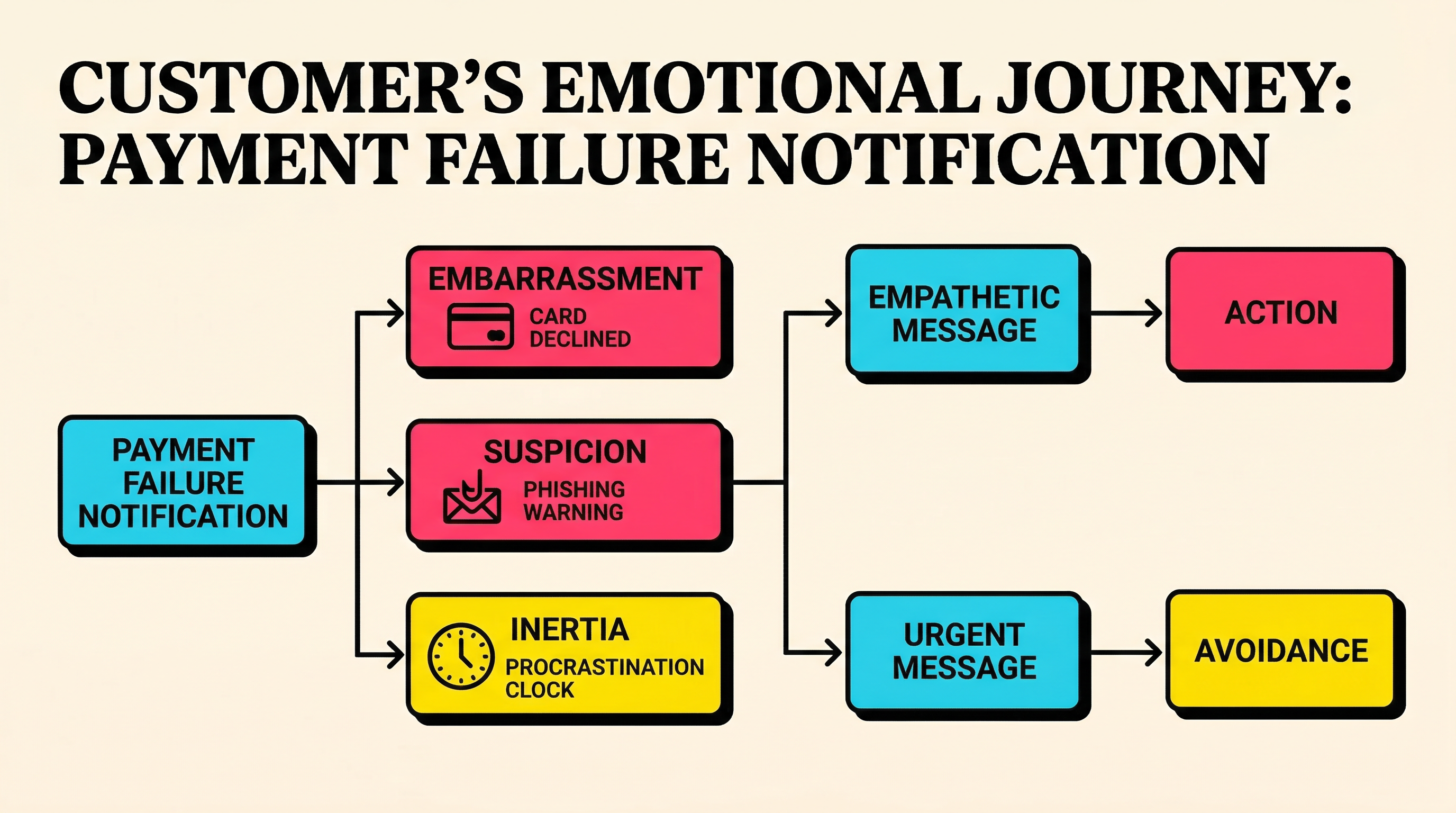
When a payment fails, customers don't just see a transaction error. They experience a cocktail of emotions: embarrassment ("my card got declined"), suspicion ("is this a phishing email?"), and inertia ("I'll deal with this later").
Behavioral economics research shows people are loss-averse and present-biased. Updating payment details is a small hassle now for a benefit they won't feel until the next billing cycle. Unless your message overcomes that friction, they'll procrastinate indefinitely.
This is where dunning email strategies come in. The right tone can flip that mental calculus from "I'll do it later" to "I should fix this now."
The Three Psychological Triggers That Drive Action
1. Empathy Over Urgency
Most dunning emails lean heavily on urgency: "Your account will be suspended in 48 hours!" This creates anxiety, not action. Customers who feel threatened are more likely to ignore the email or, worse, cancel intentionally.
Compare these two subject lines:
- ❌ "URGENT: Payment failed - account at risk"
- ✅ "Quick heads-up: we couldn't process your payment"
The second one assumes good intent. It treats the failure as a minor hiccup, not a crisis. Data from subscription businesses shows empathetic subject lines have 15-20% higher open rates and 25% better click-through rates on payment update links.
Why? Because empathy reduces cognitive load. The customer doesn't have to worry about being judged or penalized. They can focus on the simple action: update the card.
2. Clarity Beats Cleverness
Your dunning email is not the place for brand voice experiments. Customers scanning their inbox need to know three things instantly:
- What happened (payment failed)
- Why it matters (subscription paused)
- What to do (click here to update)
Overly casual or vague language creates confusion. "Oops, something went wrong!" doesn't tell me if it's a bug on your end or a problem with my card. Confusion breeds inaction.
The psychology of failed payments shows customers are already defensive. They want reassurance this isn't their fault (even when it is). Clear, neutral language gives them an easy out: "Your card issuer declined the charge. Here's how to fix it."
3. Social Proof and Trust Signals
Customers hesitate to click payment update links because of phishing paranoia. If your dunning email looks like a scam, it doesn't matter how polite it is.
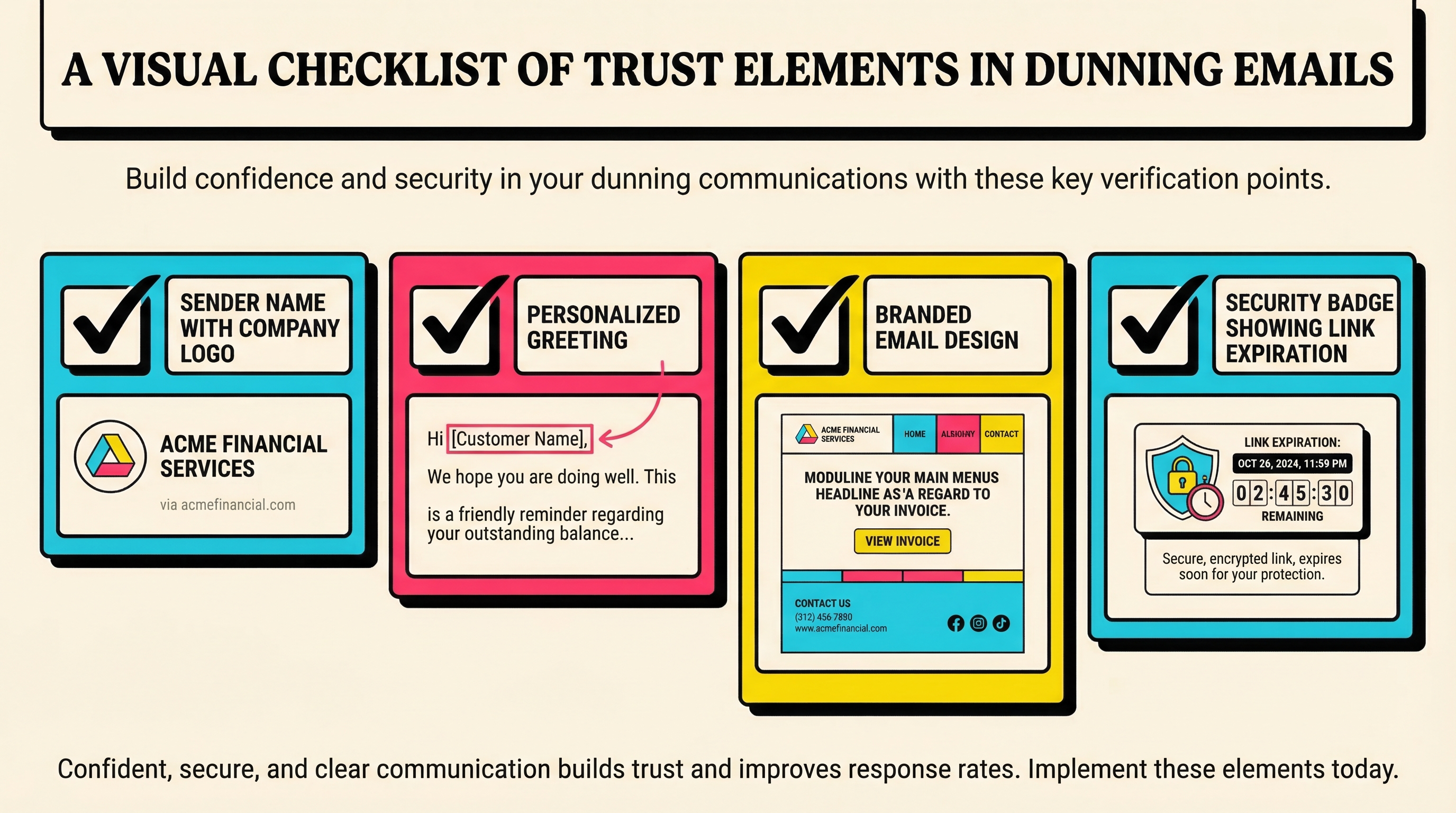
Trust signals include:
- Sender name: Use your company name, not "noreply@stripe.com"
- Personalization: Include their name and subscription details
- Branded design: Match your app's look and feel
- Security cues: "This link expires in 24 hours" (shows it's unique to them)
Adding social proof can help too: "Over 10,000 customers rely on [Product]. We'd hate to see you go." This isn't manipulation, it's a gentle reminder of what they'll lose.
Why Timing Still Matters (But Not How You Think)
Timing doesn't determine whether customers pay. It determines when they see your message and how they interpret it.
The First 24 Hours: The Sweet Spot
Send your first dunning email within 6-12 hours of the failure. Not because you need to rush them, but because:
- The charge is fresh in their mind (they might have already noticed it failed)
- You beat their credit card's fraud alert email (which will make them defensive)
- It signals competence (you're on top of your billing)
After 24 hours, customers start inventing narratives: "Maybe they don't want my business," or "I'll just switch to a competitor." The window for effortless recovery shrinks.
The Follow-Up Sequence: Escalating Empathy, Not Urgency
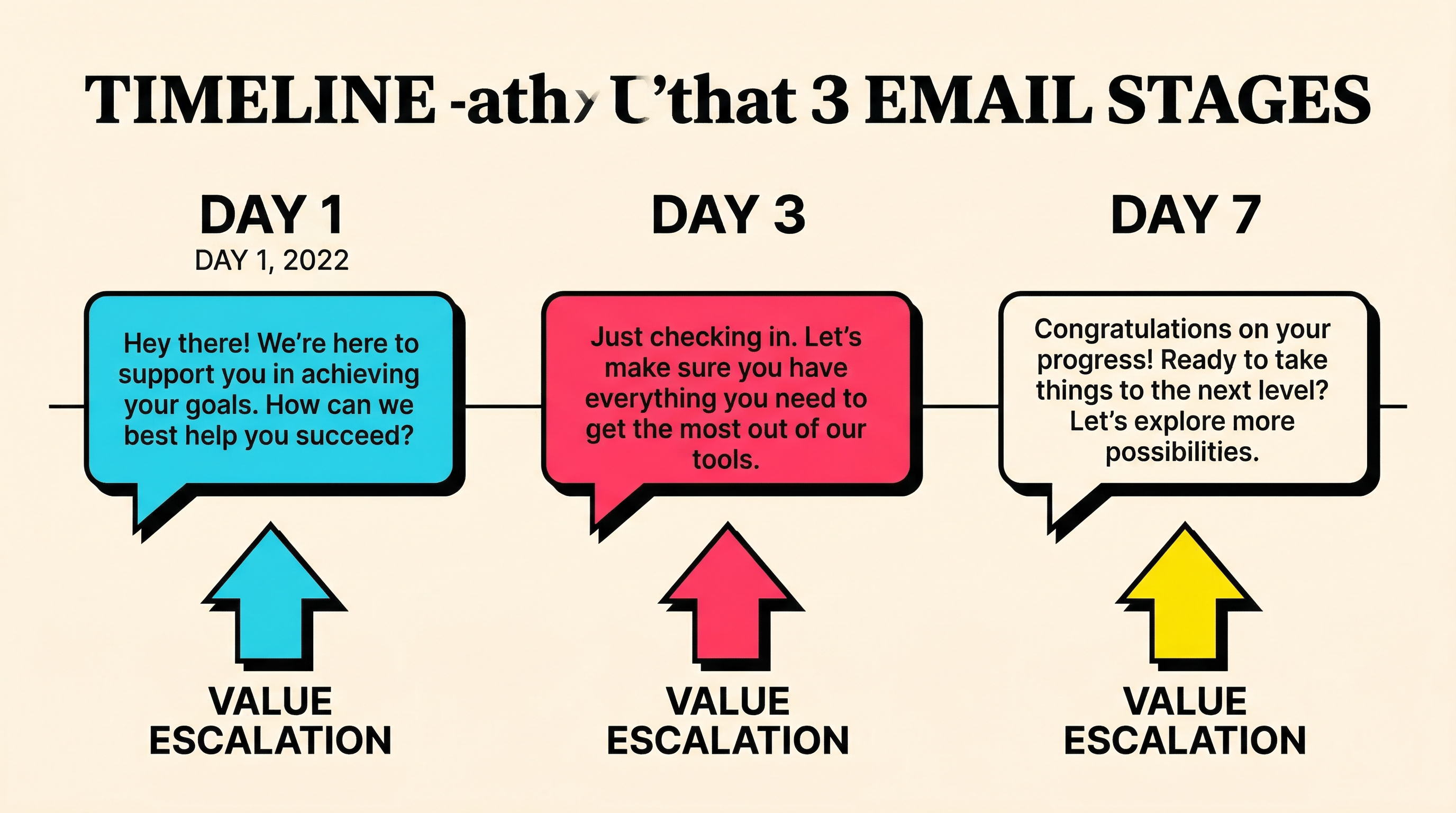
Most dunning flows escalate urgency:
- Day 1: Friendly reminder
- Day 3: Account at risk
- Day 7: Final warning
This feels logical, but it's psychologically backward. As time passes, customers become more entrenched in inaction. Escalating threats just makes them feel worse about procrastinating, which triggers avoidance behavior.
Instead, escalate value:
- Email 1 (Day 1): "We couldn't process your payment. Update here."
- Email 2 (Day 3): "You're about to lose access to [specific feature they use]. Here's a one-click fix."
- Email 3 (Day 7): "We'd hate to see you go. Is there anything we can help with?"
Notice how the tone stays helpful while the messaging shifts from transactional to relational. You're not threatening them. You're reminding them why they signed up in the first place.
The Language of Successful Dunning Emails
Words That Work
- "Quick", Signals this won't take long
- "Heads-up", Casual, not accusatory
- "Update", Active, empowering (vs. "fix" which implies fault)
- "We noticed", Shows you're paying attention without being creepy
- "You're still in control", Reinforces agency
Words to Avoid
- "Failed" / "Declined", Feels like personal failure
- "Urgent" / "Immediate", Creates anxiety, not action
- "Warning" / "Final notice", Sounds like a bill collector
- "Suspended" / "Terminated", Too harsh, too soon
- "Verify" / "Confirm", Phishing red flags
Framing Matters: Active vs. Passive Voice
Compare:
- ❌ "Your payment was declined." (Passive, feels like blame)
- ✅ "We couldn't process your payment." (Active, we share responsibility)
The second version subtly shifts the frame. It's not your failure, it's a system issue we're solving together. This tiny reframe reduces defensiveness and increases compliance.
How Customer Lifetime Value Changes the Tone
Not all customers deserve the same dunning experience. A customer paying $9/month for two weeks is different from an enterprise client at $500/month for two years.
High-Value Customers: Personal Touch
For customers with high LTV or long tenure:
- Send from a real person (sales rep, customer success manager)
- Include a phone number or calendar link
- Offer to help with billing questions directly
Example: "Hey [Name], I noticed your payment didn't go through. I'm happy to help sort this out, just reply to this email or grab 10 minutes on my calendar., Sarah"
This isn't scalable for everyone, but for your top 10% of revenue, the ROI on personalized outreach is massive.
Low-Value or New Customers: Automate with Empathy
For newer or smaller accounts, stick to automated sequences. But inject personality where you can:
- Use GIFs or emoji sparingly (if it fits your brand)
- Segment by behavior ("We noticed you've been using [Feature] a lot, don't lose access!")
- A/B test subject lines and CTAs monthly
The goal is to feel human without requiring human intervention.
When Tone Backfires: The Over-Apologetic Trap
Some founders overcorrect. They're so afraid of sounding harsh that every dunning email reads like a groveling apology:
"We're so, so sorry to bother you about this, but if it's not too much trouble, could you maybe possibly update your payment details when you have a moment? No rush! We totally understand if you're busy!"
This is psychologically weak. It signals:
- You don't value your own product
- The customer is doing you a favor by paying
- There's no real consequence to ignoring this
Confident, respectful directness works better: "Your card on file expired. Update it here to keep your access: [Link]"
You're not apologizing for running a business. You're stating a fact and offering a solution.
Measuring the Impact of Tone
You can't improve what you don't measure. Track these metrics by email variant:
- Open rate, Does your subject line grab attention?
- Click-through rate, Does your body copy drive action?
- Conversion rate, Do customers actually update their card?
- Time to update, How long from email send to payment success?
- Unsubscribe / complaint rate, Are you annoying people?
Run A/B tests on:
- Subject line tone (urgent vs. casual vs. empathetic)
- Sender name (company vs. person vs. team)
- CTA wording ("Update payment" vs. "Fix this now" vs. "Keep your access")
- Email length (short vs. detailed)
Even a 5% lift in recovery rate compounds over time. If you're processing $100k/month and losing 3% to failed payments, a 5% improvement in recovery is worth $1,800/year.
For detailed payment recovery benchmarks, most SaaS companies recover 40-60% of failed payments through dunning. Best-in-class teams hit 70%+. The difference is almost always tone and UX, not retry logic.
Beyond Email: Multi-Channel Dunning Psychology
Email isn't the only battlefield. Customers ignore emails. They don't ignore their product.
In-App Notifications
When a customer logs in after a failed payment, show a banner:
- ✅ "Payment update required, click here to fix in 30 seconds"
- ❌ "Your account is suspended due to non-payment"
The first is a speed bump. The second is a roadblock. Guess which one gets higher update rates?
SMS and Push Notifications
For mobile-first products, SMS has 98% open rates compared to email's 20-30%. But the tone threshold is even higher. A pushy SMS feels invasive.
Good SMS example: "Hi [Name], your [Product] payment didn't go through. Tap to update: [Link]"
Keep it under 160 characters. No urgency. Just information + action.
What to Do Right Now
If you're using default Stripe dunning emails or generic templates, you're leaving money on the table. Here's a 15-minute fix:
- Audit your current dunning sequence, Read it out loud. Does it sound like you're talking to a friend or a debtor?
- Rewrite your first email, Focus on clarity and empathy. Remove all-caps, exclamation marks, and threats.
- Add one trust signal, Personalize with the customer's name and subscription tier.
- Test a new subject line, Try "Quick heads-up: payment update needed" vs. your current version.
- Track opens and clicks for 7 days, See if it moves the needle.
Tone is free to change. It doesn't require new infrastructure, AI models, or consultant fees. It just requires thinking about your customer as a human being who got a declined charge, not a delinquent account.
Start Recovering More Revenue
Dunning psychology isn't about manipulation. It's about reducing friction. When you treat payment failures as a shared problem to solve (not a customer's fault to punish), recovery rates skyrocket.
Want to see how much revenue you're losing to failed payments right now? Run a free churn audit on your Stripe account. You'll get a breakdown of exactly where customers are dropping off and how much recoverable revenue is sitting in your dunning queue.
Because the best time to fix your tone was before the first payment failed. The second-best time is today.
Related Posts

7 Failed Payment Segments Every Stripe Team Should Track
Stripe vs Chargebee: Which Handles Failed Payments Better
How healthy is your Stripe account?
Get a free churn health report. Find pending cancellations, failed payments, and expiring cards putting your MRR at risk.
Run Free Audit