Open Banking and the Future of Payment Recovery
Every SaaS founder running on Stripe has felt the sting of a failed payment. A customer who wants your product, has money in their account, but their card gets declined because a number expired or an issuer flagged the transaction. You retry. You send dunning emails. Maybe you recover 30-40% of those failures. But what if the entire card-based payment model is the bottleneck?
Open banking is changing that equation. By connecting directly to customer bank accounts through regulated APIs, open banking removes the middlemen (card networks, issuers, acquirers) that cause most involuntary churn. For SaaS businesses, this is not some distant fintech trend. It is a practical recovery channel you can start using today.
What Open Banking Actually Means for SaaS Billing
Open banking refers to a set of regulations and APIs that let third-party providers access bank account data and initiate payments with the account holder's consent. The EU's PSD2 directive kicked this off in 2018, and similar frameworks now exist in the UK, Australia, Brazil, and parts of the US.
For subscription businesses, the relevant piece is payment initiation services (PIS). Instead of charging a card that routes through Visa or Mastercard's network, you can pull funds directly from a customer's bank account via API. Think of it as a modernized, instant version of direct debit, but with real-time confirmation and stronger authentication.
The key difference from traditional card payments:
- No card numbers to expire. Bank accounts don't have expiry dates. The single biggest driver of involuntary churn, expired cards, disappears entirely.
- No issuer declines. When you charge a card, the issuer can decline for dozens of reasons: insufficient funds, fraud flags, velocity limits. With open banking, you are talking directly to the bank. If the money is there, the payment goes through.
- Lower failure rates. Card payment failure rates for SaaS subscriptions typically run 5-10%. Early data from open banking payment providers shows failure rates below 2% for recurring transactions.
- Lower costs. Card interchange fees eat 2-3% of every transaction. Open banking payments cost a flat fee, usually $0.20-0.50 per transaction. For a SaaS doing $50K MRR, that is thousands saved annually.
Why Card-Based Payments Keep Failing
To understand why open banking matters for payment recovery, you need to understand why cards fail so often in the first place.
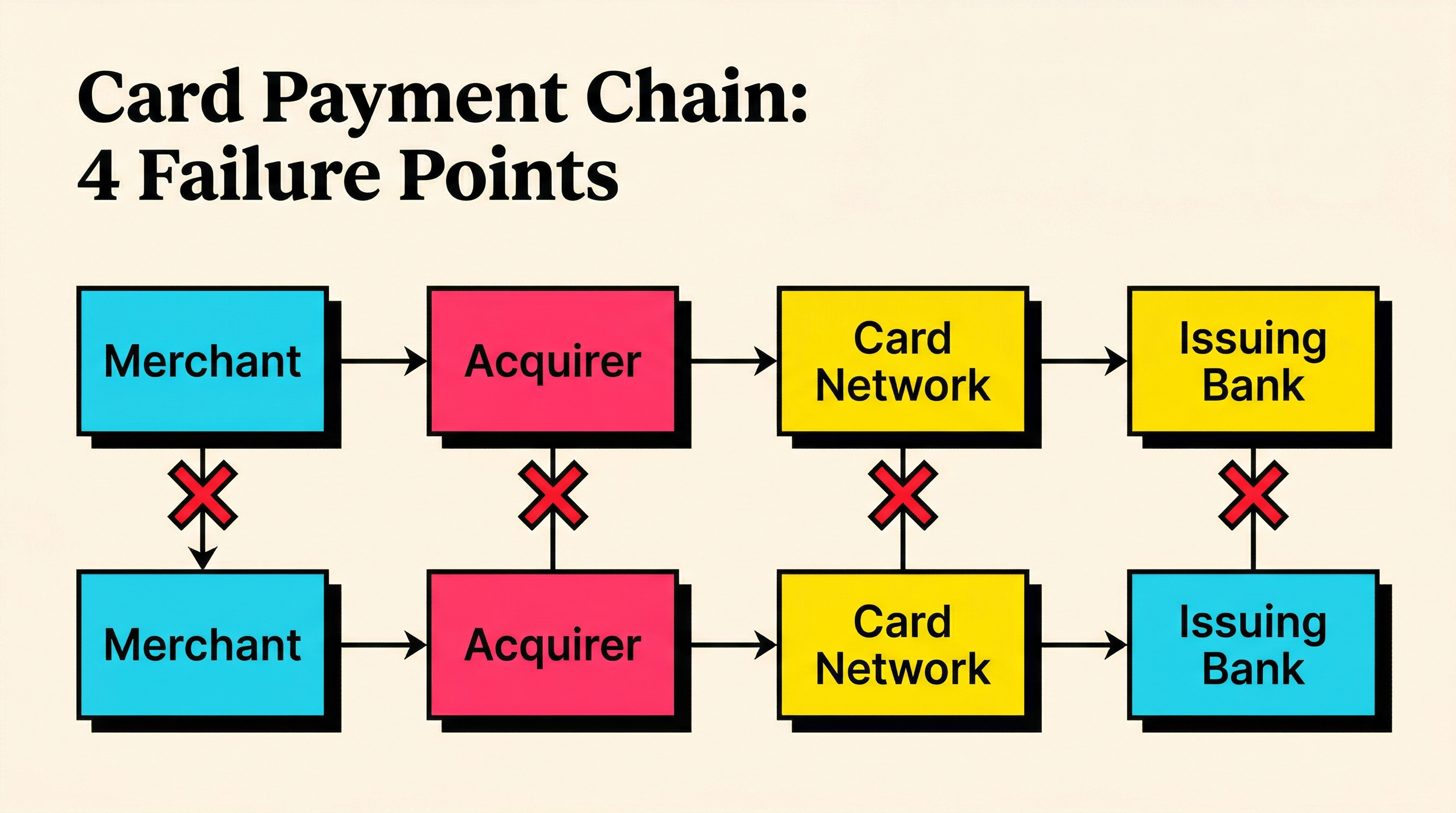
A typical card payment touches four or five intermediaries before the money moves. Each one is a potential failure point:
- Your payment processor (Stripe) packages the request
- The acquiring bank routes it to the card network
- The card network (Visa/Mastercard) passes it to the issuing bank
- The issuing bank decides whether to approve or decline
At step 4 alone, there are over 100 possible decline codes. Some are legitimate (fraud, stolen card). But many are recoverable: insufficient funds at the exact moment of charge, temporary issuer outages, overzealous fraud detection, or simply an expired card number.
Stripe's smart retries help. Custom retry logic helps more. But you are still fighting the fundamental architecture of a system designed for one-time purchases, not recurring subscriptions.
Open banking bypasses steps 2, 3, and most of step 4. The payment instruction goes from your app to the customer's bank, verified by the customer, and settled. Fewer hops means fewer failures.
The Open Banking Payment Recovery Playbook
You do not need to rip out Stripe and rebuild your billing stack. Open banking works best as a fallback recovery channel alongside your existing card-based billing. Here is how SaaS founders are using it in practice.
Step 1: Keep Cards as Primary
Cards are still the default for most customers. They are familiar, widely held, and the checkout experience is optimized. Do not fight customer expectations at signup. Accept cards as your primary payment method through Stripe.
Step 2: Offer Bank Payments as an Alternative at Checkout
Add an open banking payment option alongside card entry. Services like GoCardless, TrueLayer, Plaid, and Stripe's own bank payment methods (via Financial Connections) make this straightforward. Some customers, particularly in Europe, actually prefer bank-based payments.
Step 3: Use Open Banking as Your Recovery Fallback
This is where the real value sits. When a card payment fails:
- First: Run your normal retry sequence through Stripe (smart retries + custom logic)
- Second: Send your dunning email sequence
- Third: If the card is not recovered after 7-10 days, offer the customer a one-click option to pay via their bank account instead
This third step is where open banking payment recovery delivers outsized results. The customer still wants your product. Their bank account has money. The card is just broken. Give them a different path to pay.
Step 4: Auto-Migrate Repeat Failures to Bank Payments
If a customer's card fails more than twice in three months, proactively suggest switching to bank payments. Frame it as convenience: "Never get interrupted by an expired card again." Most customers who switch stay switched.
Real Numbers: How Open Banking Impacts Recovery Rates
The data on open banking for subscription recovery is still early but promising. Here is what the numbers look like based on publicly available data from payment providers operating in this space:
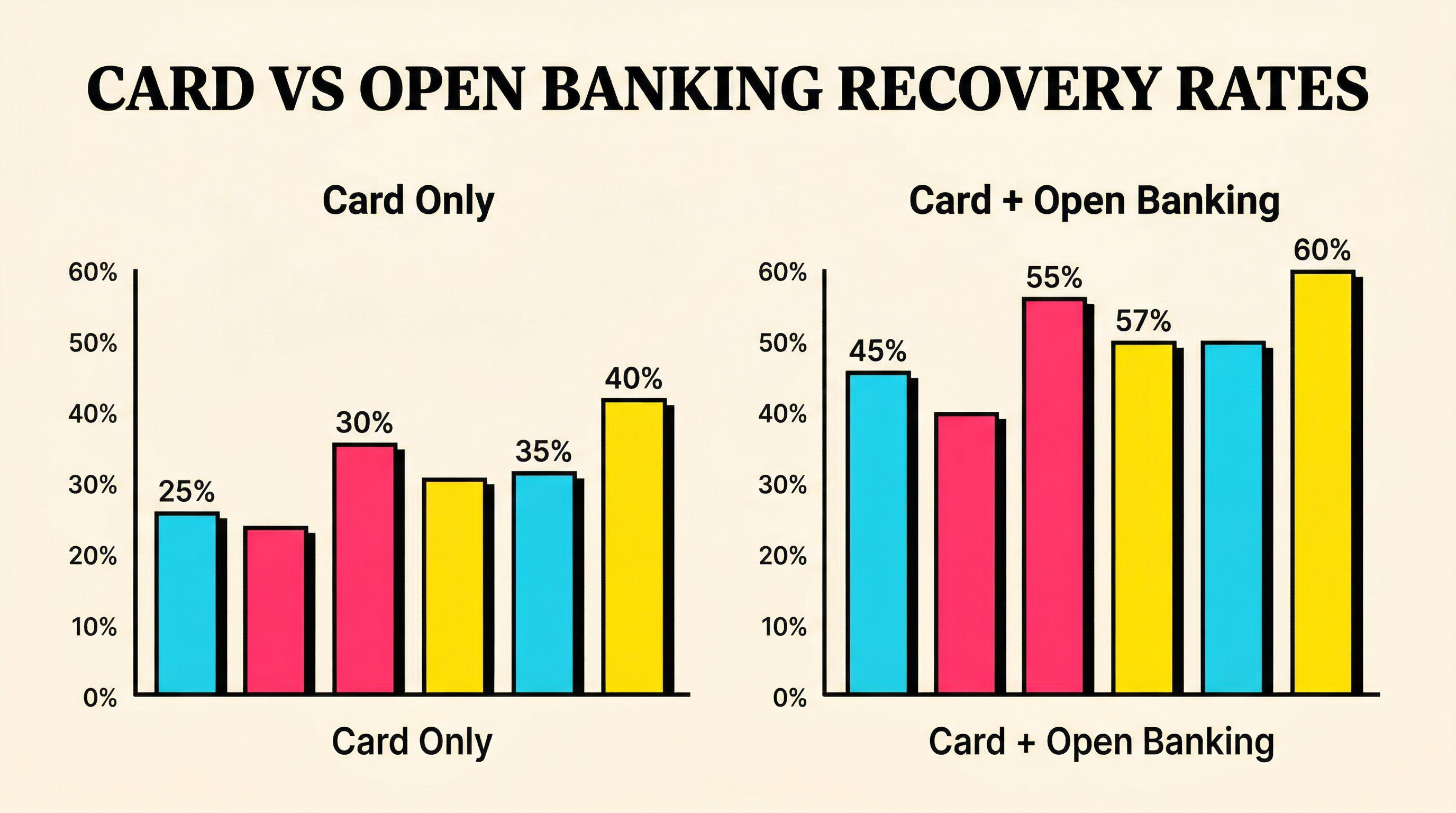
Card-only recovery (industry average):
- Initial retry recovery: 15-25%
- Dunning email recovery: 10-15%
- Total recovery rate: 25-40%
- Time to recover: 7-14 days
Card + open banking recovery:
- Initial retry recovery: 15-25% (same)
- Dunning email recovery: 10-15% (same)
- Open banking fallback recovery: 20-35% of remaining failures
- Total recovery rate: 45-60%
- Time to recover: 3-7 days (bank payments settle faster)
That gap, from 40% to 60% total recovery, is significant. For a SaaS with $100K MRR and a 5% monthly failure rate, that is the difference between losing $3,000 and losing $2,000 per month. Over a year: $12,000 in additional recovered revenue, just from adding one more payment channel.
The speed difference matters too. Card retries can take days to clear. Open banking payments confirm in seconds to minutes. Faster recovery means less customer frustration and fewer cancellations during the "my service is interrupted" window.
Which Open Banking Providers Work With Stripe
If you are already on Stripe, you have several paths to add open banking:
Stripe Financial Connections + Bank Transfers
Stripe's own bank payment support lets you accept ACH direct debit (US), BACS (UK), and SEPA (EU) through their API. This is the lowest-friction option if you want to stay within the Stripe ecosystem. The limitation: these are traditional bank debits, not true open banking with instant confirmation. Settlement takes 2-5 business days.
GoCardless
The most established open banking payment provider for SaaS. Integrates with Stripe via their Success+ product. Offers instant bank payments in the UK and EU, with variable recurring payments. Their Intelligent Retries feature uses open banking data to retry when funds are available.
TrueLayer
Focuses on open banking payment initiation. Strong in the UK and EU. Offers a Stripe-compatible checkout flow. Best for adding a bank payment option at checkout and as a recovery fallback.
Plaid + Transfer
Plaid handles account linking (primarily US), and their Transfer product initiates ACH payments. Works well as a Stripe complement for US-focused SaaS.
Choosing the right one depends on your customer geography. UK/EU SaaS businesses get the most benefit because PSD2 regulation means open banking APIs are mature and widely supported. US businesses can use ACH as a fallback today and move to full open banking as FDX and CFPA Rule 1033 frameworks mature.
What About Strong Customer Authentication (SCA)?
One concern SaaS founders raise about open banking: does it add more authentication friction? After all, 3D Secure already causes payment drop-off for card transactions.
With open banking, authentication happens once when the customer sets up the payment mandate. They log into their banking app, confirm the recurring payment authorization, and that is it. Subsequent charges process without additional authentication.
Compare that to cards, where SCA via 3D Secure can trigger on every renewal (depending on the issuer's risk engine), and open banking actually reduces authentication friction for recurring payments over time.
The Limitations (Honest Assessment)
Open banking is not a silver bullet. Here are the real constraints:
Geographic coverage is uneven. The UK and EU are years ahead. The US is catching up but fragmented. If your customers are primarily US-based, your open banking options are currently limited to ACH, which is slower and less feature-rich than European open banking.
Customer adoption takes time. Most consumers are used to entering card numbers. Asking them to log into their banking app during checkout is a different experience. Conversion at initial checkout may be lower for bank payments. That is why using it as a recovery fallback (when the card already failed) works better than leading with it.
Not all banks are connected. Open banking coverage varies by country and bank. Major banks in the UK, France, Germany, and the Netherlands have strong API coverage. Smaller banks and credit unions may lag behind.
Refund mechanics differ. Card chargebacks and refunds have well-established processes. Open banking refund flows are less standardized. Make sure your provider handles refunds cleanly before committing.
Stripe integration depth varies. While Stripe supports bank debits natively, the full open banking experience (instant confirmation, balance checks, intelligent timing) requires third-party providers. That means managing another vendor relationship.
Building Your Open Banking Strategy: A Practical Timeline
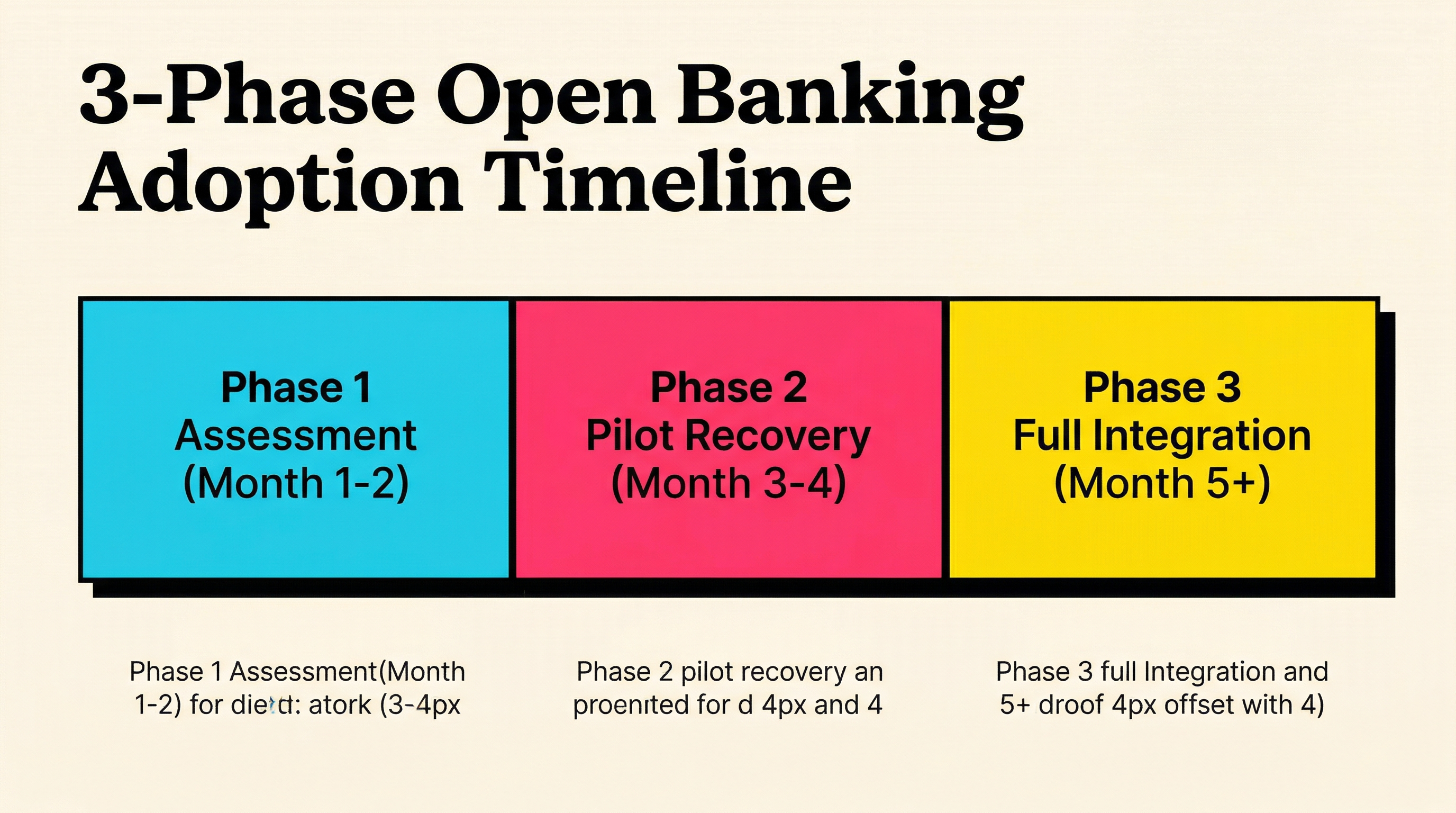
Here is a realistic rollout plan for adding open banking to your SaaS payment stack:
Month 1-2: Assessment
- Audit your current failed payment data. What percentage of failures are from expired cards vs. insufficient funds vs. issuer declines? Use your Stripe dashboard or run a payment health audit to get the breakdown.
- Identify your customer geography split. If more than 30% of your revenue comes from the UK/EU, open banking should be a priority.
Month 3-4: Pilot as Recovery Fallback
- Add a bank payment option to your dunning flow. When a customer's card fails and your retry sequence is exhausted, offer "Pay via bank" as a one-click alternative in your recovery email.
- Start with one provider (GoCardless or TrueLayer for UK/EU, Plaid for US).
- Track recovery rate lift vs. card-only baseline.
Month 5-6: Expand to Checkout
- If recovery results are positive, add bank payment as an option at initial checkout alongside card entry.
- A/B test conversion rates. Some customer segments (enterprise, European) will prefer it.
Month 7+: Optimize and Auto-Migrate
- Build logic to automatically suggest bank payments to customers with repeat card failures.
- Use open banking balance data (where available) to time retries when funds are present.
- Monitor and compare payment recovery benchmarks across both channels.
What This Means for Involuntary Churn in 2026 and Beyond
The broader trend is clear: the payments industry is moving toward account-to-account (A2A) transactions. Card networks know this. Visa and Mastercard are both investing in A2A capabilities. Stripe is expanding bank payment support. The regulatory momentum (PSD3 in the EU, Rule 1033 in the US) is pushing toward more open, more interoperable payment infrastructure.
For SaaS founders dealing with involuntary churn today, you do not need to wait for the full vision to materialize. The practical takeaway is simple:
- Cards will remain your primary payment method for the foreseeable future.
- Open banking gives you a second recovery channel that eliminates card-specific failure modes.
- The combination of both will always outperform either alone.
Every percentage point of improved recovery compounds over time. A 10% improvement in payment recovery on $100K MRR saves $6,000 per year. At $500K MRR, that is $30,000. And unlike most growth initiatives, better payment recovery requires zero new customer acquisition.
Start With What You Know
Before adding open banking to your stack, make sure your existing card recovery process is solid. Most SaaS businesses leave significant recovery on the table with their current Stripe setup alone.
The best first step: understand exactly where your payments are failing and why. Run a free churn audit at churnbot.co/audit to get a breakdown of your Stripe account's payment health, failure patterns, and recovery opportunities. Once you know your baseline, you will know exactly where open banking fits in your recovery strategy.
Related Posts
Stripe Insufficient Funds Recovery: A Playbook for SaaS Teams
Stripe Do Not Honor Recovery: What SaaS Teams Should Do Next

How healthy is your Stripe account?
Get a free churn health report. Find pending cancellations, failed payments, and expiring cards putting your MRR at risk.
Run Free Audit