How 3D Secure Impacts Your Subscription Payment Success Rate
If you run subscriptions on Stripe, 3D Secure can quietly help you or quietly wreck your renewal rate. It depends on when it gets triggered, whether the customer is present, and how cleanly you recover the authentication step.
For SaaS founders, the important thing is not whether 3D Secure is "good" or "bad." The real question is simpler: when authentication gets introduced into your billing flow, does it increase authorization confidence without creating enough friction to turn a collectible invoice into involuntary churn?
That is why 3D Secure matters for 3D secure payment success. It changes who has to do what at the moment a payment is approved. In some cases it lifts approval odds by giving issuers more confidence. In other cases it creates a dead end, especially for off-session renewals where the customer is not around to complete a challenge.
For subscription businesses, that distinction matters more than almost anywhere else. A one-time ecommerce checkout can afford a little extra friction. A recurring billing system lives or dies on reliability.
What 3D Secure actually does in subscriptions
3D Secure is an extra cardholder authentication layer used during card payments. In practical terms, it often shows up as a bank prompt asking the customer to confirm the payment through a code, banking app, biometric check, or approval screen.
For subscriptions, there are two very different moments where 3D Secure can show up:
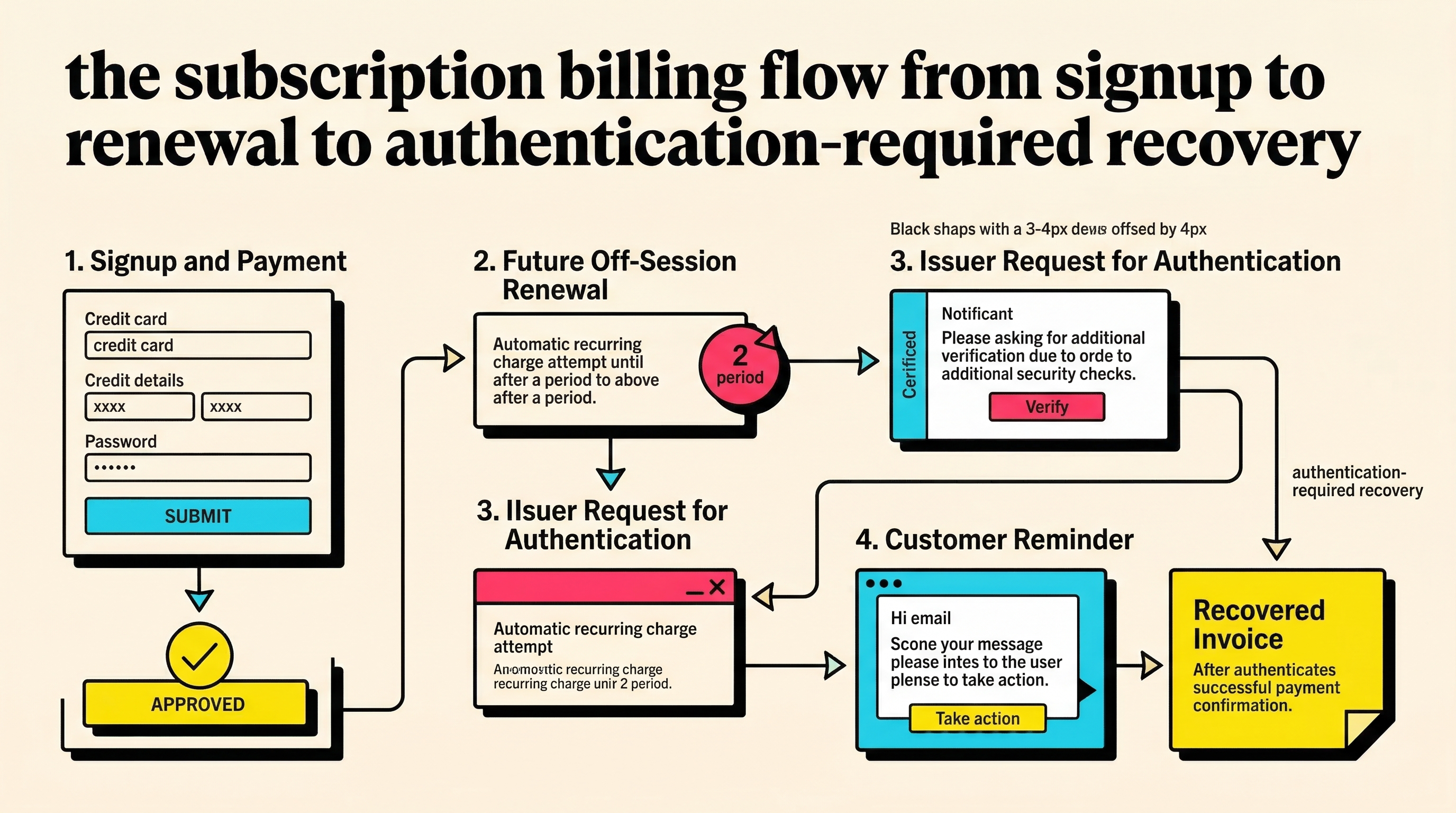
1. **During the initial signup payment**, when the customer is on-session and can complete the challenge.
2. **During a future renewal**, when the charge is often attempted off-session and the customer may not be there to authenticate.
That difference is everything.
If authentication happens during signup and the payment method is properly set up for future use, the merchant has a better chance of collecting later renewals smoothly. If the setup is weak, missing mandate context, or issuer risk changes over time, a later renewal can come back requiring authentication. At that point, your automated billing flow becomes a recovery problem.
Why 3D Secure can improve payment success
There is a reason networks, regulators, issuers, and processors keep pushing stronger authentication. Fraud pressure is real, and card issuers are more willing to approve transactions when they have more confidence the genuine cardholder is behind them.
In the right circumstances, 3D Secure helps subscription payment success in at least four ways.
1. It reduces issuer uncertainty
A bank deciding whether to approve a subscription charge is making a risk call in milliseconds. If a payment has strong customer authentication behind it, the issuer has more evidence that the payment is legitimate. That can mean fewer soft declines and fewer ambiguous risk-based rejections.
2. It supports compliance in regulated markets
In Europe and other regulated environments, strong customer authentication is not optional in many contexts. If your billing setup does not accommodate those rules, payment failures become structural, not random. Founders often blame retry timing when the real issue is that the authentication path was never handled correctly in the first place.
3. It improves the quality of the first payment setup
When a customer completes authentication during the first transaction, you are not just collecting today’s invoice. You are creating the foundation for future renewals. Clean setup reduces the odds that a later off-session payment unexpectedly falls into an authentication-required state.
4. It can lower downstream recovery workload
Every payment you get right at the front door is one less dunning sequence, support ticket, or involuntary churn event later. That is why it is useful to think about authentication and dunning together. They are part of the same revenue recovery system.
If you want a broader view of how retry logic fits into recovery, see Stripe Smart Retries vs Custom Retry Logic.
Why 3D Secure can hurt subscription payment success
The downside is friction. In a subscription business, friction compounds fast.
A customer who is already in your app can usually handle a bank challenge. A customer who signed up six weeks ago and is now being charged at 2:13 a.m. cannot. If the issuer wants them back in the loop, your automated renewal has stopped being automated.
Off-session billing is where things break
The biggest 3D Secure problem in SaaS is not that authentication exists. It is that renewal payments are often attempted when the customer is absent.
When an off-session payment comes back with an authentication requirement, several bad things can happen:
- the invoice stays open
- access may be restricted or cancelled too early
- dunning emails start late or say the wrong thing
- the customer assumes the issue is your product, not their bank
- recovery rates fall even though demand for the product has not changed
This is classic involuntary churn. The customer did not decide to leave. The payment system failed to finish the job.
Extra friction reduces completion rates
Every extra step between a failed renewal and a recovered payment costs conversion. If the customer has to open an email, click through to an invoice page, log in, update a card, and then complete a bank challenge, you are asking for a lot.
That is one reason card maintenance still matters. A clean card updater and expiry management process prevents some of these issues before authentication ever enters the picture. Related reading: Card Expiry Management: The Cheapest Churn Prevention Strategy.
Authentication-required declines are easy to misdiagnose
A founder sees a failed payment and assumes the card was bad, funds were low, or the retry schedule needs tuning. Sometimes the real issue is simply that the issuer wants cardholder authentication.
If your team treats all failures the same way, you miss the payment-specific path that would have recovered the invoice faster.
For more context on this decline category, ChurnBot’s decline code reference on authentication required is worth keeping handy.
Where 3D Secure shows up in the subscription lifecycle
At signup
This is the best place for 3D Secure to appear. The customer is active, motivated, and already expecting to complete a payment step. If authentication is needed, they can do it immediately.
This is also where you should aim to set expectations well. If the form, copy, and confirmation flow make it obvious that bank verification may happen, completion feels normal rather than suspicious.
At plan changes or invoice catch-up moments
Authentication can also surface when a customer upgrades, pays an overdue invoice manually, or reactivates after a failed renewal. These are still relatively recoverable moments because the user is on-session.
At automatic renewal
This is the danger zone. If a renewal is attempted off-session and comes back requiring customer action, your system needs a recovery path that is fast, clear, and persistent without being annoying.
That means the moment you detect an authentication-related failure, your playbook should switch from passive retries to explicit customer re-engagement.
What SaaS founders should do about it
You do not need to become a payments lawyer or issuer-risk expert. You do need a better operating system for authentication-related failures.
1. Separate authentication failures from generic declines
Do not lump 3D Secure issues into one broad "failed payment" bucket. If the issuer is asking for authentication, that is a different problem from insufficient funds or an expired card. The recovery message, urgency, and next action are different.
A generic dunning email that says "please update your payment method" can be wrong here. The customer may not need a new card at all. They may only need to complete authentication.
2. Optimize the first payment, not just the retries
Many teams over-focus on retries because retries are easy to visualize. But the better leverage point is often the initial setup. If your first transaction and mandate setup are solid, later recurring charges are more likely to clear without drama.
3. Use customer-facing recovery language that matches reality
Your recovery email should explain what happened in plain English:
- your bank needs you to confirm the payment
- your subscription is still recoverable
- here is the fastest way to fix it
- here is what happens if you ignore it
Vague notices create hesitation. Clear notices get action.
4. Review grace periods
If your product shuts access off the minute a renewal fails, you increase avoidable churn. A short grace period gives customers time to complete authentication without feeling punished for a banking workflow they did not initiate.
The right grace period depends on your product, ACV, and usage pattern, but the principle is simple: align account state changes with realistic payment recovery behavior.
5. Measure recovery by failure reason
This is where most teams are blind. They know total failed payments. They may even know aggregate recovery rate. But they do not know whether authentication-related failures recover at 15 percent, 40 percent, or 70 percent.
You want to measure at least:
- failed payments requiring customer action
- recovery rate for those invoices
- time to recovery
- cancellation rate after authentication-related failure
- revenue at risk by failure type
Without that breakdown, you cannot tell whether 3D Secure is mostly helping approvals or mostly introducing friction into renewals.
Common scenarios founders should plan for
A lot of confusion disappears once you model 3D Secure as a handful of recurring situations instead of one abstract payment concept.
Scenario 1: Signup succeeds with a challenge
This is normal and usually healthy. The customer is present, completes the bank step, and the subscription starts cleanly. Your job here is mostly UX: make the authentication step feel expected and trustworthy.
Scenario 2: Renewal fails and needs customer action
This is where revenue leaks begin. The invoice is collectible, but only if the customer returns quickly enough to authenticate. Your job is speed and clarity. Trigger the right recovery email, avoid misleading "update your card" language, and preserve access long enough for the customer to act.
Scenario 3: The customer updates the card but still does not complete authentication
This is a subtle one. Teams may celebrate the card update event even though the invoice is still unpaid. Card refresh and authentication completion are different jobs. Track both.
Scenario 4: Support gets dragged into a payment issue that is really a bank workflow
When support agents do not understand authentication-required failures, they give generic billing advice that slows recovery. A short internal playbook can fix that fast.
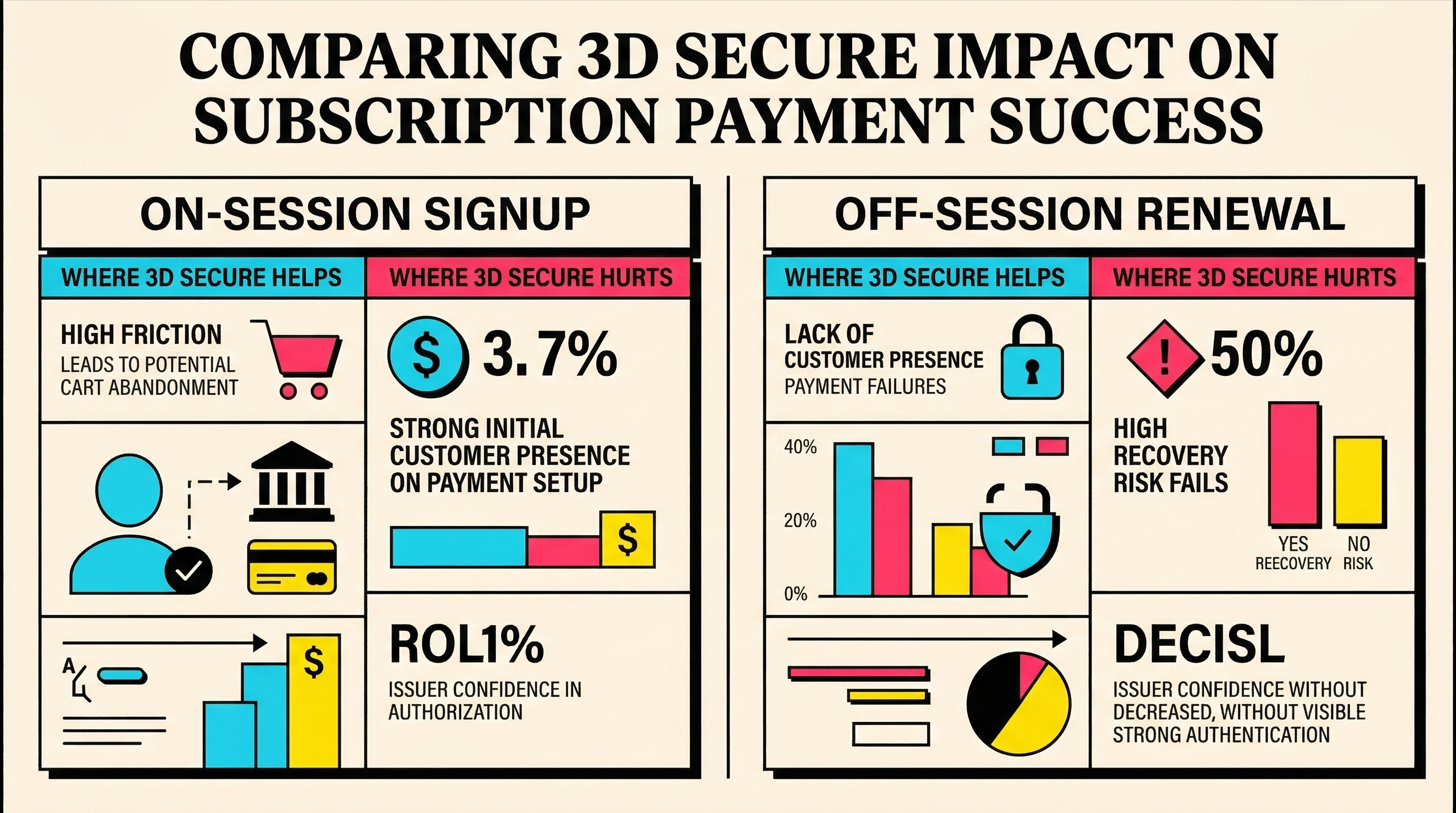
A simple framework: where 3D Secure helps versus hurts
Use this lens.
3D Secure usually helps when:
- the customer is on-session
- the challenge happens during signup or planned billing activity
- the payment method is being set up cleanly for future usage
- the market has strong authentication expectations
- your checkout explains the extra step clearly
3D Secure usually hurts when:
- the charge is off-session
- the customer has low urgency to return and fix the invoice
- recovery emails are vague or delayed
- product access is removed too quickly
- the team cannot distinguish authentication-required failures from other decline types
That is the real answer to how 3D Secure impacts your subscription payment success rate. It is not universally positive or negative. It is highly context dependent.
The operational mistake most founders make
Most teams treat payment success as a gateway setting. It is not. It is a cross-functional system involving checkout, billing logic, lifecycle messaging, support language, grace periods, and reporting.
3D Secure makes that obvious because it sits right at the boundary between risk control and conversion.
If you only optimize for authorization, you may add friction that damages retention. If you only optimize for smooth renewals, you may ignore authentication rules and create more preventable failures. Good subscription operators do both:
- get the first payment authenticated properly when needed
- preserve off-session billing reliability
- recover authentication-required invoices quickly when they fail
Final takeaway
3D Secure can absolutely improve subscription payment success. It can also create new failure points that show up later as involuntary churn. The difference comes down to where authentication appears and how well your billing system responds when customer action is required.
If you handle 3D Secure well at signup, identify authentication-required declines correctly, and run clear recovery flows, it becomes a useful part of your payment stack. If you ignore it, it turns into a silent leak in your renewal engine.
The good news is that this is fixable. Most of the damage comes from misclassification, poor messaging, and slow recovery paths, not from 3D Secure itself.
If you want to see where failed payments and recovery gaps are leaking revenue in your Stripe account, run a free churn audit at churnbot.co/audit.
Related Posts


7 Failed Payment Segments Every Stripe Team Should Track
9 Strategies to Stop Losing Customers to Payment Failures
How healthy is your Stripe account?
Get a free churn health report. Find pending cancellations, failed payments, and expiring cards putting your MRR at risk.
Run Free Audit