Payment Method Trends and What They Mean for SaaS Billing
The way people pay for software is shifting faster than most SaaS founders realize. Five years ago, credit cards dominated subscription billing. Today, digital wallets, bank transfers, buy-now-pay-later services, and regional payment methods are reshaping how recurring revenue flows into your business.
If you're still treating payment methods as a “set it and forget it” part of your billing stack, you're probably losing customers you don't even know about. Every payment method comes with its own failure rates, fraud profiles, and customer expectations. Understanding these trends isn't just interesting. It directly impacts your churn rate, your recovery rates, and your bottom line.
Let's break down what's actually happening in payment methods for SaaS in 2026, and what you should do about it.
The Current State of SaaS Payment Methods
Credit and debit cards still account for roughly 60-65% of all SaaS subscription payments globally. But that number has been sliding steadily downward from 80%+ just three years ago. The gap is being filled by a mix of alternatives that vary wildly by region, customer segment, and deal size.
Here's where things stand:
Credit/debit cards: Still the default for most SaaS products, especially in North America and Western Europe. Visa and Mastercard dominate, with Amex holding a meaningful share in B2B. Card payments are familiar, fast to set up, and well-supported by every payment processor. But they come with well-documented problems: expiration, insufficient funds, issuer declines, and fraud flags.
Digital wallets (Apple Pay, Google Pay, PayPal): Growing rapidly in B2C SaaS and increasingly showing up in SMB B2B. Wallet-based payments have a key advantage: they automatically update when a customer gets a new card number, which means fewer expired card declines. Apple Pay adoption in subscription billing grew 40% year-over-year in 2025.
Bank transfers and direct debit (ACH, SEPA, BACS): Popular for higher-value B2B subscriptions and in European markets. These methods bypass card networks entirely, which means no card expiry issues, lower processing fees (typically 0.5-1% vs 2.9% for cards), and generally higher success rates on initial charges. The tradeoff: slower settlement, more complex dispute processes, and higher setup friction for customers.
Buy Now Pay Later (BNPL): Still niche in SaaS, but growing in lower-ticket consumer subscriptions. Services like Klarna and Afterpay are experimenting with recurring payment support. Worth watching, not worth building around yet.
Regional methods: PIX in Brazil, iDEAL in the Netherlands, Bancontact in Belgium, UPI in India. If you sell internationally, ignoring these means you're invisible to huge customer pools.
Why Payment Method Mix Matters for Churn
Here's the part most founders miss: your payment method mix directly determines your involuntary churn floor. Different payment methods fail at different rates, for different reasons, and respond to different recovery strategies.
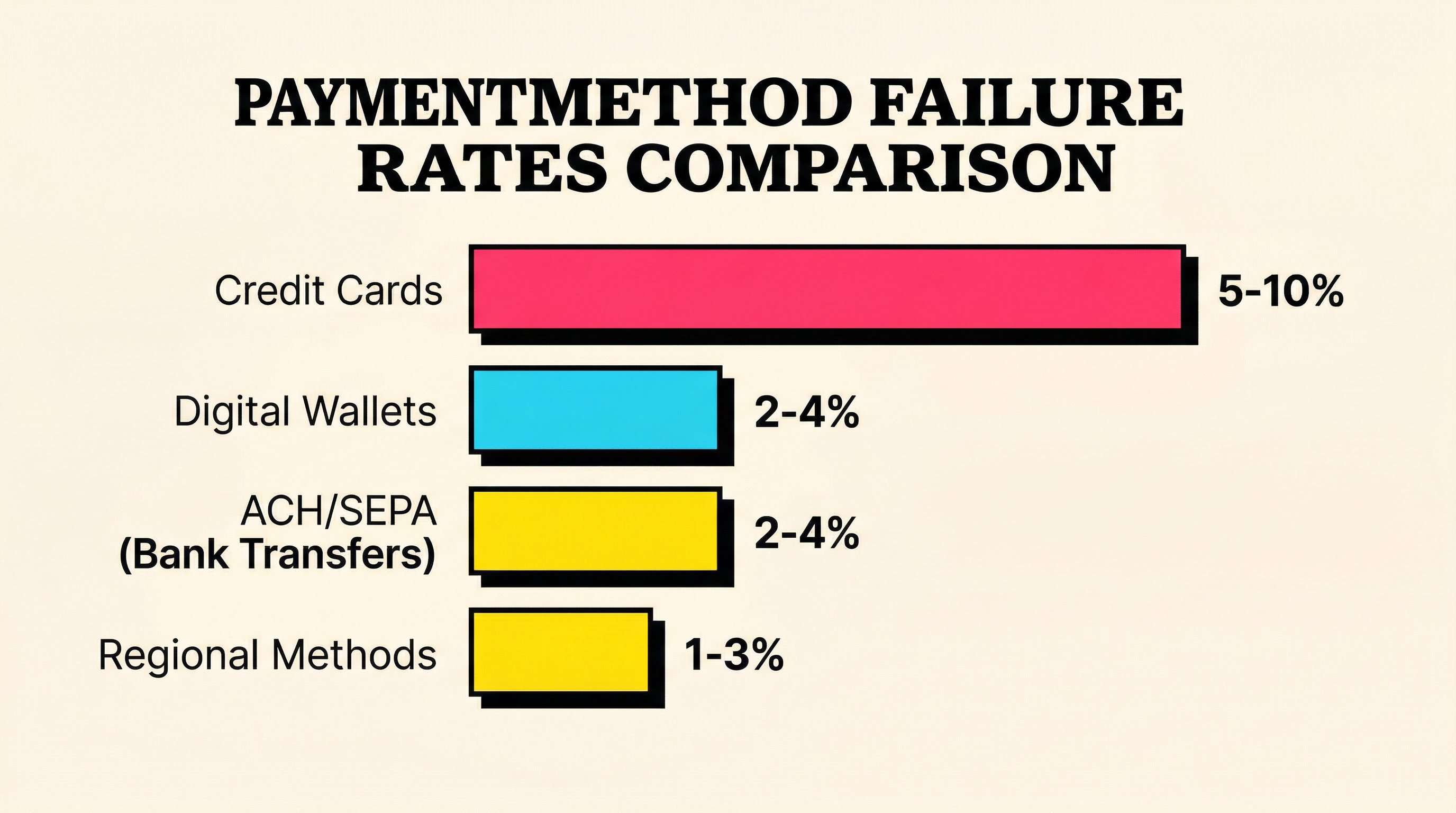
Card payments fail at a rate of roughly 5-10% per billing cycle for SaaS businesses. The biggest culprits are insufficient funds, expired cards, and issuer-initiated declines. These are the failures that feed involuntary churn, the customers who didn't choose to leave but got dropped because their payment didn't go through.
Digital wallets cut card expiry failures almost entirely. When a customer pays with Apple Pay or Google Pay, their wallet updates the card details automatically through network tokenization. That single change can eliminate 20-30% of your failed payments overnight.
Bank-based methods (ACH, SEPA) fail for different reasons: insufficient funds, account closures, or authorization revocations. But they don't suffer from card expiry at all, and their overall failure rates tend to be lower (2-4% per cycle) because bank account details change far less frequently than card numbers.
The math is straightforward. If 40% of your failed payments come from expired cards, and you shift 30% of your customer base to payment methods that don't expire, you've just reduced your involuntary churn by roughly 12%. For a $500K ARR business losing 3% monthly to failed payments, that's $18K in recovered annual revenue from the payment method shift alone.
Digital Wallets: The Biggest Opportunity Most SaaS Companies Are Missing
Digital wallets are the single biggest untapped opportunity in SaaS payment optimization right now. Here's why.
Network Tokenization Changes Everything
When a customer saves their Visa card directly in your checkout, you store a card number that will expire. When they pay via Apple Pay or Google Pay, the wallet stores a network token. A device-specific reference that the card network keeps updated automatically. New card number? New expiry date? The token still works.
Stripe reports that network-tokenized payments see authorization rates 2-5 percentage points higher than raw card payments. For a SaaS business processing 10,000 renewal charges per month, that's 200-500 additional successful payments. At an average of $50/month per customer, that's $10,000-$25,000 in monthly revenue that would have otherwise required dunning, retries, or been lost entirely.
Wallet Adoption Is Accelerating
The numbers are hard to ignore. Apple Pay now has over 700 million active users globally. Google Pay is north of 400 million. In the 18-34 demographic, wallet payments are the preferred method for online purchases, period. If your checkout doesn't offer wallet options, you're adding friction for your fastest-growing customer segment.
Implementation Is Trivial
If you're on Stripe, adding Apple Pay and Google Pay to your checkout takes about 30 minutes of development time. Stripe's Payment Element handles the detection and rendering automatically. There's no reason not to offer it.
The Catch
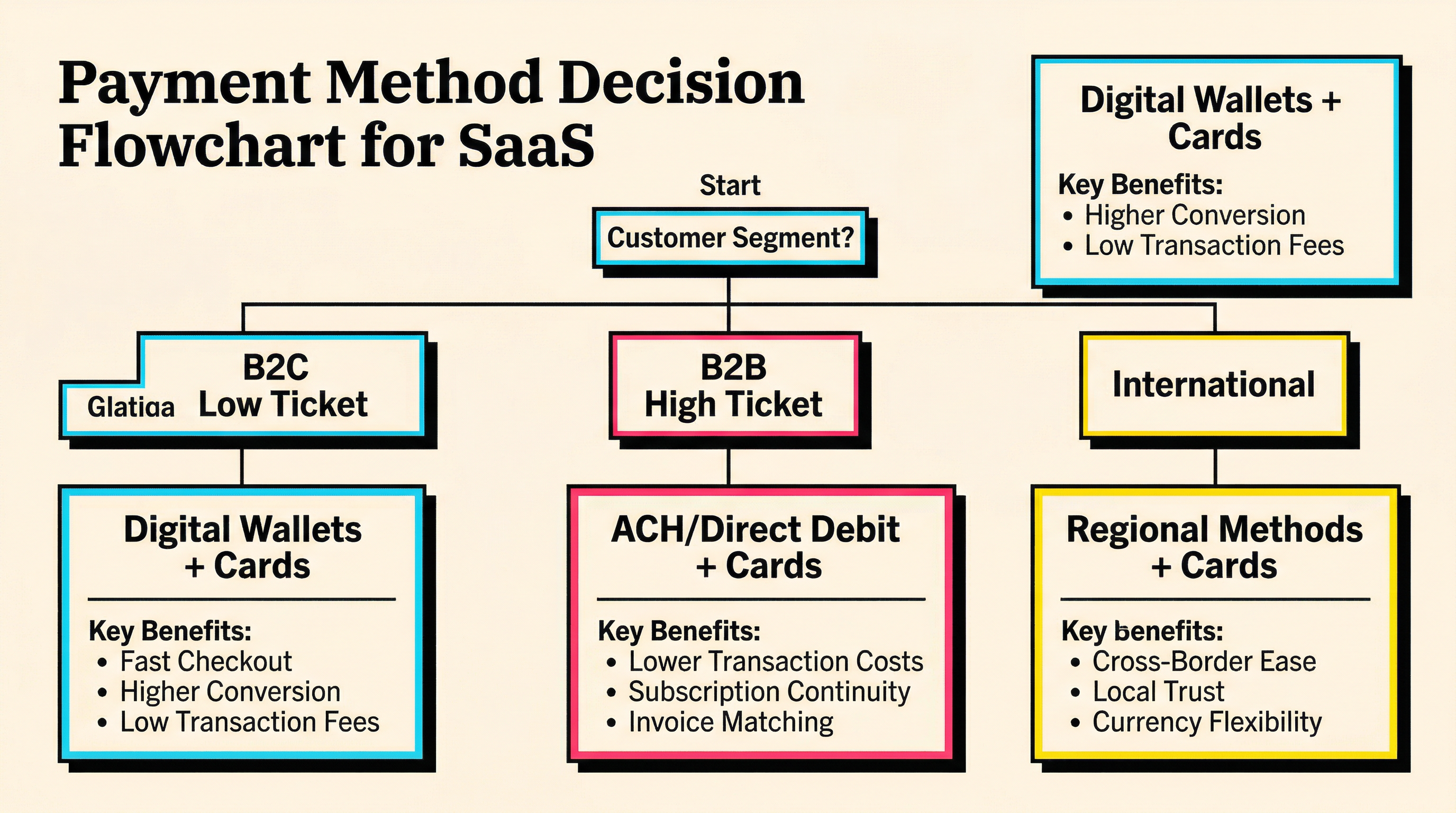
Wallets work best for customer-initiated purchases and low-friction upgrades. For B2B contracts with invoicing requirements, PO numbers, and procurement processes, wallets don't fit. Know your customer segment and offer the right mix.
ACH and Direct Debit: The B2B Revenue Protector
For B2B SaaS companies, especially those with average contract values above $200/month, bank-based payment methods deserve serious attention.
Lower Failure Rates
ACH and SEPA direct debits fail at 2-4% per cycle compared to 5-10% for cards. Bank accounts don't expire. They don't get reissued every 3 years. They don't get flagged by overzealous fraud algorithms when someone travels internationally. The primary failure reasons are insufficient funds and account closures, both of which are lower-frequency events than card-related failures.
Lower Processing Costs
Card processing typically costs 2.9% + $0.30 per transaction. ACH costs 0.8% capped at $5. For a $500/month B2B subscription, you're paying $14.80 per card charge vs $4.00 per ACH charge. Over a year, across hundreds of customers, the savings compound fast.
Higher Retention Signal
Customers who set up bank transfers tend to be more committed. Setting up ACH or direct debit requires more effort than entering a card number, which creates a psychological commitment effect. Customers on bank-based payments churn at lower rates across both voluntary and involuntary categories. The setup friction becomes retention friction, and that works in your favor.
The Tradeoffs
Bank payments settle slower (3-5 business days for ACH vs instant for cards). Disputes are handled differently and can take longer to resolve. And the upfront setup experience is worse: customers need to know their routing number and account number, or go through bank authentication. For self-serve signups, this friction can hurt conversion rates at the top of the funnel.
The smart play: offer cards for initial signup (lowest friction), then prompt high-value customers to switch to ACH/direct debit after they've been active for 60-90 days. Frame it as a benefit: “Save 2% on your subscription by paying via bank transfer.”
Regional Payment Methods: The International Growth Lever
If you're selling SaaS outside North America and Western Europe, local payment methods aren't optional. They're table stakes.
The Numbers Tell the Story
In the Netherlands, 60% of online payments go through iDEAL (bank transfer system). In Brazil, PIX handles over 40% of digital payments. In India, UPI processes billions of transactions monthly. These aren't niche alternatives. They're the dominant payment methods in massive markets.
SaaS companies that add local payment methods when expanding internationally report 20-40% increases in conversion rates. That's not a marginal improvement. That's the difference between a market working and not working.
What This Means for Churn
Regional payment methods often have different failure profiles. PIX payments in Brazil are instant and prepaid, so they don't fail due to insufficient funds in the same way card payments do. iDEAL payments are bank-authenticated, so fraud declines don't exist. But they may require re-authorization for recurring payments, which introduces its own churn risk if the customer doesn't complete the re-auth.
Understanding the failure modes of each payment method in each market is essential. What works for recovering failed card payments doesn't work for recovering failed bank authentications. Your dunning flows need to adapt.
Stripe's Role
Stripe now supports 40+ payment methods across dozens of countries. The challenge isn't technical anymore. It's operational. You need to decide which methods to offer in which markets, configure your dunning and retry logic for each method's unique failure patterns, and track recovery rates segmented by payment method.
The Rise of Multi-Method Customers
A trend that's emerging in 2026: customers increasingly use different payment methods for different things. Someone might use Apple Pay for a $15/month tool, ACH for a $500/month platform, and a corporate card for a $2,000/month enterprise subscription.
This means your billing system needs to handle method-specific logic:
Retry timing varies by method. Card retries work best at specific times (early morning, mid-week, first of the month). ACH retries should wait for business days. Wallet retries rarely fail for expiry but may fail for insufficient funds on the underlying card.
Dunning messaging should reference the method. “Your Visa ending in 4242 was declined” is more helpful than “Your payment failed.” For ACH failures, mention the bank name. For wallet failures, reference the wallet (Apple Pay, Google Pay).
Fallback options matter. If a customer's primary method fails, prompting them to try a different method on file (or add one) can recover revenue that retries alone won't. Stripe's PaymentIntent API supports this natively.
Payment Method Trends to Watch in 2026-2027
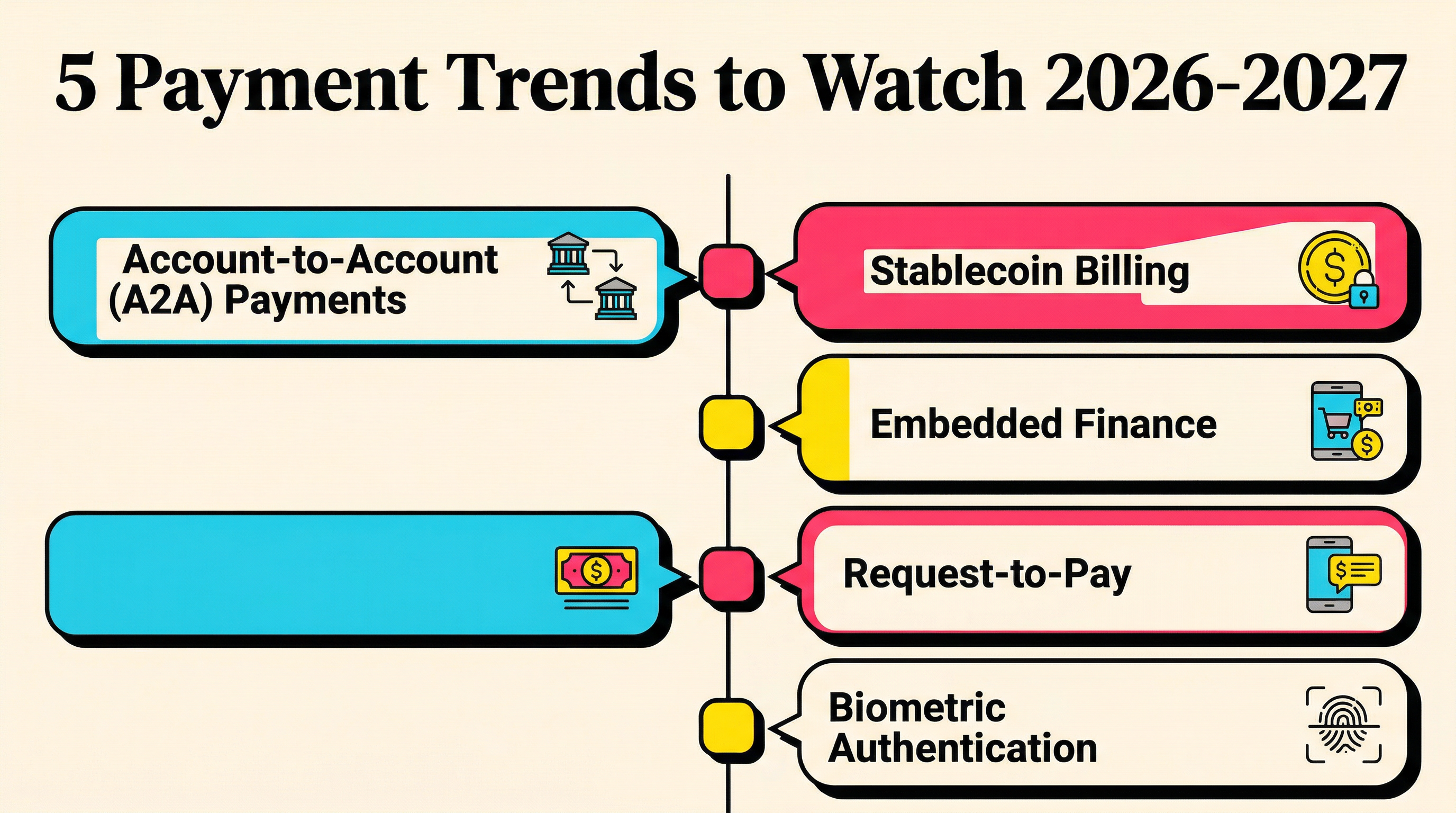
Trend 1: Account-to-Account (A2A) Payments
Open banking regulations in Europe and the UK are enabling direct bank-to-bank payments that skip card networks entirely. These payments are cheaper, faster (instant settlement in many cases), and have no expiry risk. In the UK, A2A payments grew 70% year-over-year in 2025. SaaS companies targeting European markets should be testing A2A payment options now.
Trend 2: Cryptocurrency for Recurring Billing
Still early and still messy. But stablecoin payments (USDC, USDT) are starting to appear in developer tools and infrastructure SaaS. The appeal: lower fees, no chargebacks, instant international settlement. The problems: regulatory uncertainty, customer UX, and the lack of standardized recurring billing on most blockchain networks. File this under “monitor,” not “adopt.”
Trend 3: Embedded Finance and Banking-as-a-Service
SaaS platforms are increasingly becoming payment facilitators themselves. Vertical SaaS companies (healthcare, construction, real estate) are embedding payment processing directly into their platforms. This changes the churn equation because the SaaS product becomes the payment method itself, creating deeper lock-in and different failure patterns.
Trend 4: Request-to-Pay
Instead of pulling money from a customer's account (direct debit), request-to-pay sends the customer a notification asking them to approve each payment. It's a hybrid between invoicing and direct debit. Higher customer control means fewer disputes, but also means each payment requires active customer engagement. This could become a significant method for B2B SaaS billing in markets where it gains adoption.
Trend 5: Biometric Payment Authentication
3D Secure 2.0 and SCA (Strong Customer Authentication) in Europe already require multi-factor authentication for many card payments. The next step: biometric authentication (fingerprint, face recognition) built into the payment flow. This reduces fraud declines but adds friction. SaaS companies need to ensure their payment flows handle authentication challenges gracefully to avoid dropping customers during renewal.
How to Optimize Your Payment Method Strategy
Here's a practical framework for evaluating and optimizing your payment method mix.
Step 1: Audit Your Current Mix
Pull your payment data from Stripe and segment by payment method. For each method, calculate:
- Volume (% of total payments)
- Success rate (% of charges that succeed on first attempt)
- Recovery rate (% of failed charges eventually recovered)
- Involuntary churn rate (% of failed charges that result in lost customers)
- Processing cost (% of revenue spent on payment processing)
This gives you a baseline. You'll probably find that one or two payment methods drive the majority of your failed payments and involuntary churn.
Step 2: Identify Your Biggest Lever
If card expiry is your top failure reason, add digital wallets aggressively. If you're in B2B with high-value contracts on cards, promote ACH/direct debit. If you're growing internationally and seeing low conversion in specific markets, add local payment methods.
Focus on the single change that will have the largest impact. Don't try to add five payment methods at once.
Step 3: Segment Your Dunning by Method
Your retry schedule, email templates, and escalation logic should differ by payment method. A card retry on day 1, 3, 5, and 7 doesn't make sense for an ACH payment that takes 3-5 days to clear. Build method-aware dunning flows.
Step 4: Track and Iterate
Set up payment method dashboards that track success rates, recovery rates, and churn rates by method. Review monthly. The goal isn't to find the one perfect payment method. It's to continuously shift your mix toward methods that retain more customers at lower cost.
Step 5: Run a Free Churn Audit
The fastest way to understand how your payment method mix is affecting your churn is to look at the data. Run a free churn audit to see exactly where your failed payments are coming from, which decline codes are hitting hardest, and where your recovery process has gaps.
The Bottom Line
Payment method trends aren't just a fintech curiosity. They're a direct lever on your SaaS retention and revenue. The companies that adapt their billing stack to match how their customers actually want to pay will see lower involuntary churn, higher recovery rates, and better unit economics.
The shift is already happening. Digital wallets are eliminating card expiry as a churn driver. Bank-based payments are reducing failure rates for B2B. Regional methods are unlocking international growth. The only question is whether you're positioned to benefit from these trends or getting left behind.
Start by understanding your current payment method mix and its impact on your churn. A free churn audit at ChurnBot gives you that visibility in minutes, not months. Your failed payment data tells a story. Make sure you're reading it.
Related Posts
Stripe Insufficient Funds Recovery: A Playbook for SaaS Teams
Stripe Do Not Honor Recovery: What SaaS Teams Should Do Next

How healthy is your Stripe account?
Get a free churn health report. Find pending cancellations, failed payments, and expiring cards putting your MRR at risk.
Run Free Audit