The SaaS Billing Compliance Checklist for 2026
Billing compliance sounds like legal-admin sludge until it starts killing revenue.
Most SaaS founders learn this the annoying way. A renewal fails because Strong Customer Authentication was triggered and the customer never completed the flow. A perfectly legitimate card gets blocked because your tax setup is inconsistent across regions. Finance discovers invoice records are messy. Support is stuck explaining why an active customer lost access after a payment issue nobody saw coming.
That is why SaaS billing compliance matters in 2026. It is not just about avoiding fines or looking tidy for auditors. It sits directly in the path of payment success, involuntary churn, and customer trust. If your billing stack is sloppy, compliance issues turn into failed payments and failed payments turn into lost revenue.
This guide is a practical checklist for founders and operators running subscriptions, especially if Stripe is at the center of the stack. We are not doing lawyer cosplay here. The goal is simple: make sure your billing setup does not create preventable churn.
What SaaS billing compliance actually covers in 2026
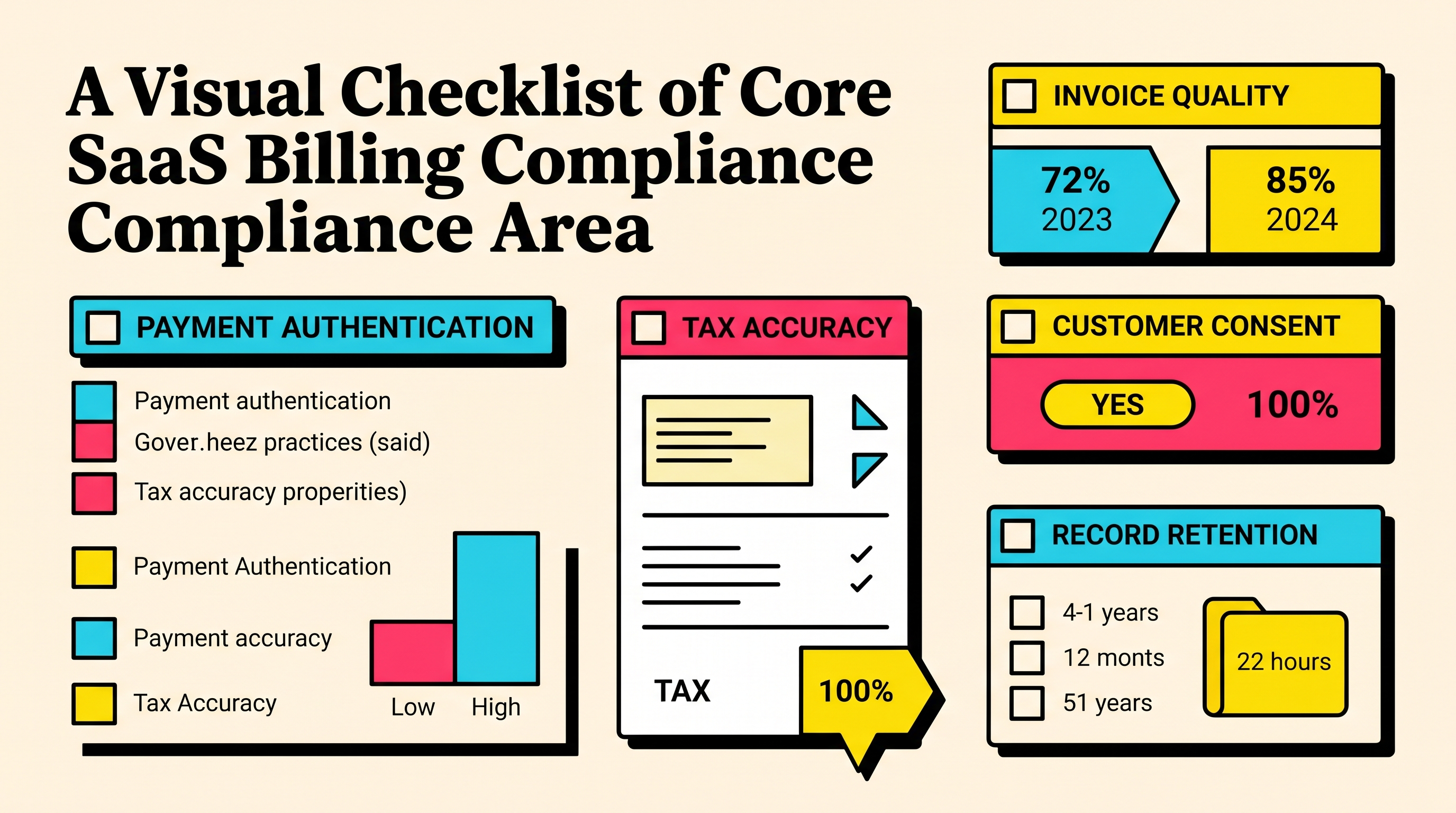
A lot of teams hear “compliance” and immediately think GDPR banners and terms pages. Those matter, but billing compliance is broader. In practice, it touches five areas:
- payment authentication and authorization rules
- tax calculation and invoice accuracy
- subscription disclosures and customer consent
- record keeping and auditability
- failed-payment handling and account access policy
That mix matters because the biggest billing messes are cross-functional. Product owns checkout. Finance owns tax logic. Engineering owns webhooks. Support deals with angry customers when renewals break. Nobody owns the whole journey, which is exactly why gaps appear.
For Stripe-heavy SaaS companies, compliance also overlaps with practical payment hygiene. If your team has never reviewed decline reasons systematically, the decline codes library is worth keeping close. Some billing issues are true bank declines. Others are self-inflicted wounds caused by bad setup, weak messaging, or missing customer action.
The 2026 SaaS billing compliance checklist
Use this as an audit, not as a vague aspiration board. If you cannot answer “yes” to an item, it is probably a live risk.
1. Your subscription terms are visible before checkout
Customers should be able to see what they are agreeing to before they pay. That includes price, billing frequency, renewal behavior, cancellation terms, and any trial-to-paid transition.
The obvious reason is legal clarity. The practical reason is fewer charge disputes and fewer “I did not realise this would renew” complaints.
Check:
- plan price is shown clearly in the checkout flow
- billing interval is explicit, monthly or annual, not implied
- renewal behavior is stated in plain English
- trial length and post-trial charge timing are shown before payment
- cancellation path is documented in the product or on the pricing flow
If your subscription terms need a support agent to explain them, they are not compliant enough. They are just hidden.
2. Payment authentication flows are configured for reality, not hope
In 2026, too many teams still treat payment authentication as a rare edge case. It is not. Depending on market, issuer behavior, risk signals, and payment method, customers will get pushed through extra authentication steps. If those flows are broken, you get failed renewals that look mysterious until you dig in.
Check:
- your checkout supports required customer authentication when triggered
- renewal failure messaging explains when customer action is needed
- update-payment flows work cleanly on mobile and desktop
- retry logic does not mindlessly hammer cards that require authentication
- support can distinguish temporary bank issues from authentication failures
This is one reason the payment recovery benchmarks for SaaS topic matters. Recovery is not just “send more retries.” Sometimes the customer must complete a step, and your workflow needs to make that obvious.
3. Tax logic is accurate across regions you actually sell into
If you sell globally, tax errors are not just accounting problems. They create checkout friction, invoice mismatches, refund pain, and customer distrust. For some SaaS businesses, they also create support volume that hides real churn issues.
Check:
- tax collection rules are configured for every region where you actively sell
- business vs consumer logic is handled correctly where required
- tax IDs, VAT numbers, or equivalent fields are collected when relevant
- invoices show tax amounts clearly and consistently
- finance can explain how tax is calculated without reverse-engineering production data
If your founder answer to tax logic is “Stripe probably handles it,” that is not a system. That is wishful thinking wearing a dashboard.
4. Invoices and receipts contain the information customers expect
Bad invoice hygiene creates downstream nonsense. Procurement teams delay payment. Finance teams query every line item. Customers lose trust because the amount charged does not match the document they received.
Check:
- invoice dates, amounts, currency, tax, and legal entity details are complete
- recurring charges match the plan description customers saw at signup
- credit notes and refunds are documented cleanly
- invoices are accessible from the product or billing emails
- internal teams know which system is the source of truth
This is boring work. It is also the kind that quietly prevents churn in larger accounts, because billing confidence matters long before a customer ever says “compliance issue” out loud.
5. Consent and evidence are stored, not assumed
When a customer disputes a charge, “they definitely meant to sign up” is not evidence. You need records that show what the customer agreed to and when.
Check:
- you retain timestamped evidence of signup and plan selection
- trial acceptance and renewal terms can be reconstructed later
- billing emails and account notices are logged consistently
- important subscription changes create an auditable record
- team members know where that evidence lives
This is not just for disputes. It also sharpens your own internal debugging. If a customer says they never saw a renewal warning, you should be able to verify that quickly instead of turning it into a Slack archaeology expedition.
6. Failed-payment workflows match the reason for failure
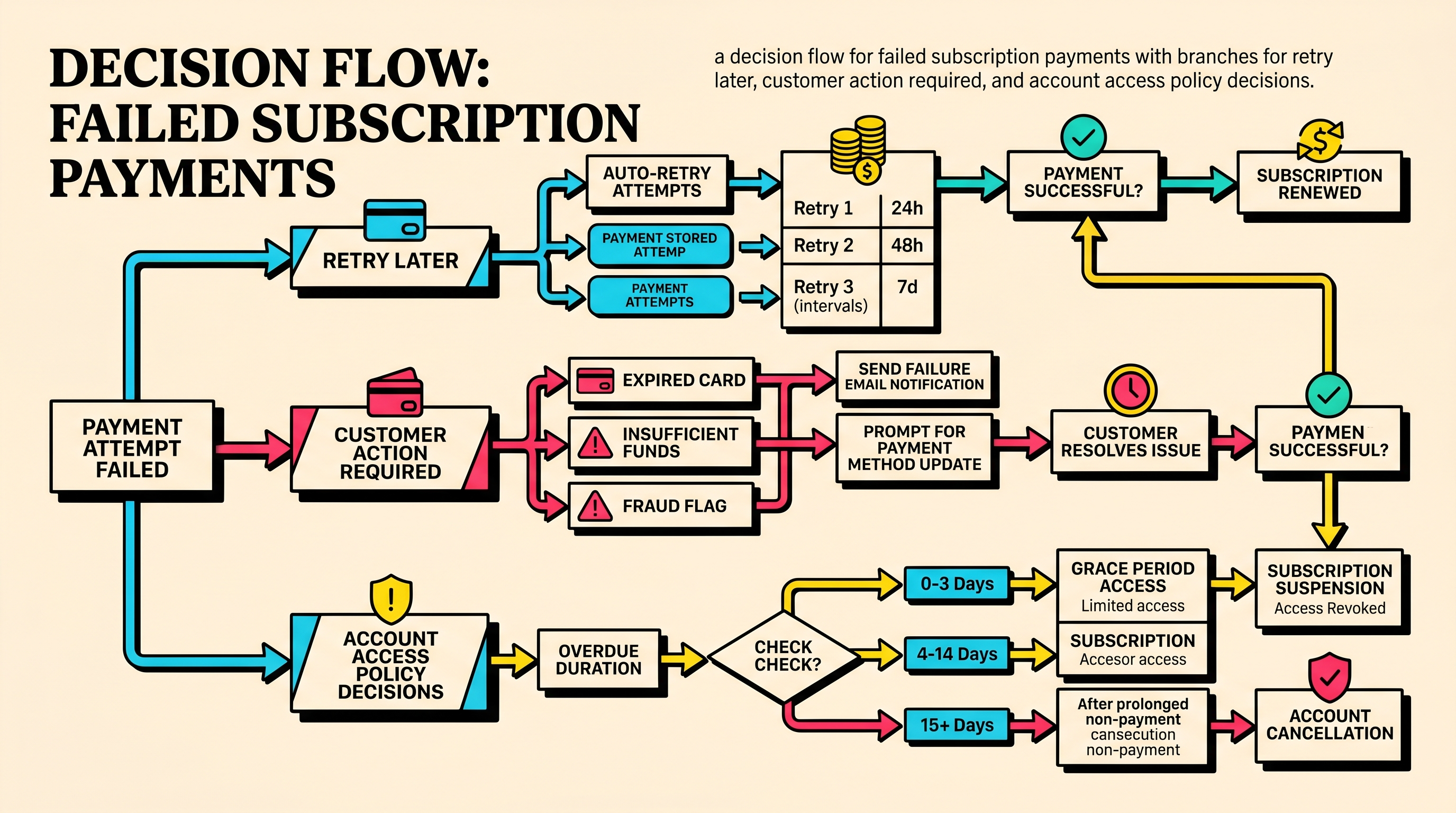
This is where compliance and churn collide head-on.
A compliant billing setup should not treat every failed payment the same way. Expired card, insufficient funds, authentication required, and suspected fraud do not deserve identical recovery logic. If your system does one thing for all failures, it is wasting recovery opportunities and increasing customer friction.
Check:
- failed payments are segmented by decline reason or action required
- dunning messages tell customers exactly what to do next
- grace periods are defined and intentional, not accidental
- access policy for past-due accounts is documented internally
- retries stop when more retries would be stupid
This is the same reason a clean SaaS billing compliance review often doubles as a churn audit. Sloppy billing policy causes involuntary churn faster than most founders realise.
7. Dunning emails are accurate, timely, and not vaguely threatening
Many dunning emails are weirdly terrible. They either sound robotic and useless or go full fake-urgent in a way that feels scammy. Neither helps recovery.
Check:
- subject lines clearly state there is a billing issue
- the email explains what failed and what the customer needs to do
- links to update payment details are obvious
- timing matches the actual retry and grace-period logic
- copy does not promise outcomes your system cannot deliver
Accuracy is part of compliance. If your email says access will end in seven days but the product actually cuts access in two, you have a trust problem and possibly a dispute problem.
8. Refund and cancellation rules are documented and followed consistently
Consistency matters. If one support agent refunds failed renewals automatically and another refuses every request, you do not have policy. You have chaos.
Check:
- refund rules are documented internally
- support knows when exceptions are allowed
- cancellations stop future charges reliably
- proration behavior is clear for plan changes
- finance and support are aligned on what counts as recoverable revenue versus refund risk
Customers are surprisingly tolerant of mistakes when the fix is clear and fair. They get furious when the system looks random.
9. Webhooks, billing events, and audit trails are actually monitored
A huge amount of SaaS billing compliance depends on event reliability. If a payment method updates but your app never processes the event, a customer can still churn even though they did the right thing.
Check:
- critical billing webhooks are monitored for failures
- retries and dead-letter handling exist for important events
- subscription state changes are logged somewhere queryable
- billing events can be reconciled against customer-facing status
- someone gets alerted when the billing event pipeline breaks
This is where teams usually discover that “the provider sends webhooks” is not the same as “our billing system is reliable.” It is not. Not even close.
10. Data retention and access controls are sane
Billing data is sensitive. You do not need every team member poking around payment records because permissions were never cleaned up.
Check:
- access to billing systems is limited by role
- exported billing data is not floating around in random spreadsheets forever
- retention periods are documented for key billing records
- deletion and anonymisation policies are understood where required
- vendors touching billing data are known and reviewed
Even if you are not in a heavily regulated space, basic discipline here saves you from future pain.
11. Multi-entity, multi-currency, and regional edge cases have an owner
Once a SaaS business expands internationally, billing edge cases multiply fast. Different entities, currencies, local taxes, and payment behavior can turn a simple setup into spaghetti.
Check:
- each selling entity has clear ownership
- currency presentation matches how customers are charged
- tax and invoice logic is correct per entity or region
- support knows how regional billing differences affect troubleshooting
- nobody is “temporarily” managing this forever without process
The trap here is pretending edge cases are rare. They stop being edge cases the moment 20 percent of your revenue depends on them.
12. You review billing friction as a revenue problem, not just a compliance problem
This is the final item because it is the one founders skip.
A good compliance review should answer three practical questions:
- where are customers getting confused during checkout or renewal?
- which failed payments are genuinely unrecoverable versus process failures?
- what percentage of churn is actually billing friction in disguise?
If your team cannot answer that, you are probably losing revenue under the label of “normal churn.” That is lazy accounting for a fixable problem.
The failed payment prevention checklist for new SaaS is a useful companion here because it shifts the conversation from reactive recovery to upstream prevention.
A simple operating model for staying compliant without building a bureaucracy
Most teams do not need a giant compliance machine. They need a repeatable operating rhythm.
A practical version looks like this:
- monthly review of failed-payment reasons and recovery rates
- quarterly audit of checkout terms, invoices, and billing emails
- quarterly test of update-payment flows on mobile and desktop
- documented owner for tax setup, support policy, and billing event reliability
- one dashboard or report tying billing friction to churn outcomes
That is enough to catch a shocking amount of nonsense before it grows teeth.
Common mistakes founders make
A few patterns show up over and over:
- assuming the billing provider automatically solved compliance
- treating tax setup as a finance-only issue
- letting support improvise refund policy
- using the same retry and dunning path for every failure reason
- not testing renewal experiences until customers complain
- focusing on chargeback risk while ignoring involuntary churn
The theme is always the same. Teams think billing compliance is back-office admin. In reality, it is a product, finance, and retention system wearing a boring hat.
Final check before you call this done
If you only do one thing after reading this, do this: pick ten failed renewals from the last 30 days and trace each one from invoice creation to final outcome.
If the path is hard to reconstruct, your billing system is too opaque.
If multiple outcomes depend on manual heroics from support, your process is too fragile.
If customers are being asked to do unclear or unnecessary steps, your compliance setup is actively hurting recovery.
That is the whole game. Better compliance is not about looking impressive. It is about removing preventable friction from the revenue path.
If you want to see where Stripe billing issues and failed-payment gaps may be costing you recoverable revenue, run a free churn audit at churnbot.co/audit.
Related Posts

7 Failed Payment Segments Every Stripe Team Should Track
Pre-Dunning: How to Prevent Failed Payments Before They Happen
The Complete Toolkit for Managing Failed Payments
How healthy is your Stripe account?
Get a free churn health report. Find pending cancellations, failed payments, and expiring cards putting your MRR at risk.
Run Free Audit