Why SaaS Payment Failure Rates Are Rising in 2026
If you run a SaaS business on Stripe, you've probably noticed something unsettling in your dashboard over the past few months: your payment failure rate is creeping up.
You're not imagining it. Across the board, SaaS payment failure rates are rising in 2026, and the trend is accelerating. This isn't just noise in the data. It's a structural shift that's hitting subscription businesses hard, and if you're not paying attention, it's silently bleeding your MRR dry.
The numbers tell a stark story. In 2023, the average SaaS payment failure rate sat around 9%. By late 2025, that climbed to 11.3%. Early 2026 data suggests we're now pushing 13% or higher for some verticals. That's a 44% increase in just three years.
For a $50k MRR business, that's an extra $2,000 per month walking out the door. For a $500k MRR company, it's $20,000. This isn't a rounding error anymore. It's a revenue crisis masquerading as a billing problem.
So what's driving this surge? And more importantly, what can you do about it? Let's break it down.
The Four Forces Driving SaaS Payment Failure Rates in 2026
1. The Great Card Issuer Crackdown
The biggest driver? Card issuers have gotten a lot stricter about what they approve.
In response to rising fraud and regulatory pressure (especially in Europe with PSD2 and Strong Customer Authentication), banks and card networks have tightened their approval algorithms. What used to pass through without friction now gets flagged, declined, or bounced to additional verification.
This means legitimate transactions are getting caught in the crossfire. Subscription charges, especially recurring ones without 3D Secure, are under heavier scrutiny than ever.
The result: more "insufficient funds" and "do not honor" decline codes, even when the customer's card is valid and has enough balance.
Stripe's own data shows that issuer-side declines (where the bank says no, not Stripe) have increased by 18% year-over-year. That's a structural change, not a temporary blip.
2. Economic Pressure on Customers
Let's not sugarcoat it: 2026 is a tough year for consumer and SMB budgets.
Inflation has cooled, but its effects linger. Real wages haven't caught up. Small businesses are still recovering from multiple years of economic volatility. And in many markets, credit card balances are at all-time highs.
What does that mean for your SaaS? More cards hitting their limits. More customers choosing which subscriptions to keep and which to let lapse. More involuntary churn from genuine insufficient funds.
This is especially pronounced in lower-price-point SaaS ($10-$50/month). When budgets are tight, these are the first charges to fail, not because customers want to cancel, but because they're juggling too many expenses on a maxed-out card.
3. The Shift to Virtual and Digital-First Cards
Virtual cards and digital wallets are everywhere now. Apple Pay, Google Pay, Privacy.com cards, Revolut virtual cards—customers love them because they offer better security and control.
But they're also a nightmare for subscription billing.
Why? Because virtual cards often come with spending limits, expiry quirks, and issuer rules that don't play nicely with recurring charges. A customer might set up a virtual card for a single purchase, forget about it, and then your monthly charge hits a dead end.
Worst of all, virtual card declines often come back as vague error codes like "card not supported" or "transaction not allowed," giving you zero insight into what actually went wrong.
The shift to digital-first payment methods is great for fraud prevention, but it's increasing baseline failure rates across the board.
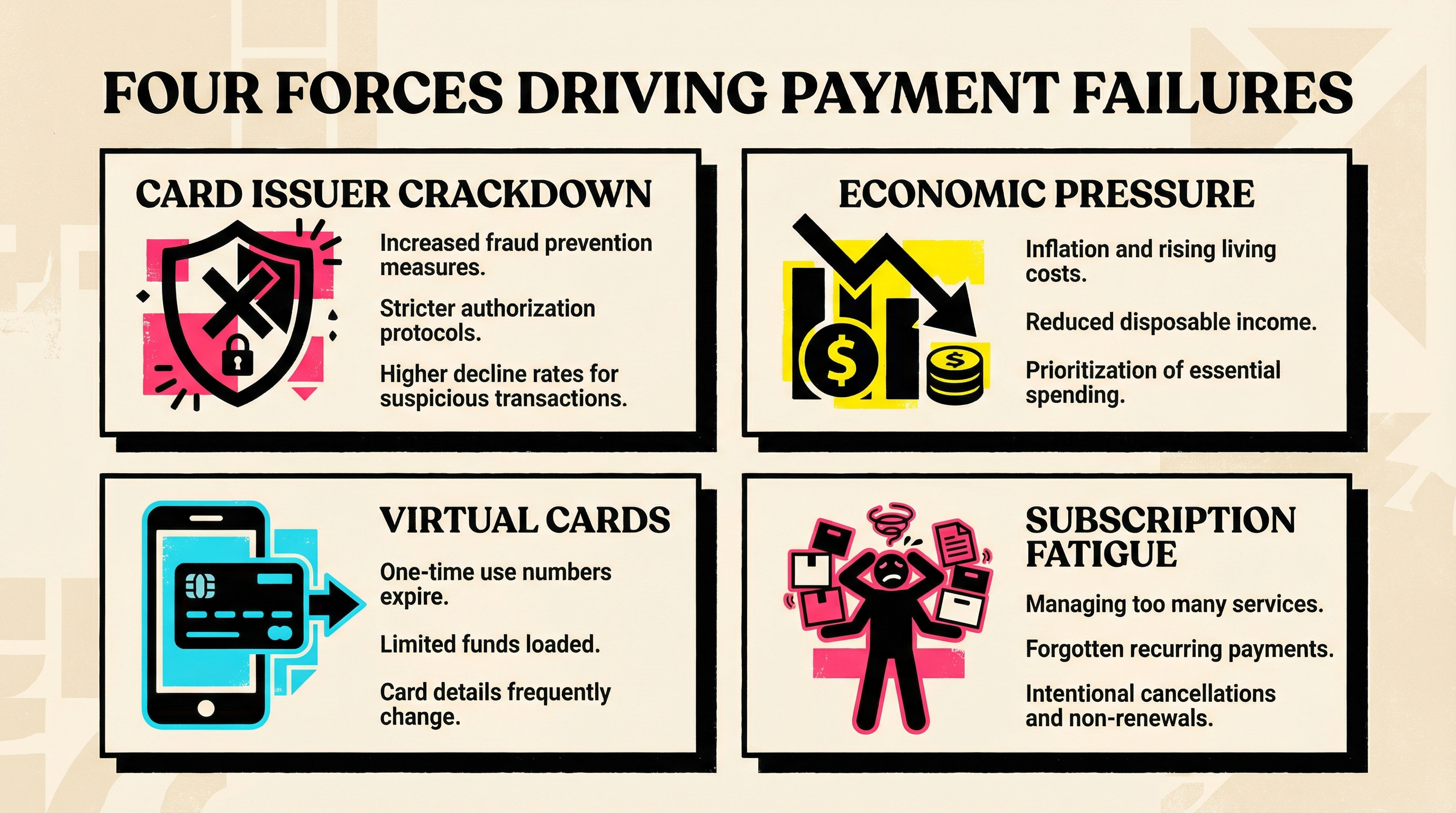
4. Subscription Fatigue and Passive Churn
Here's the uncomfortable truth: some of your payment failures aren't accidents. They're passive cancellations.
In 2026, the average consumer has 12+ active subscriptions. That's a lot of recurring charges hitting their card every month. When they see a charge they don't recognize or don't remember signing up for, they're more likely to just... let it fail.
No angry cancellation email. No support ticket. Just a declined card and radio silence.
This is involuntary churn on the surface, but it's really voluntary churn in disguise. The customer didn't explicitly cancel, but they also didn't update their payment method when your dunning emails hit their inbox.
The line between involuntary and voluntary churn is blurring, and it's making payment recovery harder than ever.
What Rising Payment Failures Actually Cost You
Let's get specific about the damage.
If your payment failure rate increases from 9% to 13%, here's what happens:
- Lost MRR: A $100k MRR business loses an extra $4,000/month. That's $48k/year in revenue walking out the door.
- Higher CAC payback: If your CAC is $500 and ARPU is $50/month, you need 10 months to break even. A 4% bump in churn means you're losing customers before they pay back acquisition costs.
- Compounding effect: If you don't recover those failed payments, you lose not just this month's revenue, but every future month from those churned customers. Over a year, that 4% increase becomes a 50%+ hit to annual recurring revenue from those cohorts.
And here's the kicker: most of these failures are recoverable. Studies show that 40-60% of failed payments can be recovered with the right approach. But if you're not actively managing payment recovery, you're just letting that revenue slip away.
If you're curious how much you're actually losing, run a free churn audit and see the real numbers from your Stripe account.
The Silent Killers: Which Failure Types Are Spiking?
Not all payment failures are created equal. Some are spiking faster than others in 2026.
Card Expiry: The Low-Hanging Fruit
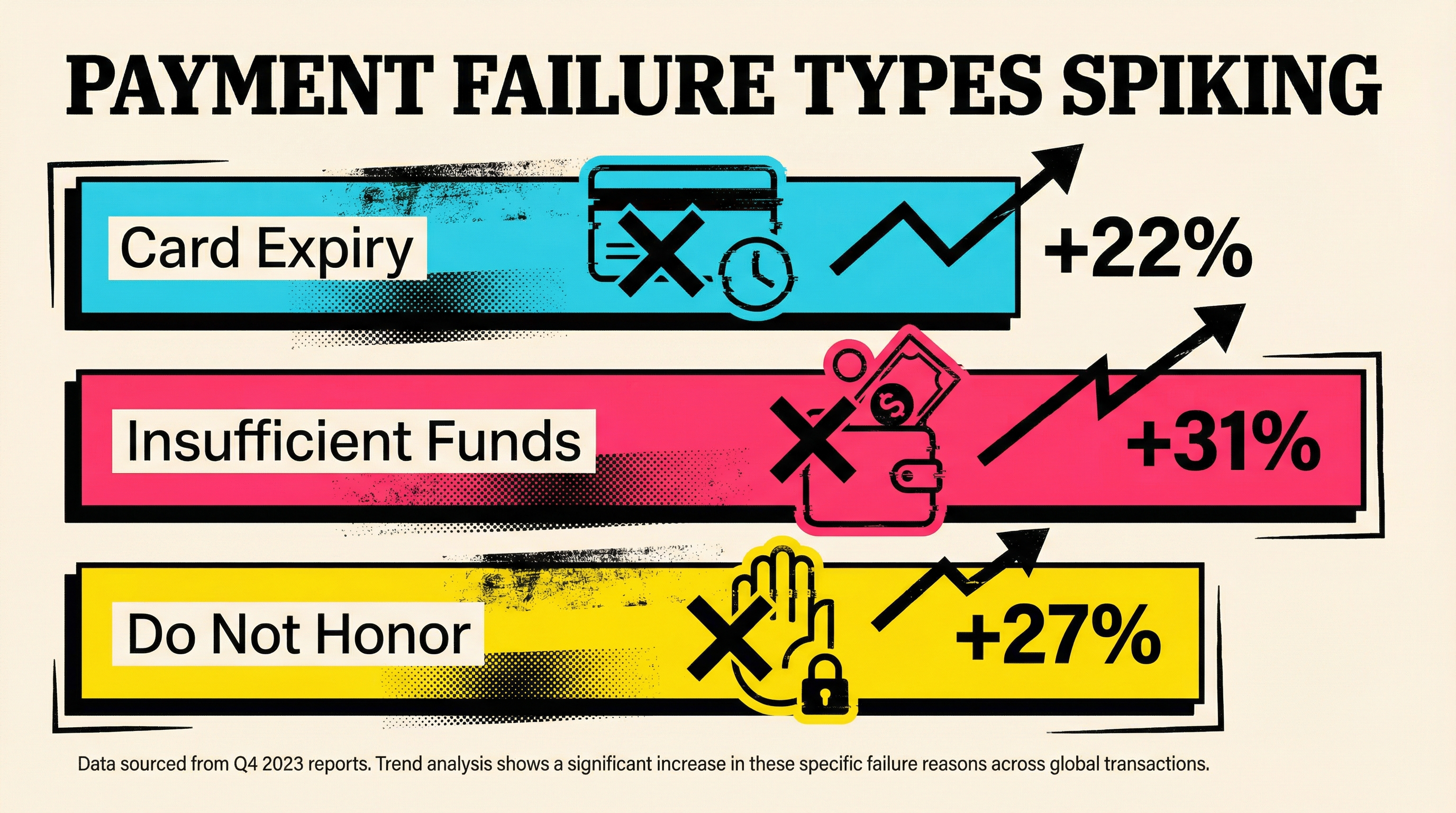
Expired cards remain the easiest failure to prevent, but they're still a major driver. With the shift to virtual cards (which often have shorter lifespans), expiry-related failures are up 22% compared to 2023.
The good news: this is 100% preventable with proactive card expiry management. Stripe's Account Updater and pre-dunning emails can catch most of these before they fail.
Insufficient Funds: The Economic Indicator
Insufficient funds declines are the canary in the coal mine for economic health. In Q1 2026, these failures are up 31% year-over-year.
This is partly economic (customers genuinely don't have the money), but it's also timing-related. If your charge hits the same day as rent or a big bill, you lose. Smart retry logic that spreads attempts across multiple days can help here.
Do Not Honor: The Mystery Decline
The vaguest decline code is also the fastest-growing. "Do not honor" failures (where the bank says no but won't tell you why) are up 27% in 2026.
These are often fraud-prevention false positives. The bank's algorithm sees something it doesn't like (maybe your merchant name, maybe the charge amount, maybe the customer's spending pattern) and just blocks it.
There's no silver bullet for these, but customer communication helps. If a charge fails with "do not honor," reaching out to the customer immediately and asking them to manually retry (or contact their bank) can recover 30-40% of these failures.
For a full breakdown of what each decline code means and how to handle it, check out Stripe decline codes explained.
What You Can Do About It (Starting Today)
Rising payment failure rates are a macro trend you can't control. But you can control how you respond.
Here are the highest-leverage moves you can make right now:
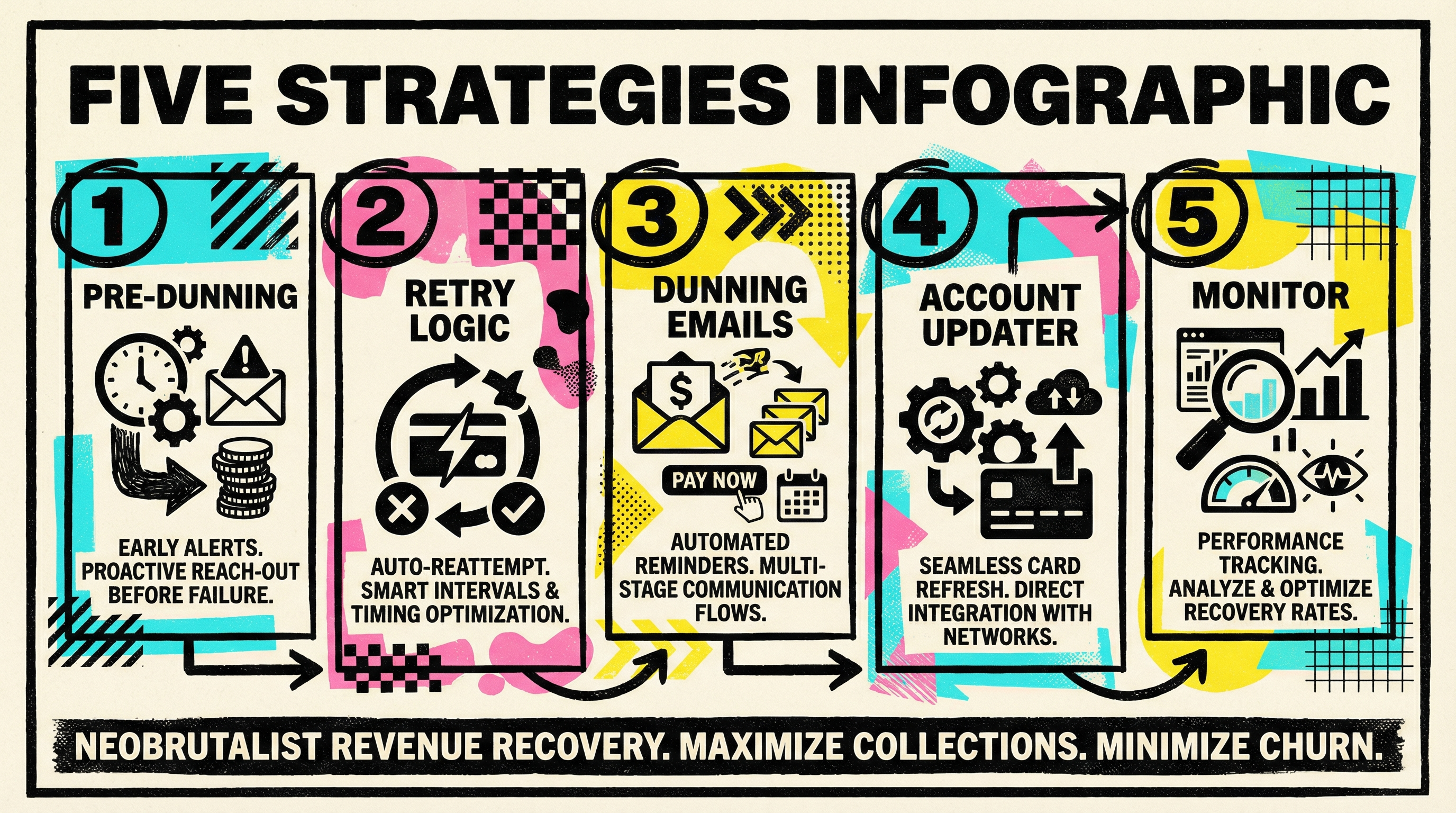
1. Implement Pre-Dunning (Before Charges Fail)
Don't wait for a charge to fail. Catch problems before they happen.
Pre-dunning means reaching out to customers 3-7 days before their renewal if:
- Their card is expiring soon
- Their last charge failed
- They've shown signs of payment issues in the past
A simple email saying "Hey, your card expires next week, mind updating it?" can prevent 40%+ of expiry-related failures.
2. Optimize Your Retry Logic
Stripe's Smart Retries are good, but they're not perfect. If you're running any volume, you need custom retry logic tailored to your business.
Best practices:
- Retry failed charges at different times of day (morning vs. evening)
- Space retries 3-5 days apart to give customers time to add funds
- Use different retry schedules based on decline code (expiry = retry immediately, insufficient funds = wait 3 days)
- Stop retrying after 3-4 attempts to avoid annoying customers and racking up Stripe fees
If you want a step-by-step guide, read how to set up a payment recovery flow in Stripe.
3. Improve Your Dunning Emails
Your dunning emails are probably boring, generic, and getting ignored.
A good dunning email:
- Has a clear, urgent subject line ("Action needed: payment failed")
- Explains what happened in plain language
- Gives a one-click link to update payment details
- Reminds the customer why they signed up in the first place
- Doesn't sound like a robot wrote it
Test different messaging, CTAs, and send timing. Small changes here can boost recovery rates by 20-30%.
4. Use Account Updater
Stripe's Account Updater automatically pulls updated card details from card networks when a card expires or is replaced. It's not 100% coverage, but it catches a meaningful chunk of expiry failures before they happen.
If you're not using it, turn it on. It costs nothing and prevents easy failures.
5. Monitor Your Failure Trends Weekly
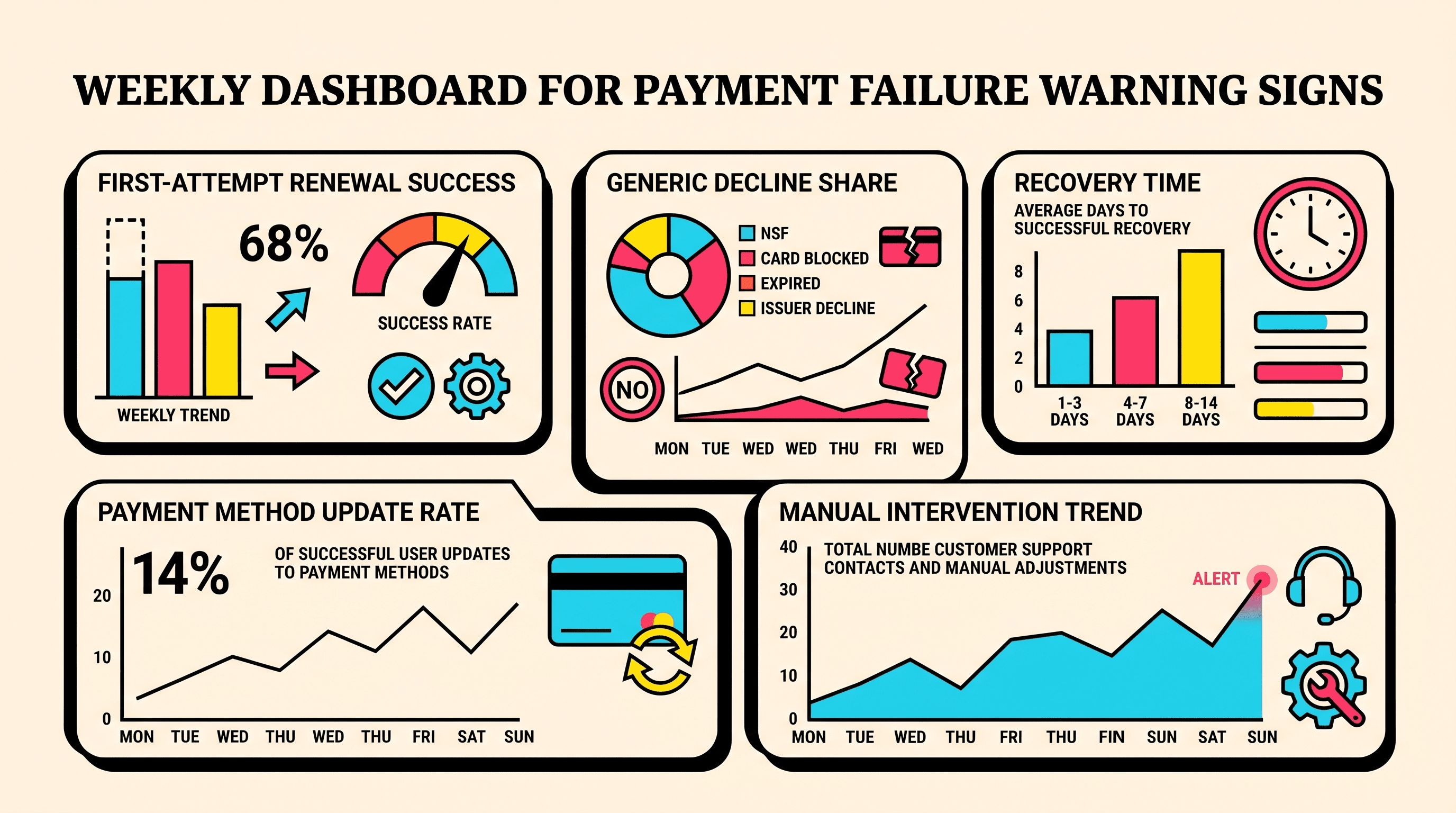
You can't fix what you don't measure. Set up a weekly dashboard that tracks:
- Overall payment failure rate
- Failure rate by decline code
- Recovery rate (% of failed payments you successfully retry)
- Time-to-recovery (how long it takes to recover a failed payment)
If you see a sudden spike in a specific decline code, investigate immediately. It might be a Stripe issue, a bank issue, or a problem with your checkout flow.
The 2026 Playbook: Treat Payment Failures Like a Product Problem
Here's the shift that separates winners from losers in 2026: stop treating payment failures as a billing issue and start treating them as a product problem.
That means:
- Building a dedicated payment recovery flow (not just Stripe's default emails)
- Assigning someone to own payment failure metrics
- Running experiments on retry logic, email copy, and timing
- Instrumenting your checkout and payment flows to catch issues before they become failures
The best SaaS companies in 2026 have payment recovery rates north of 60%. The worst are stuck at 20-30%. That gap is the difference between growing and treading water.
If you're not actively managing this, you're leaving 6-7 figures on the table every year.
What to Expect for the Rest of 2026
Will payment failure rates keep climbing?
Probably. The four forces we covered (issuer crackdowns, economic pressure, virtual cards, subscription fatigue) aren't going away anytime soon.
But here's the good news: as the problem gets worse, the tools get better. Stripe is rolling out better retry logic, more transparent decline data, and improved card updater coverage. Third-party tools are getting smarter about recovery workflows.
The companies that win in this environment will be the ones that:
- Treat payment recovery as a revenue lever, not a cost center
- Invest in proactive prevention (pre-dunning, expiry management)
- Optimize their retry and recovery flows aggressively
- Communicate with customers like humans, not billing robots
The Bottom Line
SaaS payment failure rates are rising in 2026, and the trend is accelerating. If you're not actively managing payment recovery, you're losing 6-7 figures in preventable revenue every year.
The good news? Most of this is fixable. With the right systems, you can recover 40-60% of failed payments and turn a revenue leak into a growth lever.
Want to see exactly how much revenue you're losing to failed payments? Run a free churn audit at ChurnBot and get a full breakdown of your Stripe payment health in under 60 seconds.
Related Posts
10 Early Warning Signs of Growing Payment Failure Risk
Regional Payment Failure Patterns: What the Data Shows

6 Hidden Stripe Settings That Reduce Payment Failures
How healthy is your Stripe account?
Get a free churn health report. Find pending cancellations, failed payments, and expiring cards putting your MRR at risk.
Run Free Audit