Stripe Billing vs Manual Subscription Management for Churn
You're running subscriptions on Stripe. But are you using Stripe Billing, or are you managing subscriptions manually through the API? The answer has a direct impact on how much involuntary churn you're losing to failed payments, and most founders don't realize it until the revenue damage is already done.
This isn't a feature comparison article. It's a breakdown of how each approach handles the payment failure lifecycle, where the churn gaps appear, and which setup gives you the best shot at keeping customers who actually want to stay.
What We Mean by "Stripe Billing" vs "Manual"
First, let's define terms. Stripe offers two distinct paths for managing recurring payments:
Stripe Billing is the full subscription management layer. You create Products, Prices, and Subscription objects through Stripe's API or dashboard. Stripe handles the billing cycle, invoicing, proration, and has built-in dunning tools like Smart Retries and automatic emails. Manual subscription management means you're using Stripe as a payment processor but handling the subscription logic yourself. You store billing cycles in your database, trigger charges via the PaymentIntent or Charge API when they're due, and manage all retry logic, emails, and state transitions in your own code.Both approaches work. Both can process payments reliably. But they diverge significantly when a payment fails, and that's where churn enters the picture.
According to industry data, the average SaaS company loses 9-12% of its MRR to involuntary churn annually. That's customers who wanted to keep paying but couldn't because of card issues, insufficient funds, or expired payment methods. The difference between Stripe Billing and manual management can swing your recovery rate by 10-20 percentage points.
The Payment Failure Lifecycle: Where Churn Actually Happens
To understand why the approach matters, you need to understand what happens when a payment fails. It's not a single event. It's a sequence:
- Initial charge attempt fails
- Retry logic kicks in (or doesn't)
- Customer notification goes out (or doesn't)
- Grace period runs (or doesn't exist)
- Subscription cancellation happens (immediately or after exhausting retries)
Each step is a decision point. Get any of them wrong and you lose a customer who was perfectly happy with your product.
Stripe Billing: The Built-In Safety Net
When you use Stripe Billing, you get several layers of protection out of the box:
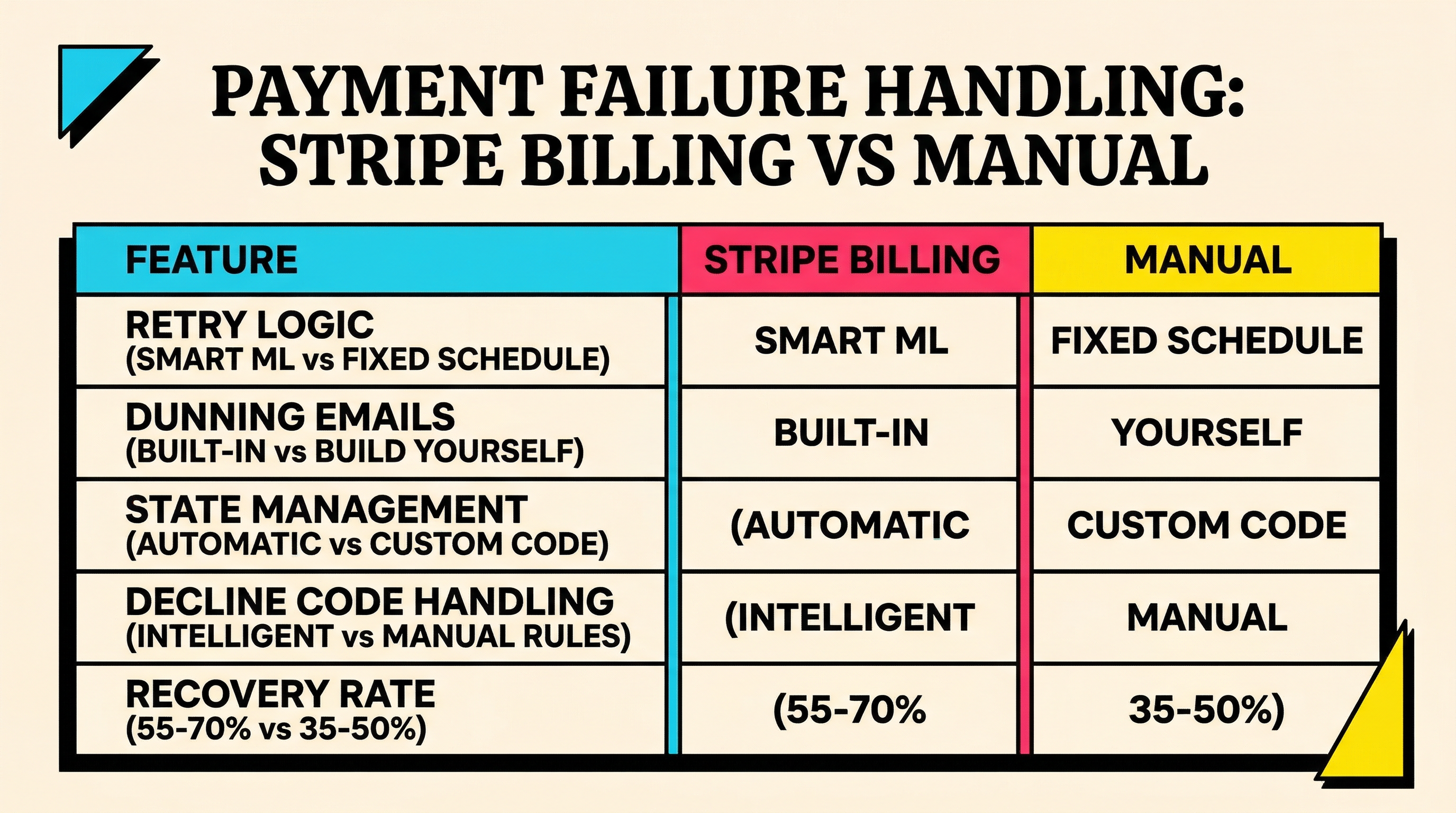
Smart Retries. Stripe's machine learning system analyzes billions of payment attempts across their network to determine the optimal time to retry a failed charge. This isn't a simple "try again in 3 days" schedule. Stripe looks at the card network, the issuer's historical acceptance patterns, the time of day, and the day of the week. According to Stripe's published data, Smart Retries recover up to 25% more failed payments compared to fixed retry schedules. Automated dunning emails. Stripe can send branded emails to customers when their payment fails, asking them to update their payment method. You configure these in the dashboard: first notice, reminder, final warning. They're not beautiful, but they work. Subscription status management. Stripe automatically transitions subscriptions throughpast_due, unpaid, and canceled states based on your configured rules. You decide how many retry attempts before cancellation, whether to leave the subscription active during retries, and how long the grace period lasts.
Invoice lifecycle. Every billing cycle creates an Invoice object with its own state machine. Failed invoices remain open and retryable. You can see exactly which invoices failed, why they failed, and whether recovery was attempted.
Manual Management: The DIY Challenge
When you're managing subscriptions manually, every single one of those features becomes your responsibility:
Retry logic. You need to build a job queue that schedules retry attempts. When should you retry? How many times? With what spacing? Most manual implementations use a fixed schedule like "retry at day 1, 3, 5, 7." That's predictable, but it ignores the context that makes Smart Retries effective. You're retrying at the same time for every customer regardless of their card type, issuer, or location. Customer communication. You need to build and send dunning emails yourself. That means email templates, a sending service (SendGrid, Postmark, SES), tracking opens and clicks, and handling unsubscribes. It's a separate system to build and maintain. State management. Your database needs to track subscription states, payment attempt counts, grace periods, and cancellation triggers. A bug in this logic can silently cancel paying customers or keep failed subscriptions active indefinitely (both are bad). Decline code handling. Different decline codes require different responses. Acard_declined with reason insufficient_funds is worth retrying. A card_declined with reason stolen_card is not. With Stripe Billing, this intelligence is baked in. Manually, you need to understand every Stripe decline code and handle them appropriately.
!Comparison of payment failure handling between Stripe Billing and manual subscription management
Stripe Billing Churn: The Numbers That Matter
Let's get specific about how each approach performs. These numbers come from industry benchmarks and Stripe's published data:
Recovery rates:- Stripe Billing with Smart Retries: 55-70% of failed payments recovered
- Manual fixed-schedule retries: 35-50% of failed payments recovered
- No retry logic at all: 10-15% self-resolve (customer updates card independently)
- Smart Retries typically recover payments within 7-14 days
- Manual retries usually attempt over 7-14 days but with worse timing
- The first 48 hours after failure are the most critical recovery window
- Dunning emails increase recovery rates by 15-25% on top of retries alone
- Best-performing dunning sequences use 3-4 emails over 7-10 days
- SMS notifications (manual only, Stripe doesn't offer this) can add another 5-10%
The gap between 55-70% and 35-50% recovery doesn't sound dramatic until you run the math. For a SaaS company at $50,000 MRR with a 5% monthly payment failure rate:
- $2,500/month in failed payments
- Stripe Billing recovers ~$1,500-1,750
- Manual retries recover ~$875-1,250
- Difference: $250-875/month, or $3,000-10,500/year
That's pure profit. No acquisition cost, no onboarding. Just keeping customers you already have.
Where Stripe Billing Falls Short
Stripe Billing isn't perfect. Understanding its limitations is just as important as knowing its strengths.
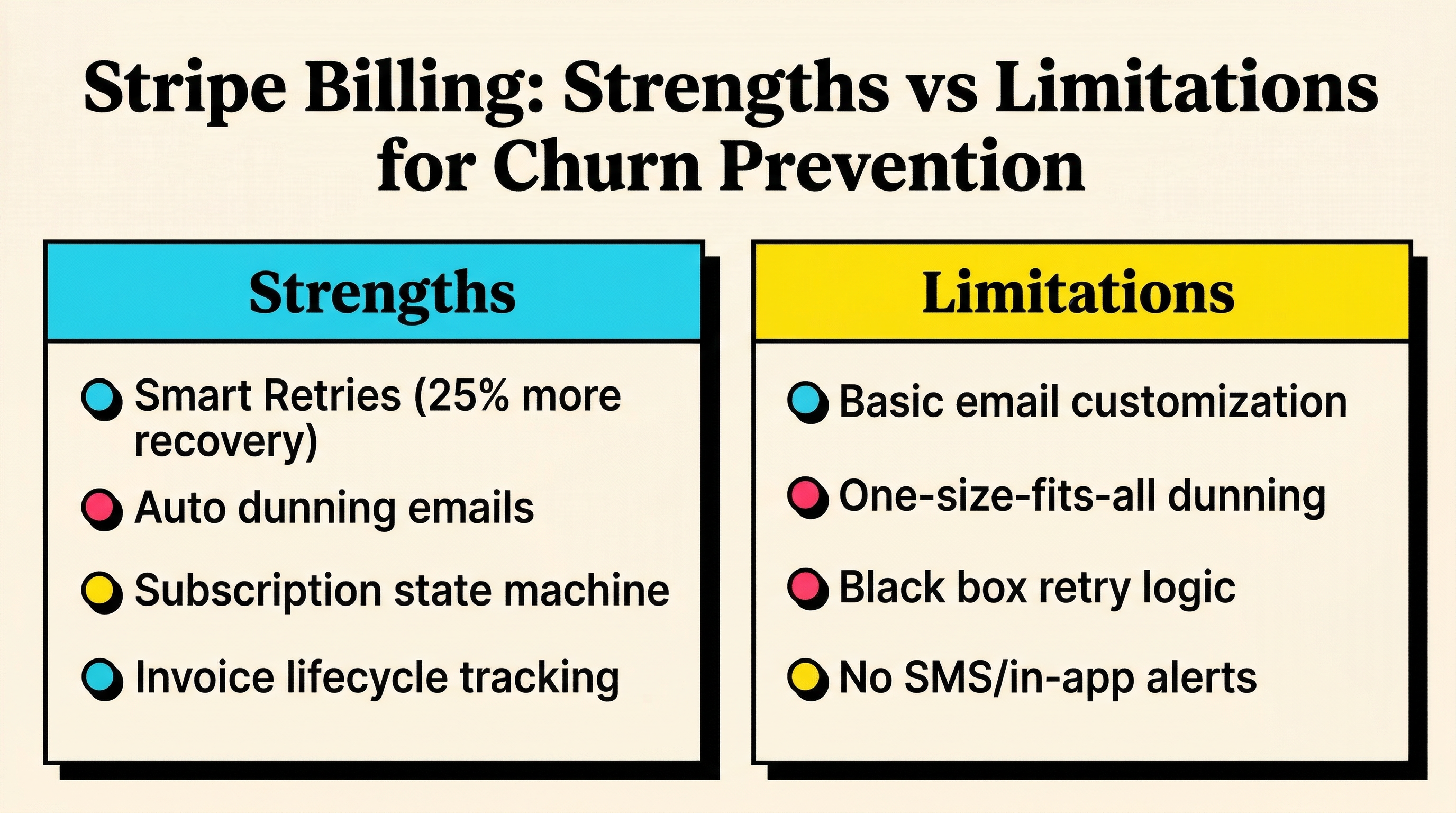
Limited email customization. Stripe's dunning emails are functional but basic. You can add your logo and adjust copy, but you can't build sophisticated email sequences with dynamic content, A/B testing, or personalized messaging. If your brand voice matters (and it should), you might find Stripe's emails feel generic. One-size-fits-all dunning. Stripe's dunning settings apply to all customers equally. You can't set different retry strategies for enterprise customers versus SMB, or for customers on annual plans versus monthly. Every subscription follows the same rules. Black box retries. Smart Retries work well, but you can't see exactly why Stripe chose to retry at a specific time. If you need to explain to your CFO why a customer was charged at 3 AM on a Tuesday, you'll get "machine learning" as the answer. Webhook complexity. While Stripe Billing handles the billing logic, you still need to listen to webhooks to keep your application in sync.invoice.payment_failed, customer.subscription.updated, customer.subscription.deleted: you need handlers for all of these. Miss one and your app state diverges from Stripe's state, which causes its own set of problems.
No SMS or in-app notifications. Stripe only sends emails. If your customers don't read email (increasingly common), you're missing a critical notification channel. Manual implementations can add SMS via Twilio, in-app banners, push notifications, or even Slack/Discord alerts.
!Stripe Billing strengths vs limitations for churn prevention in SaaS
Where Manual Management Wins
There are legitimate reasons to manage subscriptions manually, especially if you're willing to invest in building robust recovery infrastructure:
Full control over retry timing. You can build intelligent retry logic that considers your specific customer base. If you know most of your customers are in the US and get paid on the 1st and 15th, you can time retries accordingly. You can even let customers choose their billing date and retry around paycheck cycles. Multi-channel dunning. Email, SMS, in-app notifications, push notifications, Slack messages. You choose the channels that reach your customers best. Some SaaS companies report that in-app notifications recover more payments than email because users see them when they're already engaged with the product. Segmented strategies. High-value enterprise customer on a $5,000/month plan? Maybe you want a personal phone call before cancellation. $29/month SMB customer? Automated emails are fine. Manual management lets you build these workflows. Custom grace periods. Stripe Billing's grace period settings are global. Manually, you can offer different grace periods based on customer tenure, plan value, or payment history. A loyal customer who's been paying for 3 years might deserve a longer grace period than someone in their first month. Integration with your support workflow. When you manage subscriptions manually, you can automatically create support tickets, alert your CS team, or trigger custom workflows when payments fail. This human touch can recover customers that automation misses.The Hybrid Approach: Best of Both Worlds
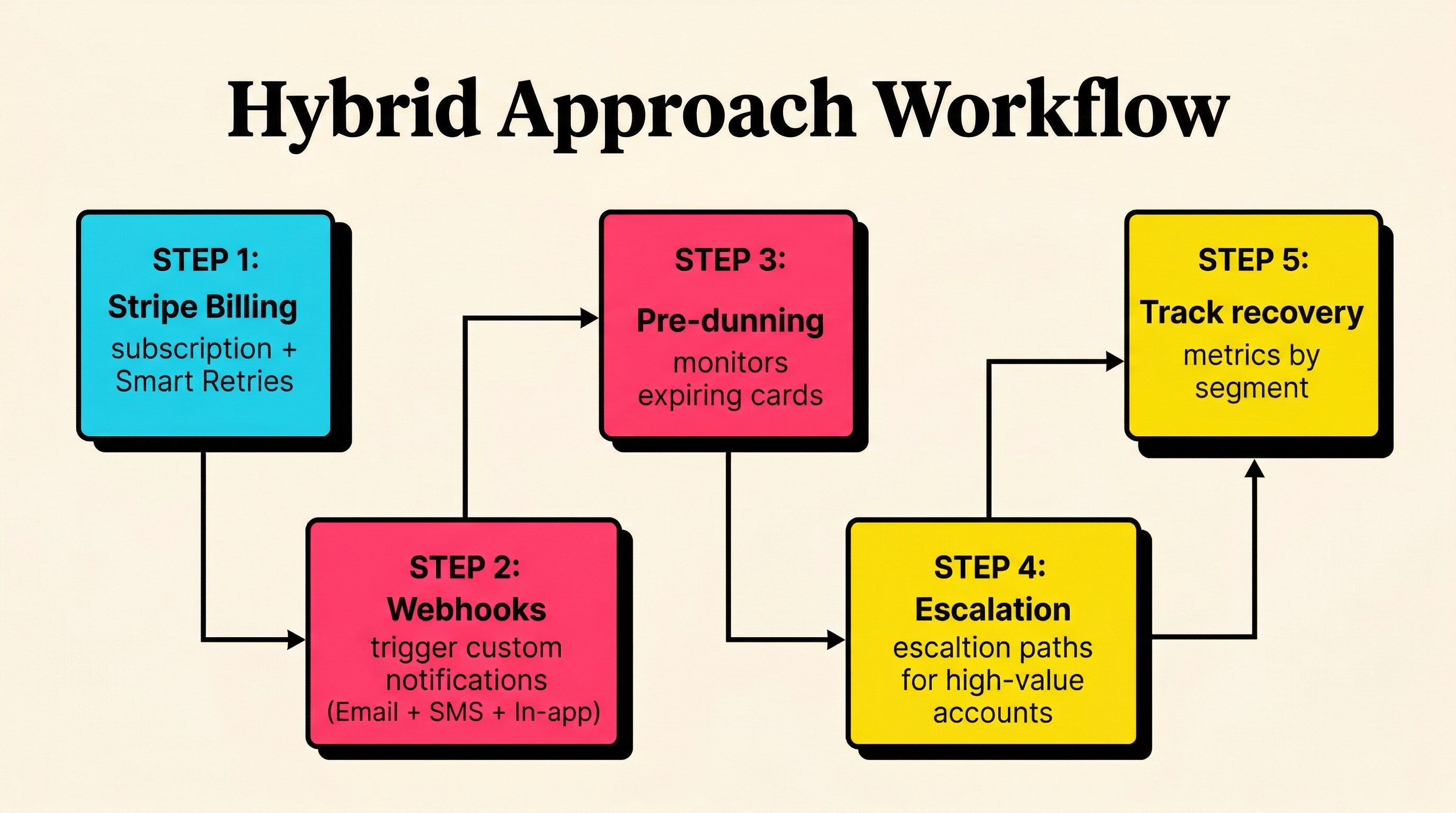
Here's what the smartest SaaS companies do: use Stripe Billing for subscription management and payment processing, but layer their own recovery logic on top.
This means:
- Let Stripe Billing handle the basics. Create subscriptions through Stripe's API. Let Smart Retries do the first round of recovery. Use Stripe's subscription state machine for lifecycle management.
- Listen to webhooks and augment. When you receive an
invoice.payment_failedwebhook, trigger your own notification system alongside Stripe's dunning emails. Send an SMS. Show an in-app banner. Create a support ticket for high-value accounts.
- Add pre-dunning prevention. Monitor for expiring cards before they fail. Stripe Billing doesn't proactively alert customers about upcoming card expirations (though the card networks' Account Updater service helps). Build a system that checks
card.exp_monthandcard.exp_yearand prompts customers to update their payment method 30 days before expiration.
- Build escalation paths. If Stripe's retries fail after 7 days, trigger your own recovery sequence. A personal email from the founder. A discount offer. A phone call for high-value accounts. These second-line tactics can recover another 10-15% of failed payments that automated systems miss.
- Track everything. Use Stripe's reporting for baseline metrics, but build your own dashboard that tracks recovery rates by decline code, plan type, customer segment, and notification channel. Understanding your payment health benchmarks lets you optimize over time.
!Hybrid approach workflow combining Stripe Billing with custom recovery logic
Implementation Decision Framework
Still not sure which approach to use? Here's a practical framework:
Choose Stripe Billing if:
- You have fewer than 1,000 subscribers
- Your engineering team is small (1-5 developers)
- You'd rather spend time building product features than billing infrastructure
- Your average revenue per customer is under $200/month
- You're in the first 2 years of your SaaS
The reasoning: Stripe Billing gets you 80% of the way with 10% of the effort. Smart Retries alone will recover more payments than most custom implementations. The engineering time you save is better spent on product-market fit.
Choose manual management if:
- You have enterprise customers paying $5,000+/month
- You need segment-specific billing rules (usage-based, hybrid pricing, custom terms)
- You have a dedicated billing/payments engineer
- Your payment failure rate is above 8% and you've already tried Stripe Billing
- You need SMS/in-app/multi-channel dunning
The reasoning: At enterprise scale, the revenue at risk justifies the engineering investment. A single recovered $10,000 payment pays for a month of engineering time.
Choose the hybrid approach if:
- You're between 500-10,000 subscribers
- You have moderate engineering resources
- You want Smart Retries plus custom notifications
- You're seeing 5-10% monthly payment failure rates
- You want to optimize recovery without rebuilding billing from scratch
The reasoning: Most growing SaaS companies land here. Stripe Billing provides the foundation. Your custom layer handles the edge cases and high-value recovery that automation misses.
Common Mistakes That Increase Churn (Both Approaches)
Regardless of which approach you choose, these mistakes will cost you customers:
Canceling too quickly. If your first retry fails and you immediately cancel the subscription, you're throwing away customers. Most payment failures are temporary. Industry best practice is a minimum 7-day grace period with 3-4 retry attempts. Not communicating at all. Surprising number of SaaS companies have no dunning emails. The customer's payment fails, retries happen silently, and then the subscription cancels without the customer knowing. They come back a month later wondering why they lost access. Ignoring decline codes. Ado_not_honor response from the issuer is very different from insufficient_funds. The first might indicate fraud. The second will likely resolve on payday. Treating all failures the same wastes retries on unrecoverable payments and gives up too early on recoverable ones.
No payment method update flow. When a customer's card is declined, do they know how to update it? Is there a direct link in your dunning email that takes them straight to a payment update page? Every click between "your payment failed" and "enter new card" reduces your recovery rate by 20-30%.
Not monitoring recovery metrics. If you don't measure your recovery rate, you can't improve it. Track: total failed payments, recovered payments, recovery rate by decline code, time to recovery, and revenue impact. Run a regular audit of your payment health to spot trends before they become problems.
Setting Up Stripe Billing for Minimum Churn
If you're going with Stripe Billing (or the hybrid approach), here's the configuration that minimizes involuntary churn:
Subscription settings:- Set
payment_behaviortodefault_incompleteso new subscriptions don't fail silently - Configure
collection_methodascharge_automatically - Set
days_until_dueappropriately if using invoices
- Enable Smart Retries
- Set retry schedule to maximum (up to 4 retries over 3-4 weeks)
- Configure email notifications: send on first failure, send reminder at day 3, send final notice at day 7
- Set subscription status after all retries fail to
canceled(notunpaid, which leaves zombie subscriptions)
invoice.payment_failed: trigger your own notification, log the decline codecustomer.subscription.updated: sync subscription status to your databasecustomer.subscription.deleted: handle access revocation gracefullyinvoice.paid: celebrate! Clear any "payment failed" banners in your appcustomer.source.expiring: proactively notify customer to update their card
- Enable Stripe's automatic card updates. When a card is reissued with a new number or expiry, Stripe automatically updates it. This prevents 10-20% of failures from cards that would have otherwise expired.
Measuring the Impact
After you've set up your chosen approach, track these metrics monthly:
- Payment failure rate: Failed charges / Total charges. Target: under 5%.
- Recovery rate: Recovered payments / Failed payments. Target: above 60%.
- Time to recovery: Average days between failure and successful re-charge. Target: under 7 days.
- Involuntary churn rate: Subscriptions canceled due to payment failure / Total active subscriptions. Target: under 1% monthly.
- Revenue impact: Dollar value of recovered payments. This is the number that proves ROI.
Compare your numbers against SaaS payment recovery benchmarks to see where you stand.
The Bottom Line
Stripe billing churn is a solvable problem. The question is how much engineering effort you want to invest in solving it.
For most SaaS companies under $500K ARR, Stripe Billing with Smart Retries is the right choice. It recovers more payments than you'd expect, it requires minimal engineering, and it lets you focus on building your product.
For companies above $1M ARR with significant enterprise revenue, the hybrid approach makes sense. Use Stripe Billing as your foundation, but layer custom notifications, segmented strategies, and human escalation paths on top.
Going fully manual only makes sense if you have unique billing requirements that Stripe Billing can't accommodate, like complex usage-based pricing or regulatory requirements that demand custom invoicing.
Whatever approach you choose, the worst thing you can do is nothing. Every month you're not actively recovering failed payments, you're losing customers who want to pay you. That's not churn. That's waste.
Take the First Step
Not sure how much revenue you're losing to failed payments right now? Run a free churn audit to see exactly where your Stripe account is leaking revenue, which decline codes are hitting you hardest, and what your recovery rate looks like compared to industry benchmarks. It takes two minutes and might save you thousands.
Related Posts

7 Failed Payment Segments Every Stripe Team Should Track


The Anatomy of a Failed Payment: What Actually Happens
How healthy is your Stripe account?
Get a free churn health report. Find pending cancellations, failed payments, and expiring cards putting your MRR at risk.
Run Free Audit