Understanding Stripe Invoice Lifecycle: From Draft to Failed
If you use Stripe Billing, the invoice lifecycle determines whether recurring revenue gets collected cleanly or quietly turns into churn. Most founders look at the moment a payment fails and start troubleshooting there. That is usually too late.
The better move is to understand the full stripe invoice lifecycle from the moment an invoice is created to the point where it is paid, retried, marked uncollectible, or left to die in the background. Every stage has operational consequences. Every state change changes what your customer sees, what Stripe attempts next, and how much recoverable revenue is still on the table.
For subscription businesses, that matters because invoice failures are rarely isolated accounting events. They are customer retention events. A draft invoice that never finalizes, an open invoice that never gets chased properly, or a failed payment that gets treated like a cancellation can all produce the same outcome: lost MRR that looks inevitable but was actually preventable.
Why the Stripe invoice lifecycle matters more than most teams think
A lot of SaaS operators think in subscriptions, charges, and failed payments. Stripe does too, but invoices sit in the middle of that system. The invoice is the commercial record of what the customer owes. It is also the trigger point for collection behavior, retries, emails, and dunning logic.
That means the stripe invoice lifecycle is not just a billing detail. It is the workflow that decides whether revenue is:
- billed correctly
- collected automatically
- recovered after failure
- written off too early
- allowed to create involuntary churn
If you are only watching churn at the cancellation level, you are missing the upstream mechanics. Revenue often leaks out of the invoice pipeline long before a customer is formally lost.
The core Stripe invoice lifecycle, in plain English
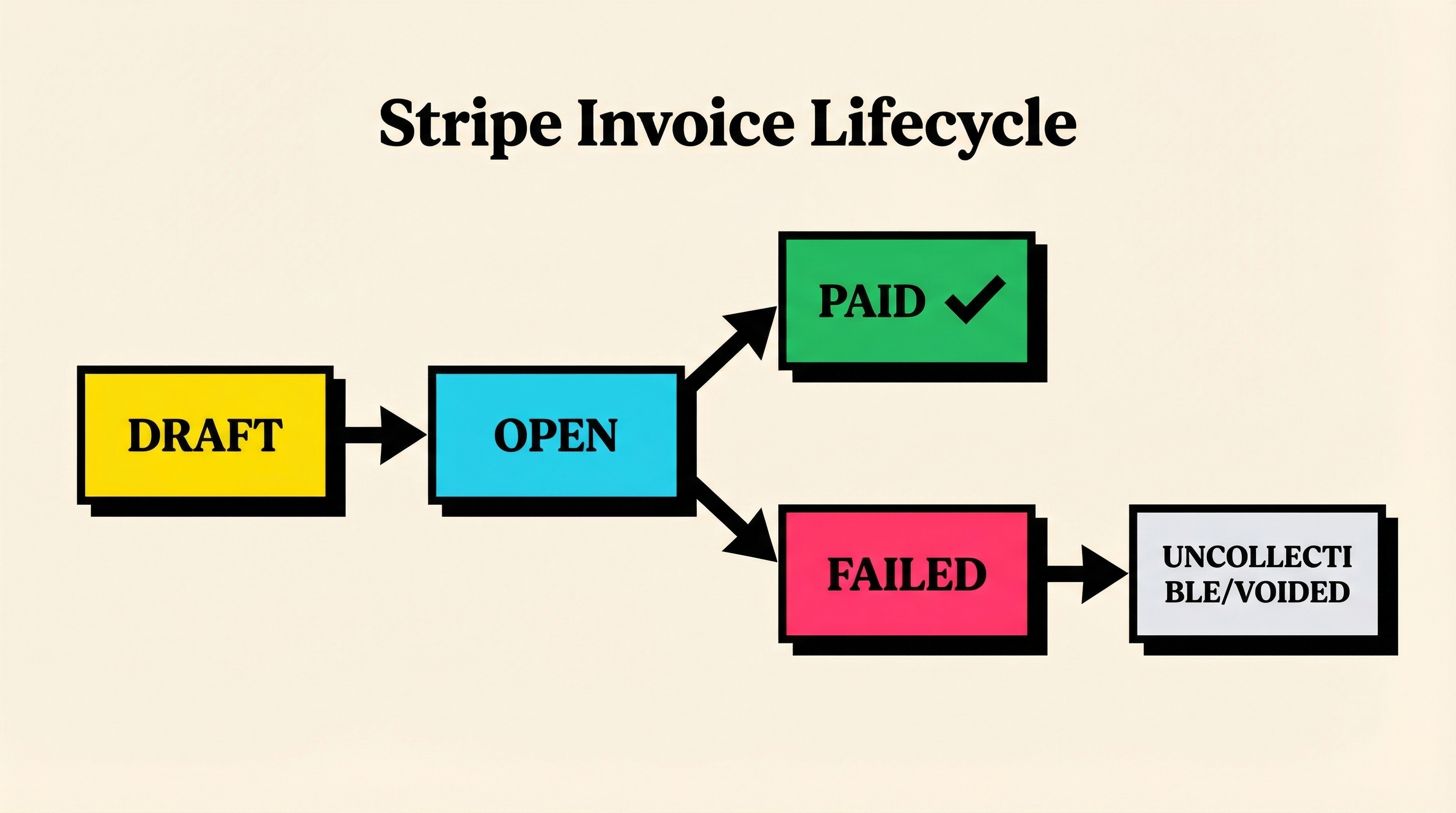
At a high level, a typical subscription invoice moves through a simple sequence:
- **Draft**: Stripe has generated the invoice, but it is not finalized yet.
- **Open**: The invoice is finalized and awaiting payment.
- **Paid**: The invoice was successfully collected.
- **Past due or payment failed state**: The invoice remains open because collection failed.
- **Recovered, voided, or marked uncollectible**: The invoice eventually gets resolved one way or another.
That sounds straightforward, but the real-world behavior around each stage is where teams either keep revenue or lose it.
Stage 1: Draft invoice
A draft invoice exists before Stripe finalizes it for collection. This stage often gets ignored because founders assume nothing important happens until payment is attempted. In practice, draft is where billing correctness gets locked in.
In draft, Stripe can still adjust invoice items, taxes, discounts, proration, and line items depending on your setup. This is useful, but it also means mistakes here can ripple downstream.
Common problems at the draft stage include:
- incorrect plan or quantity data
- unexpected proration after seat or plan changes
- duplicate or stale invoice items
- discount logic not applied correctly
- tax amounts that surprise the customer later
Why does this matter for churn? Because billing confusion destroys trust. If a customer sees an invoice amount they did not expect, recovery gets harder even if the payment method itself is fine. A payment issue becomes a product and support issue fast.
For founders, the lesson is simple: do not think of draft as a harmless pre-payment state. Treat it as the last quality-control checkpoint before a receivable becomes customer-facing.
Stage 2: Open invoice
Once finalized, the invoice becomes open and Stripe can attempt collection. This is the stage where the invoice stops being a draft object and starts becoming a real revenue event.
If the customer is on automatic collection, Stripe will try to charge the default payment method. If you use manual collection, the invoice may sit open waiting for the customer to pay. Either way, open invoices need active attention because this is the exact state where recoverable revenue starts to accumulate.
Open does not mean lost. It means collectible.
That distinction matters. A lot of teams overreact to any open invoice and restrict service too early, or underreact and let open invoices age silently. Both are expensive mistakes.
What to watch in the open state
When invoices are open, you should know at least:
- how many are newly open versus aging
- how many are auto-collection versus manual
- which failure reasons sit behind unpaid invoices
- how much MRR is tied up in open invoices
- how long customers typically take to recover
If you already review payment health operationally, this complements the checklist thinking in The Stripe Payment Health Checklist.
Stage 3: Paid invoice
This is the happy path. Stripe finalized the invoice, attempted collection, and the invoice became paid.
The trap is assuming that paid means healthy and unpaid means unhealthy. Good operators go one step deeper. They ask:
- Was it paid immediately or after retries?
- Did it require customer intervention?
- Was there a card update before payment succeeded?
- Did the customer hit friction that might affect next cycle retention?
A recovered invoice is better than a lost invoice, but it may still be a warning sign. If more customers are needing extra touches before payment lands, your billing system is getting less reliable even if top-line collections still look acceptable.
Stage 4: Payment attempt fails
This is where most teams start paying attention. Stripe tries to collect the open invoice and the payment does not go through. The invoice stays open, and now you are in revenue recovery territory.
This is also where it helps to stop thinking in generic failed-payment language. Not all failures are equal.
Some invoices fail because the card expired. Some fail because of insufficient funds. Some fail because authentication is required. Some fail because the issuer would not approve the charge. The recovery path should change accordingly.
If you need a practical reference for failure categories, ChurnBot’s Stripe decline codes guide is useful for translating raw payment failures into action.
Why failed invoices become churn so easily
An unpaid invoice is not churn yet. It becomes churn when the system around it fails.
That usually happens in one of four ways:
- retries are poorly timed
- the customer message is vague or wrong
- access is removed too early
- nobody distinguishes temporary recoverable failures from harder billing problems
This is why invoice operations and churn reduction are tightly linked. If you do not manage the stripe invoice lifecycle intentionally, you are letting your billing system decide retention policy by accident.
Stage 5: Retry and dunning window
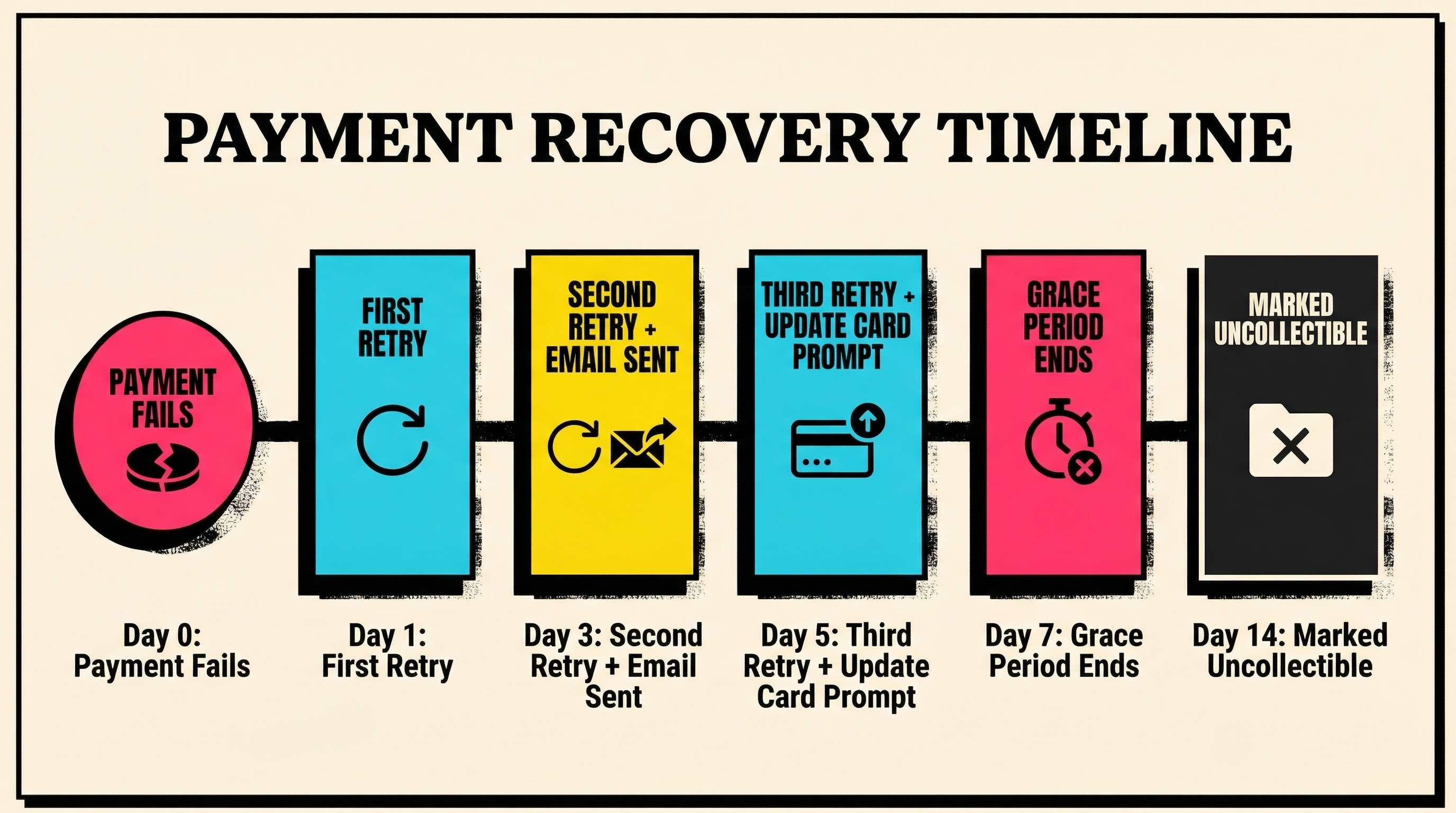
After a payment failure, the invoice may remain open while Stripe and your billing workflow try to recover it. This is the highest leverage part of the lifecycle for most SaaS businesses.
The customer has not explicitly cancelled. The revenue may still be collectible. The account relationship still exists. You are not fighting product-market fit here. You are fighting billing friction.
What good recovery looks like
A good recovery flow usually includes:
- retries timed around likely fund availability or issuer behavior
- messaging that explains the exact next action
- a clear payment-method update path when needed
- a separate path for authentication-required failures
- a grace period that reflects customer reality, not finance anxiety
This is where the invoice lifecycle becomes an operating system, not a record. The question is no longer “did the invoice fail?” It is “what should happen next to maximize recovery without damaging the customer relationship?”
If you want a strategy lens on retry behavior itself, see Stripe Smart Retries vs Custom Retry Logic.
Stage 6: Uncollectible, voided, or abandoned
Eventually, unpaid invoices get resolved. Sometimes that means the customer pays. Sometimes the invoice is voided. Sometimes it is marked uncollectible. Sometimes the account is cancelled while the invoice remains a finance cleanup problem.
These end states are where many companies hide operational mistakes.
Marked uncollectible
This can be the right accounting move, but it is also a signal. If too many invoices are reaching uncollectible status, something earlier in your lifecycle is underperforming. It may be recovery messaging. It may be payment-method hygiene. It may be the initial setup quality. It may be your timing.
Voided
Voiding can be appropriate when the invoice should never have been collectible in the first place. But if voiding becomes common, that suggests invoice creation quality issues upstream. Draft and finalization logic deserve another look.
Quiet abandonment
This is the most dangerous outcome because it can hide in dashboards. An invoice remains unresolved, the customer quietly disappears, and the team talks about churn as though it were a product problem. Sometimes it is. Often it started as a payment recovery problem that nobody owned tightly enough.
The states founders should monitor weekly
You do not need a massive BI stack to manage the stripe invoice lifecycle better. You do need a tighter operating view.
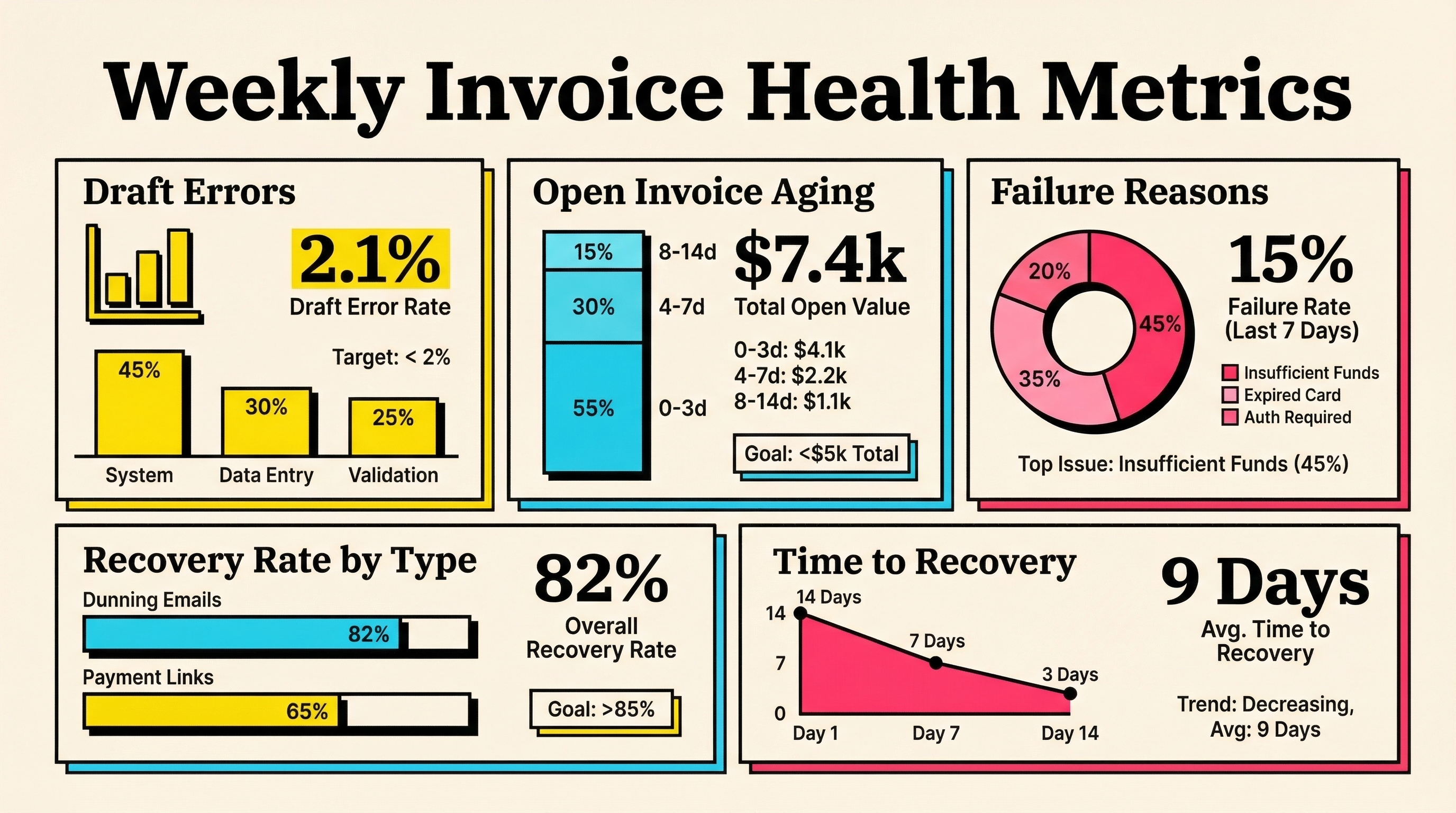
At minimum, track these weekly:
1. Draft-to-open conversion problems
How many invoices are being created with odd totals, manual intervention, or preventable corrections before finalization?
2. Open invoice aging
How much revenue is sitting in open invoices by age bucket: 0 to 3 days, 4 to 7 days, 8 to 14 days, and beyond?
3. Failure reasons behind unpaid invoices
Are most failures insufficient funds, expired cards, authentication issues, generic declines, or something else?
4. Recovery rate by failure type
Your aggregate recovery rate matters less than your segmented one. A 35 percent recovery rate means very different things if expired-card recovery is strong but authentication-required recovery is terrible.
5. Time to recovery
If most recovered invoices come back within 48 hours, your grace period and messaging should reflect that. If recovery stretches beyond a week, your sequence may be too passive or confusing.
Common invoice lifecycle mistakes SaaS teams make
Treating all unpaid invoices the same
Not every open invoice has the same probability of recovery. Segmenting by cause changes what you do next.
Cancelling access based on failure, not intent
A failed payment is not the same as a cancellation. If a customer still wants the product, aggressive access removal can create avoidable churn.
Over-optimizing the retry schedule and ignoring invoice quality
Teams obsess over retries because the lever is obvious. But if invoices are confusing or wrong, retries only chase a broken experience harder.
Looking at churn after the fact
By the time churn shows up in your retention dashboard, the invoice lifecycle has already done its damage. Monitoring invoice states gives you earlier warnings.
Leaving billing in a silo
Billing, support, and product all affect recovery. When these teams operate separately, customers get mixed signals during the most fragile part of the lifecycle.
A practical operating model for founders
If you want a simple way to manage the stripe invoice lifecycle better, use this playbook:
- Review draft anomalies before they finalize into customer-facing debt.
- Track open invoice volume and aging every week.
- Classify failed payments by reason, not just by count.
- Align dunning copy to the real next action the customer needs to take.
- Protect a short recovery window before restricting access.
- Review uncollectible and voided invoices as process feedback, not just accounting cleanup.
This is not complicated. It is disciplined. Most lost revenue in billing systems comes from teams being vaguely aware of invoice states without ever operationalizing them.
Final takeaway
The stripe invoice lifecycle is not just a backend workflow from draft to failed. It is the system that determines whether earned revenue actually gets collected.
When you understand each stage clearly, you stop treating failed invoices like isolated finance noise. You start seeing them for what they are: a recoverable retention problem with specific levers at each step.
That shift matters. It helps you catch billing errors earlier, manage open invoices more intentionally, recover more failed payments, and reduce involuntary churn without changing your product at all.
If you want to see where your Stripe billing flow is leaking revenue, run a free churn audit at churnbot.co/audit.
Related Posts

7 Failed Payment Segments Every Stripe Team Should Track

6 Hidden Stripe Settings That Reduce Payment Failures
How healthy is your Stripe account?
Get a free churn health report. Find pending cancellations, failed payments, and expiring cards putting your MRR at risk.
Run Free Audit