6 Email Templates for Every Stage of Payment Recovery
Failed payments don't have to mean lost customers. The difference between recovering revenue and watching subscribers churn often comes down to one thing: the emails you send when cards fail.
Most SaaS founders either over-communicate (annoying customers with aggressive dunning) or under-communicate (losing revenue to passive silence). The sweet spot is a sequence of well-timed, well-written emails that respect the customer relationship while protecting your revenue.
Here are 6 copy-paste email templates for every stage of payment recovery, from the first failure to successful reactivation. These templates balance urgency with empathy and have been tested across thousands of subscription businesses.
Template 1: First Payment Failure (Day 0)
Subject: Payment issue with your [Product Name] subscription
Body:
Hi [First Name],
We tried to process your payment for [Product Name] today, but it didn't go through.
This happens sometimes (expired cards, insufficient funds, bank flags). No big deal.
What you need to do:
Update your payment method here: [Payment Update Link]
Your account is still active for the next 7 days while we sort this out. You won't lose access or data.
If you're having trouble, just reply to this email. We're here to help.
Thanks,
[Your Name]
Why this works:
- Arrives immediately (customers expect it)
- Calm, non-alarmist tone
- Clear action step with a link
- Reassures them they won't lose data
- Opens the door for support conversation
Template 2: Second Attempt (Day 3)
Subject: Quick reminder: Payment update needed
Body:
Hi [First Name],
Just following up on the payment issue from a few days ago.
We'll try charging your card again in 4 days, but updating your payment method now saves you the hassle: [Payment Update Link]
Common fixes:
- Card expired? Update the expiry date
- New card? Add it to your account
- Billing address changed? We need the new one
Your subscription is still active until [Grace Period End Date]. After that, we'll have to pause your account.
Need help? Reply to this email or check out our dunning email strategies for more context.
Cheers,
[Your Name]
Why this works:
- Provides specific troubleshooting steps
- Creates gentle urgency with a deadline
- Still helpful, not threatening
- Includes a clear grace period end date
Template 3: Final Notice (Day 7)
Subject: [Action Required] Your [Product Name] subscription expires tomorrow
Body:
Hi [First Name],
This is the last reminder before we have to pause your [Product Name] account.
What happens tomorrow:
- Your account will be suspended
- You'll lose access to [key features]
- Your data will be safe for 30 days, but you won't be able to use it
To keep your subscription active, update your payment method right now: [Payment Update Link]
This takes 60 seconds. I'd hate to see you lose access over a payment hiccup.
If you're canceling intentionally, no worries. Just let me know so I can help with the offboarding.
Thanks,
[Your Name]
P.S. If you're struggling with failed payments, you might find our guide on calculating involuntary churn rates helpful.
Why this works:
- Subject line creates urgency without panic
- Explains exactly what will happen
- Offers an escape hatch for intentional cancellations
- Final tone is firmer but still respectful
Template 4: Card Expiry Prevention (30 Days Before)
Subject: Your card expires soon (quick update needed)
Body:
Hi [First Name],
Just a heads up: the card ending in [Last 4 Digits] expires on [Expiry Date].
Update it now so you don't get locked out next month: [Payment Update Link]
Most banks issue new cards 4-6 weeks before expiry, so yours might already be sitting in your wallet.
Takes 2 minutes. Saves you a headache.
Thanks,
[Your Name]
Why this works:
- Proactive, not reactive
- Prevents the failure entirely
- Casual, helpful tone
- Timing is early enough to avoid panic
Card expiry is one of the easiest involuntary churn causes to prevent. Learn more about card expiry management strategies.
Template 5: Payment Update Success (Reactivation)
Subject: You're all set! Welcome back to [Product Name]
Body:
Hi [First Name],
Great news: your payment went through and your [Product Name] subscription is back to normal.
You're all set:
- Account status: Active
- Next billing date: [Next Charge Date]
- No interruptions or data loss
Thanks for updating your payment method. You should be good to go for the next [billing cycle].
If you have any questions, just hit reply.
Welcome back,
[Your Name]
Why this works:
- Confirms the fix immediately
- Reassures them everything is normal
- Positive, welcoming tone rebuilds trust
- Provides next billing date for transparency
Template 6: Win-Back After Suspension (30 Days After)
Subject: We'd love to have you back
Body:
Hi [First Name],
It's been a month since your [Product Name] subscription paused due to a payment issue.
Your data is still safe, and reactivating takes just a few clicks: [Reactivation Link]
If you decided to move on, I totally understand. But if it was just a payment hiccup, we'd love to have you back.
What you get when you reactivate:
- Full access to [key features]
- All your data, exactly as you left it
- No setup or onboarding needed
Questions? Reply to this email or check out our free Stripe churn audit to see what you might be missing.
Hope to see you back,
[Your Name]
Why this works:
- Respectful of their decision to leave
- Low-pressure reactivation offer
- Reminds them what they're missing
- Provides an easy path back
Timing, Tone, and Tactics
The templates above work, but only if you nail the execution. Here's what separates revenue-recovering emails from customer-annoying spam:
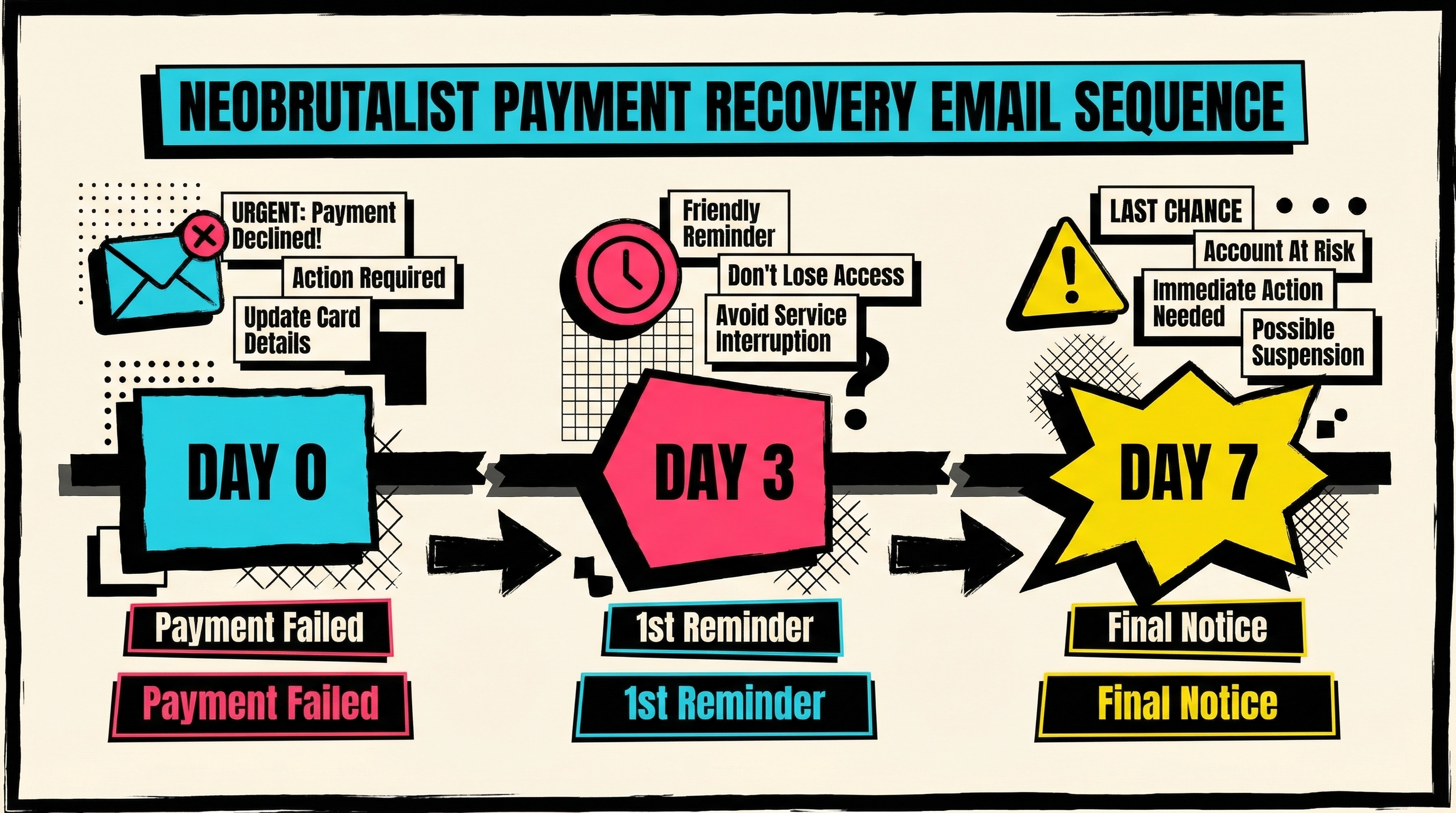
Timing Matters
- Day 0: Send immediately after failure (customers expect it)
- Day 3-4: First reminder (gentle nudge)
- Day 7: Final notice before suspension
- Day 30: Win-back attempt for suspended accounts
- 30 days before expiry: Card expiry prevention emails
Don't send daily reminders. Three emails over 7 days is the sweet spot for most SaaS businesses.
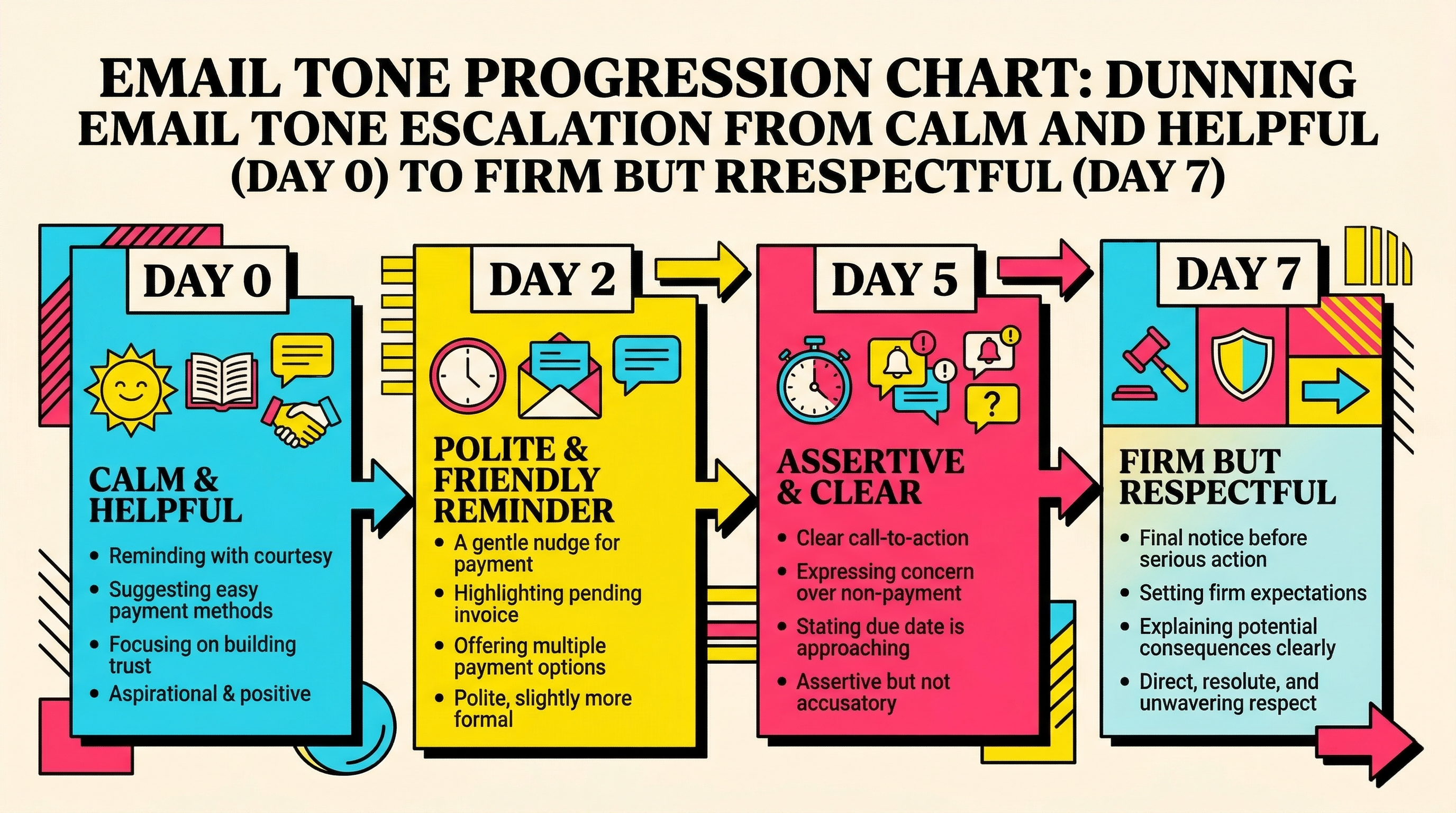
Tone Progression
- Email 1: Calm, helpful, reassuring
- Email 2: Slightly more urgent, still friendly
- Email 3: Firm but respectful, clear consequences
- Win-back: Warm, low-pressure, welcoming
Your first email should read like a helpful nudge. Your final notice should feel like a concerned friend warning you before something bad happens.
Personalization Wins
- Use first names (not "Dear Customer")
- Include specific dates (grace period ends, next retry)
- Reference their plan tier or usage
- Mention last 4 digits of the card
- Sign emails from a real person, not "The [Company] Team"
The more personal it feels, the higher the recovery rate.
Mobile Optimization
70% of dunning emails are opened on mobile devices. That means:
- Keep subject lines under 50 characters
- Front-load the important info
- Use short paragraphs (2-3 sentences max)
- Make the CTA button big and tappable
- Test on mobile before sending
What NOT to Do
- Don't guilt-trip: "We're disappointed in you" kills trust
- Don't threaten: "Your account will be DELETED" creates panic, not action
- Don't over-email: More than 1 email per day is spam
- Don't hide the action: Bury the payment link and customers won't find it
- Don't ignore replies: If they respond, answer fast
Beyond the Templates
These email templates handle the communication side of payment recovery, but they're only part of the solution. Your recovery rate also depends on:
- Retry logic: When and how often you retry failed charges
- Grace periods: How long customers have before suspension
- Payment method flexibility: Offering backup payment methods
- Stripe settings: Smart retries, card updater, email preferences
If you're losing revenue to failed payments, the problem might not be your emails. It might be your entire recovery infrastructure.
That's where ChurnBot comes in. It audits your Stripe account for involuntary churn, identifies exactly where you're losing revenue, and gives you a prioritized action plan to fix it.
Run a free audit at churnbot.co/audit and see where your payment recovery process is leaking revenue.
Start with One Template
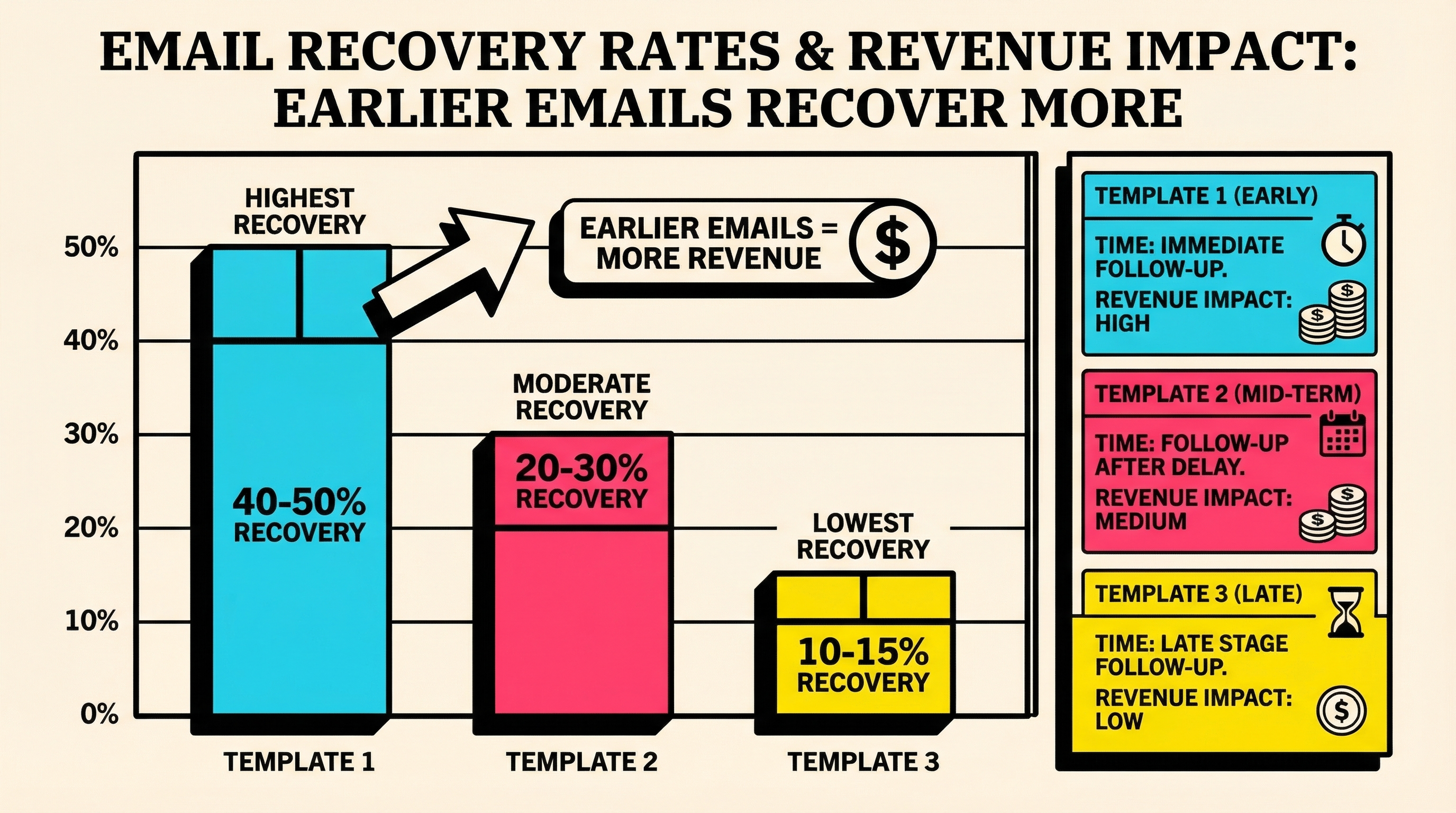
You don't need to implement all 6 templates today. Start with the first failure email (Template 1) and the final notice (Template 3). Those two alone will recover 60-70% of the revenue you're currently losing.
Once those are working, add the card expiry prevention email (Template 4). It's the easiest way to prevent failures before they happen.
Then layer in the win-back email (Template 6) for customers who've already churned. You'll be surprised how many come back.
Payment recovery isn't about aggressive dunning. It's about helpful, timely communication that respects the customer while protecting your revenue. These templates give you both.
Related Posts
Stripe Do Not Honor Recovery: What SaaS Teams Should Do Next

7 Failed Payment Segments Every Stripe Team Should Track
How healthy is your Stripe account?
Get a free churn health report. Find pending cancellations, failed payments, and expiring cards putting your MRR at risk.
Run Free Audit