How Failed Payments Silently Destroy Your MRR
Every month, your MRR dashboard shows steady growth. New customers sign up, upgrades happen, and everything looks healthy. But underneath the surface, a silent killer is eating away at your revenue: failed payments.
Most SaaS founders obsess over acquiring new customers while ignoring the customers they're losing to preventable payment failures. The math is brutal. A single failed payment doesn't just cost you one month of revenue. It compounds, month after month, until that customer is gone forever.
The Hidden Math of Failed Payment Revenue Loss
Let's start with the numbers that most founders miss.
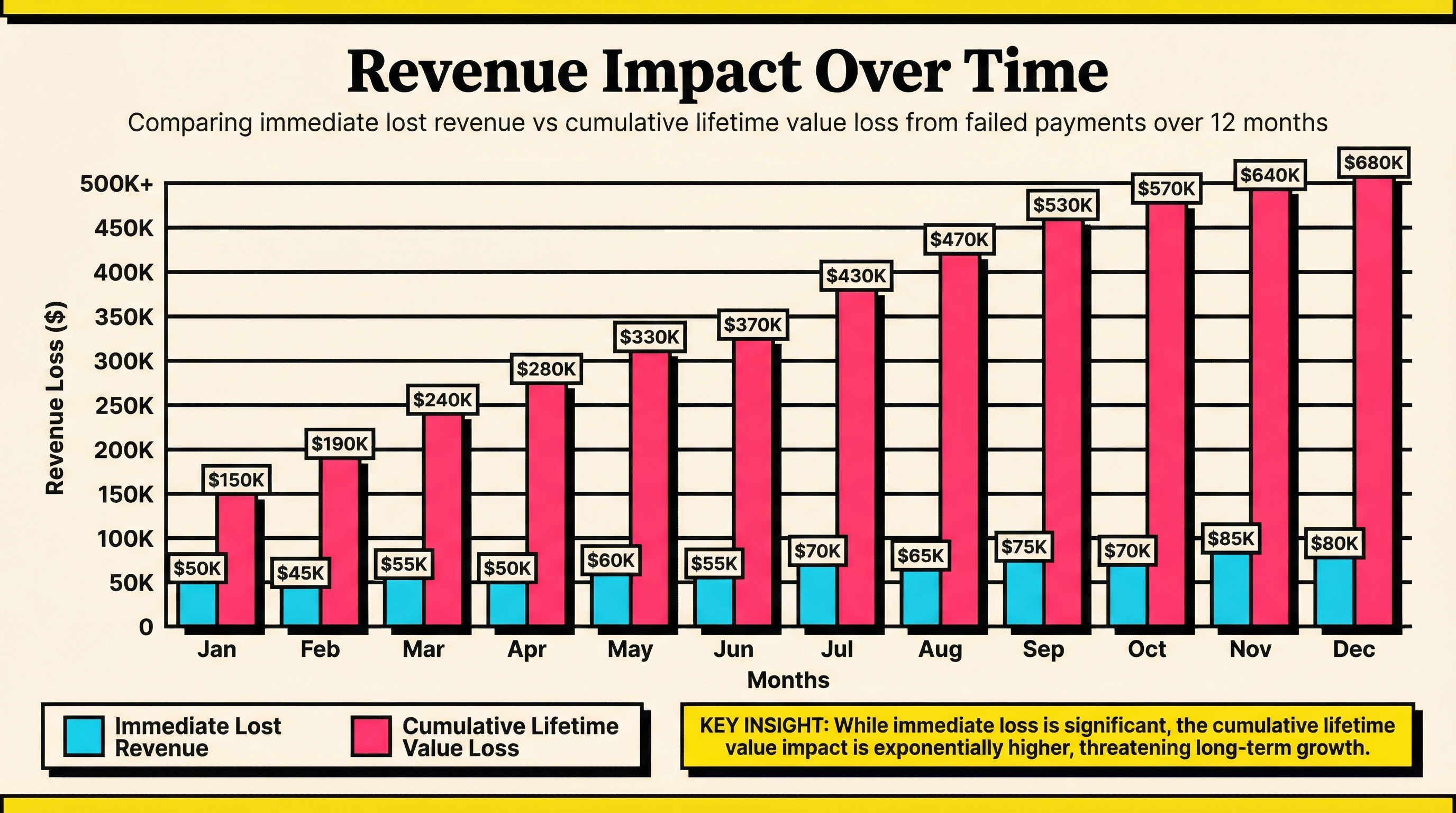
When a payment fails, you don't just lose that month's subscription fee. You lose the customer's lifetime value. If your average customer stays for 24 months at $99/month, a single failed payment that leads to churn costs you $2,376 in potential revenue.
The average SaaS company experiences payment failure rates between 5-15% per billing cycle. For a company with 1,000 customers paying $99/month:
- 5% failure rate = 50 failed payments per month
- At $99/month, that's $4,950 in immediate lost revenue
- If 40% of those failures lead to permanent churn (20 customers lost)
- Lost LTV: 20 customers × $2,376 = $47,520 in lifetime revenue
Every. Single. Month.
That's $570,240 per year in preventable revenue loss, from just a 5% failure rate.
Why Failed Payments Don't Show Up on Your Radar
There are three reasons failed payments fly under the radar:
1. MRR Dashboards Hide the Problem
Most MRR dashboards show you net numbers. They add new MRR, subtract churned MRR, and show you a growth line. What they don't show is why customers churned.
You see "10 churned customers this month" but you don't see:
- 4 churned because they found a competitor
- 2 churned because they no longer needed the product
- 4 churned because their credit card expired
That last group? Those are customers who wanted to keep paying you. They just couldn't. And your dashboard treats them the same as intentional churn.
2. Stripe Hides Failed Payments in the Background
Stripe's Smart Retries system automatically retries failed payments behind the scenes. This is both a blessing and a curse.
It's great because some payments recover automatically. It's terrible because it makes you think the problem is being handled. Stripe will retry a failed payment several times over 3-4 weeks, but if those retries fail, the subscription quietly cancels.
You never see the failed attempts. You only see the final churn event. By then, it's too late.
Understanding Stripe decline codes can help you identify which failures are recoverable and which aren't, but you need to actively monitor this data.
3. Failed Payments Feel Like a Technical Problem
When you think about churn, you think about product-market fit, customer satisfaction, and competitive threats. Failed payments feel like a payments infrastructure issue, not a retention issue.
But here's the truth: involuntary churn (churn caused by failed payments) accounts for 20-40% of all churn in subscription businesses. It's not a side issue. It's one of your biggest retention levers.
The Five Ways Failed Payments Destroy MRR
1. Immediate Revenue Loss
The most obvious hit: when a payment fails, you don't get paid that month. For a $99/month subscription, that's $99 gone.
But the impact compounds across your customer base. If 100 payments fail this month and you recover 60% of them, you've permanently lost $3,960 in MRR from those 40 unrecovered payments.
That MRR doesn't come back. It's gone from your baseline, and you have to acquire new customers just to get back to where you were.
2. Customer Lifetime Value Erosion
Every failed payment that leads to churn doesn't just cost you this month's revenue. It costs you every future month that customer would have stayed.
Consider two scenarios:
Scenario A: Customer stays for planned 24 months
- Revenue: $99 × 24 = $2,376
Scenario B: Customer churns at month 8 due to failed payment
- Revenue: $99 × 8 = $792
- Lost revenue: $2,376 - $792 = $1,584
Multiply that across dozens or hundreds of customers per year, and you're looking at six-figure revenue losses.
3. CAC Payback Period Extension
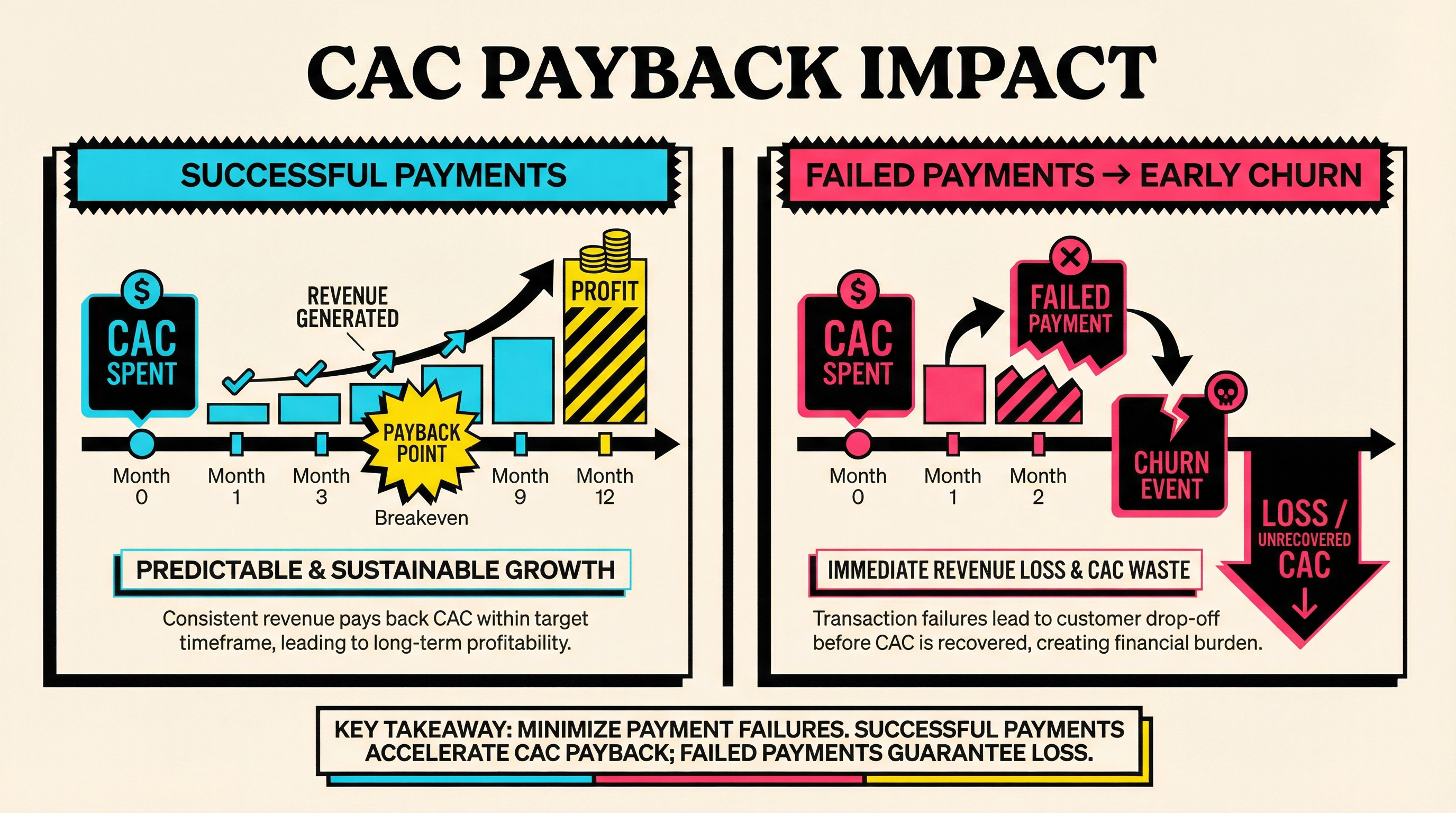
Let's say your customer acquisition cost (CAC) is $500, and you have a target payback period of 6 months. That means you need each customer to pay you for at least 6 months to break even on acquisition.
When a payment fails in month 3 or 4 and the customer churns, you never recover your CAC. You spent $500 to acquire a customer who only paid you $297-$396. You lost money on that customer.
Failed payments turn CAC-positive customers into CAC-negative ones. Scale that across your customer base and suddenly your entire acquisition model is underwater.
4. Cohort Retention Curve Degradation
Healthy SaaS businesses have cohort retention curves that flatten over time. You lose some customers in the first few months, but after 12-18 months, the curve flattens and customers stick around for years.
Failed payments destroy this curve. They create churn spikes at predictable intervals:
- 30-60 days: Initial failed payments
- 12-13 months: Credit card expiration wave
- 24-25 months: Second credit card expiration wave
These spikes prevent your retention curve from ever flattening. You're constantly hemorrhaging customers who should be entering their "sticky" phase.
5. Compounding MRR Growth Rate Suppression
MRR growth compounds. A 5% monthly growth rate doesn't just add 5% to your current MRR. It multiplies your MRR by 1.05 every month.
Failed payments suppress this compounding by constantly pulling MRR backwards. Instead of starting each month at a higher baseline, you're starting from a lower one because of unrecovered payments.
Consider this over 12 months:
Without Failed Payment Recovery:
- Starting MRR: $100,000
- 5% new MRR growth per month
- 2% lost to failed payments each month (net 3% growth)
- Ending MRR: $142,576
With 80% Failed Payment Recovery:
- Starting MRR: $100,000
- 5% new MRR growth per month
- 0.4% lost to failed payments (2% × 20% failure rate)
- Net 4.6% growth
- Ending MRR: $171,193
That's a $28,617 difference (20% higher MRR) just from recovering failed payments.
The Real Cost: What Founders Actually Lose
Let's model a realistic scenario for a mid-stage SaaS company:
- 2,000 active subscriptions
- $149/month average subscription price
- $298,000 monthly MRR
- 8% monthly payment failure rate (160 failed payments/month)
- 50% recovery rate (industry average without intervention)
- 24-month average customer lifetime
Monthly Impact:
- Failed payments: 160
- Unrecovered: 80
- Immediate lost revenue: $11,920/month
- Churned customers (40% of unrecovered): 32
- Lost LTV: 32 × ($149 × 24) = $114,048/month
Annual Impact:
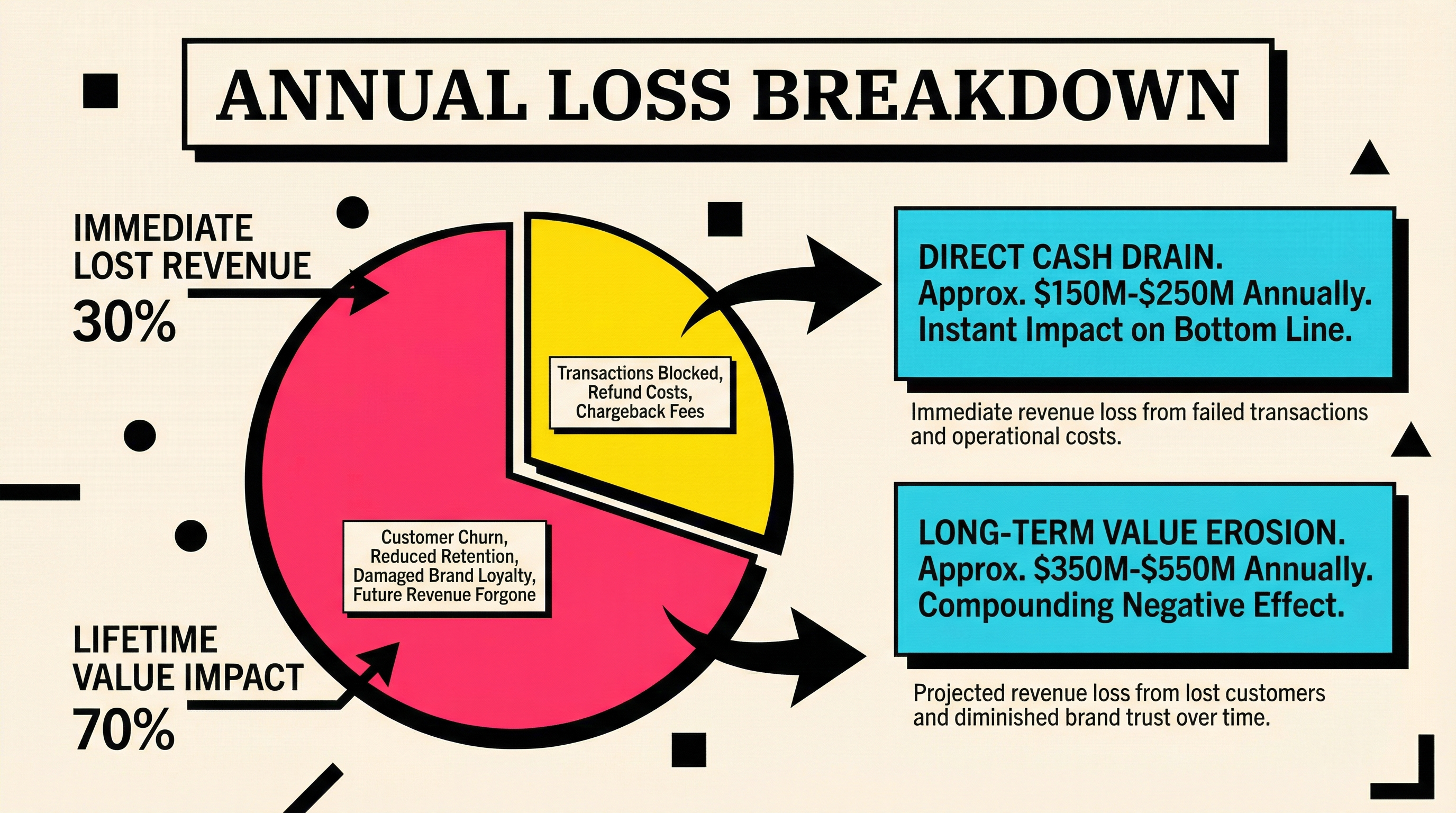
- Immediate lost revenue: $143,040
- Lost lifetime value: $1,368,576
- Total revenue loss: $1,511,616
That's more than 5x your current monthly MRR, lost every single year to preventable failed payments.
Why Most Recovery Attempts Fail
Seeing these numbers, most founders immediately think: "We need to fix this." They set up dunning emails, add retry logic, and hope for the best.
But most recovery attempts fail because they miss three critical elements:
Poor Timing
Sending a dunning email 7 days after a payment fails gives the customer a full week to forget about your product. By day 7, they've adapted to life without your tool. They're already mentally churned.
Effective recovery happens within 24-48 hours of the first failure, while the customer still has your product top-of-mind.
Generic Messaging
Most dunning emails are variations of: "Your payment failed. Update your card."
These don't work because they don't give the customer a reason to act. Better messaging reminds them of the value they're about to lose and makes updating their payment method feel urgent and easy.
No Multi-Channel Approach
Email-only recovery misses customers who:
- Don't check email regularly
- Have your emails filtered to promotions
- Changed their email address
- Ignore transactional emails
Effective recovery uses email, in-app notifications, SMS (when appropriate), and account restrictions to create multiple touchpoints.
How to Actually Fix Failed Payment Revenue Loss
The fix isn't one tactic. It's a system:
1. Track Failed Payments as a First-Class Metric
Add these metrics to your weekly dashboard:
- Payment failure rate (failed payments / total billing attempts)
- Payment recovery rate (recovered payments / total failed payments)
- Revenue recovery rate (recovered MRR / total failed MRR)
- Time-to-recovery (hours between failure and recovery)
What gets measured gets managed. Make failed payments as visible as churn rate.
2. Implement Pre-Dunning
Don't wait for payments to fail. Reach out 7-14 days before a card expires with a friendly reminder to update payment details.
Pre-dunning prevents 60-80% of card expiration failures, which are the most preventable type of payment failure.
3. Optimize Your Retry Logic
Stripe's Smart Retries are good, but not perfect. Layer your own retry logic on top:
- Immediate retry for transient errors (network timeouts, issuer unavailable)
- Delayed retry for insufficient funds (retry after 3-4 days, when payday likely hits)
- Abandon retry for fraud/stolen card (don't waste attempts)
4. Build a Dunning Sequence, Not a Dunning Email
A single email has a 20-30% recovery rate. A sequence has a 60-80% recovery rate.
Day 0 (failure): Immediate email + in-app notification
Day 1: Follow-up email with urgency
Day 3: Final reminder with account suspension warning
Day 7: Account suspended, final recovery offer
Each message should increase urgency while maintaining a helpful, non-aggressive tone.
5. Use Account Restrictions Strategically
Don't immediately disable accounts when payments fail. That pushes customers away.
Instead, use graduated restrictions:
- Days 0-3: Full access, warnings only
- Days 4-7: Read-only access, cannot create new items
- Days 8+: Account suspended
This gives customers time to fix payment issues without losing access completely.
The Opportunity Cost of Ignoring This
Every month you don't fix failed payment recovery is a month of lost revenue you can never get back.
If you're losing $10,000/month to unrecovered payments, that's $120,000/year. Over three years, that's $360,000. That's:
- An extra hire you couldn't make
- A marketing budget you didn't have
- Product features you couldn't build
- Runway you didn't extend
Failed payments aren't just a revenue problem. They're an opportunity cost that compounds over time.
Start With an Audit
Before you build recovery systems, you need to know where you stand. Most founders have no idea:
- What their actual failure rate is
- Which decline codes they're seeing most
- How much revenue they're losing monthly
- What their recovery rate currently is
You can't fix what you can't measure.
Run a free churn audit on your Stripe account to see exactly where you're losing revenue to failed payments. It takes 2 minutes to connect and gives you a complete breakdown of your failed payment data, including which customers are at risk and how much revenue you're leaving on the table.
The Bottom Line
Failed payments don't feel urgent. They don't trigger alerts. They don't show up in your growth metrics. But they're quietly destroying your MRR, month after month, customer after customer.
The math is simple: every failed payment you don't recover costs you hundreds or thousands of dollars in lifetime value. Across your customer base, that adds up to six or seven figures per year.
The good news? This is one of the most fixable problems in SaaS. Unlike product-market fit or competitive positioning, payment recovery is mechanical. Build the right system, and you can recover 60-80% of failed payments that would otherwise churn.
Stop letting failed payments silently destroy your MRR. Start measuring, start recovering, start keeping the revenue you've already earned.
Related Posts
Stripe Do Not Honor Recovery: What SaaS Teams Should Do Next

7 Failed Payment Segments Every Stripe Team Should Track
How healthy is your Stripe account?
Get a free churn health report. Find pending cancellations, failed payments, and expiring cards putting your MRR at risk.
Run Free Audit