5 Myths About SaaS Churn That Are Costing You Revenue

Every SaaS founder thinks they understand churn. Most don't.
And that misunderstanding costs real money. Not theoretical losses, actual MRR walking out the door every month while you focus on the wrong metrics, track the wrong customers, and implement the wrong fixes.
This article breaks down the five most damaging myths about SaaS churn that I've seen cost founders tens of thousands in preventable revenue loss. If you're tracking churn the conventional way, you're probably making at least three of these mistakes.
Let's fix that.
Myth #1: Low Churn Rate Means Healthy Retention
The Reality: Your 3% monthly churn rate might be hiding a revenue disaster.
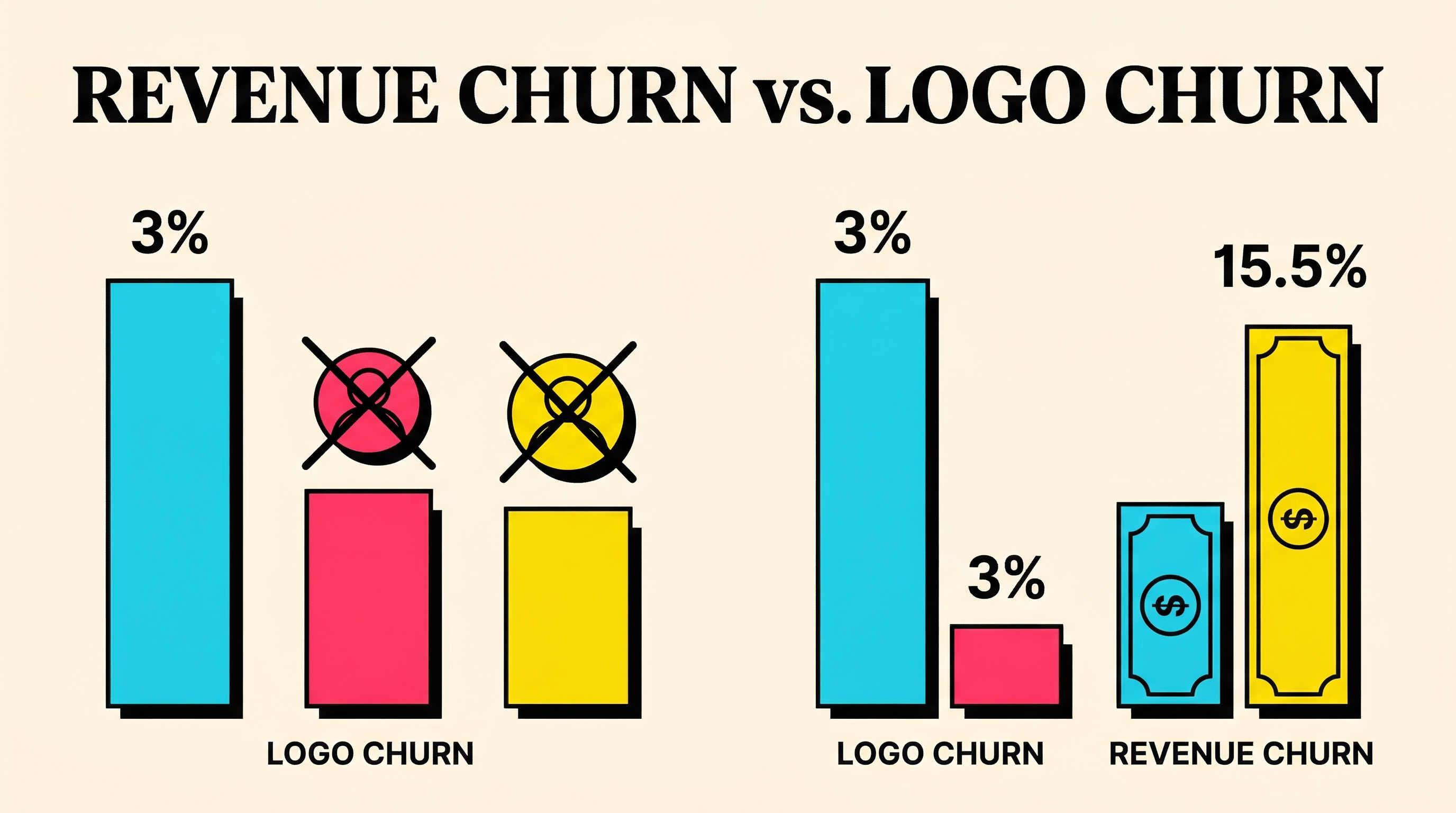
Most SaaS dashboards show you customer churn (logo churn). You lose 3 customers per 100 each month, and you think that's acceptable for your stage. What they don't show you is that those 3 customers might represent 15% of your MRR.
This is the difference between customer churn and revenue churn, and confusing the two is one of the most expensive mistakes in SaaS metrics tracking.
Why This Matters
Let's run the numbers:
- You have 100 customers
- Average MRR: $200/month
- Total MRR: $20,000
Scenario A (uniform churn): You lose 3 customers randomly. Impact: $600 MRR (3% revenue churn).
Scenario B (power law churn): You lose 1 enterprise customer ($3,000/mo) and 2 starter customers ($50/mo each). Impact: $3,100 MRR (15.5% revenue churn).
Same 3% logo churn. Wildly different business impact.
This is why net revenue retention exists as a metric, it accounts for expansion revenue alongside churn, giving you the full revenue picture that logo churn obscures.
What to Do Instead
Track both metrics, but weight revenue churn 10x higher in your decision-making. If you're only tracking one, track revenue churn.
Build customer cohorts by revenue tier. If you notice higher churn in your top quartile, that's a five-alarm fire, regardless of what your overall churn rate looks like.
And remember: a 2% logo churn rate with 8% revenue churn means you're losing your best customers. Fix that before you spend another dollar on acquisition.
Myth #2: Voluntary and Involuntary Churn Need the Same Solution
The Reality: Treating all churn the same is like treating a broken leg and a heart attack with the same medicine.
Voluntary churn (customers who actively cancel) and involuntary churn (failed payments, expired cards) have completely different root causes, require different fixes, and have different recovery windows.
Yet most SaaS companies lump them together in their churn metrics and wonder why their retention initiatives barely move the needle.
The Critical Difference
Involuntary churn is a billing operations problem:
- Expired credit cards
- Insufficient funds
- Wrong payment details
- Bank declines
These customers didn't decide to leave. They want your product. Their payment method just failed, and your system kicked them out.
Recovery rate for involuntary churn with proper dunning: 60-70%
Recovery rate for voluntary churn with win-back campaigns: 5-15%
The effort-to-ROI ratio isn't even close.
Voluntary churn is a product, pricing, or value problem:
- Feature gaps
- Poor onboarding
- Better competitor
- Budget cuts
- Value mismatch
These customers actively decided to cancel. Fixing this requires product improvements, better onboarding, smarter pricing, or accepting that you weren't the right fit.
What to Do Instead
Separate these metrics in your dashboard. Track them independently. Measure them against different benchmarks.
For involuntary churn, focus on payment operations:
- Card expiry management
- Smart retry logic
- Pre-dunning alerts
- Payment method update flows
For voluntary churn, analyze exit surveys, feature usage patterns, and customer health scores. These require completely different solutions.
If you're a typical B2B SaaS, 20-40% of your total churn is involuntary. That's low-hanging fruit you can recover with operational fixes, not product overhauls.
Myth #3: You Need to Reduce Churn to Grow Faster
The Reality: Not all churn is created equal, and obsessing over total churn rate can actually slow your growth.
Here's the uncomfortable truth: if you're a healthy, growing SaaS business, some churn is good for you.
Churning out bad-fit customers who consume support resources, drag down your NPS, and were never going to expand makes room for better customers. The goal isn't zero churn. The goal is high net revenue retention while churning out the customers who were never going to scale with you.
The Math That Matters
Net Revenue Retention (NRR) combines:
- Revenue churn (money lost from cancellations and downgrades)
- Expansion revenue (upsells, cross-sells, usage growth)
You can have 5% monthly revenue churn and 120% NRR if your expansion revenue from good customers outweighs losses from bad-fit customers.
Public SaaS benchmarks:
- Top quartile NRR: 120%+
- Median NRR: 100-110%
- Struggling companies: <95%
The companies with 120%+ NRR aren't eliminating churn, they're maximizing expansion from ideal customers while letting poor fits churn out.
What to Do Instead
Stop optimizing for the lowest possible churn rate. Start optimizing for the highest net revenue retention.
Analyze churn by customer segment:
- Which cohorts have high churn but low lifetime value? Let them churn. Tighten qualification.
- Which cohorts have low churn and high expansion? Double down on acquiring more customers like these.
Run the math: if reducing churn from 5% to 4% requires 40 hours of engineering work, but that 1% is entirely low-LTV customers, you just wasted 40 hours that could have gone into features that drive expansion revenue.
Counterintuitive, but true: sometimes the best retention strategy is better customer selection, not better retention tactics.
Myth #4: Churn Is a Customer Success Problem
The Reality: Customer success can't save customers from bad onboarding, broken billing, poor product-market fit, or payment failures they don't even know about.
The most common churn prevention advice is "hire more CSMs" or "implement a customer success platform." This advice ignores the actual data on where churn happens.
Research from Stripe and ChartMogul shows:
- 30-40% of churn is involuntary (payment failures)
- 40-50% of churn happens in the first 90 days (onboarding failures)
- 60%+ of at-risk signals come from product usage data, not support interactions
Customer success can't fix payment processing bugs. They can't redesign your onboarding flow. They can't prevent failed payments from expired credit cards.
The Real Churn Prevention Stack
- Product: Does the core product deliver value quickly? (Onboarding)
- Engineering: Are payment failures handled gracefully? (Billing operations)
- Pricing: Are you charging the right customers the right amount? (Packaging)
- Sales: Are you selling to the right ICP? (Qualification)
- Customer Success: Can you expand and retain high-value customers? (Relationship management)
Churn prevention is a full-stack problem. Treating it as a CS-only problem is why your churn initiatives aren't working.
What to Do Instead
Map every churned customer to a root cause category:
- Involuntary (billing failure)
- Onboarding failure (didn't reach activation)
- Feature gap (missing capabilities)
- Value mismatch (wrong ICP)
- Poor experience (support, bugs, performance)
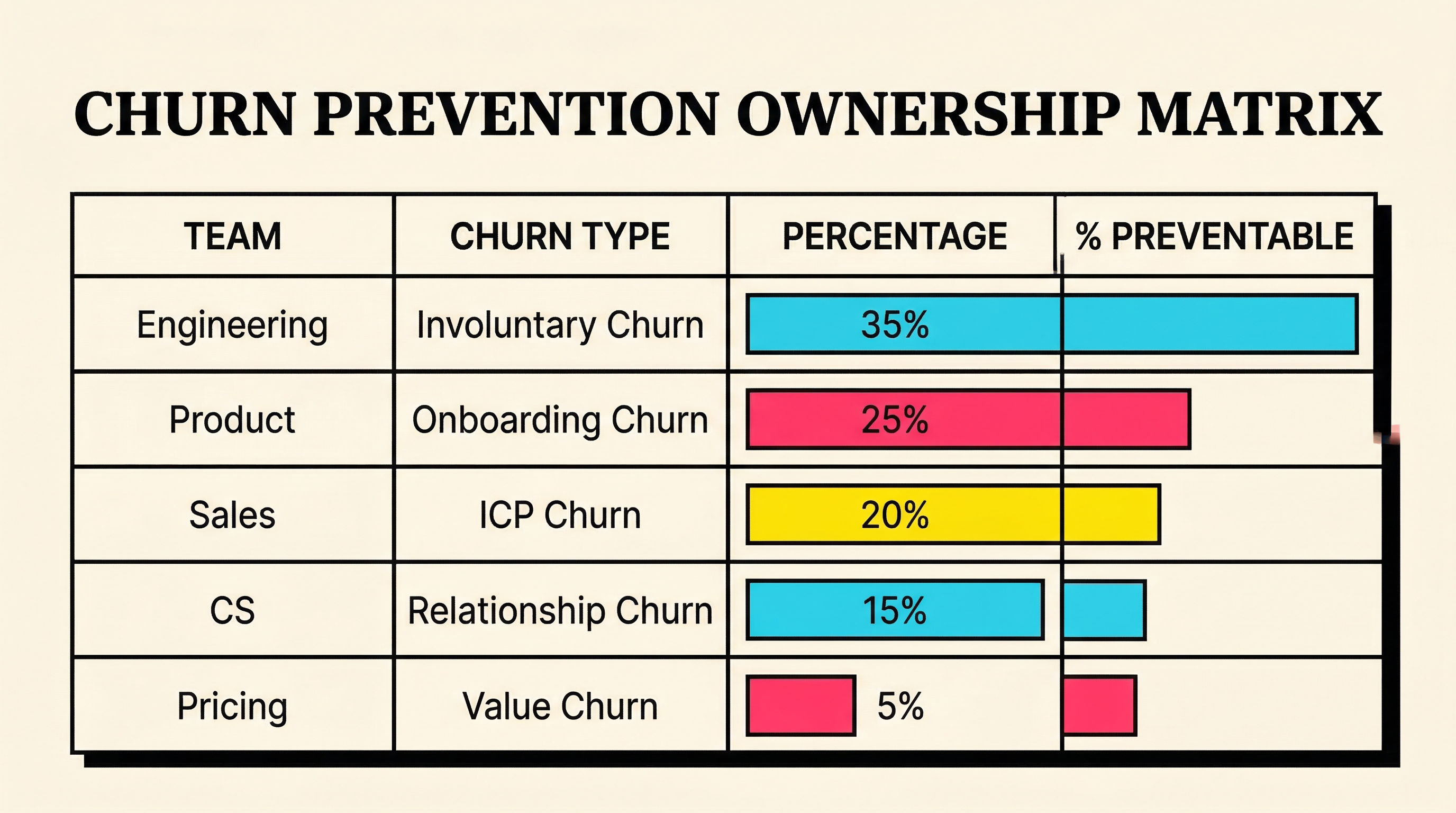
Then assign ownership:
- Engineering owns involuntary churn (billing infrastructure, payment recovery flows)
- Product owns onboarding churn (activation, aha moments, time-to-value)
- Sales/Marketing own ICP churn (better qualification, clearer positioning)
- CS owns relationship churn (expansion opportunities, health monitoring)
If 35% of your churn is involuntary but you're spending zero engineering time on payment recovery systems, you're optimizing the wrong lever.
Myth #5: Analyzing Churn Requires Expensive Analytics Tools
The Reality: The highest-impact churn insights come from dead-simple manual analysis, not complex analytics dashboards.
SaaS founders love buying analytics platforms. Amplitude, Mixpanel, Heap, full-stack product analytics with funnel tracking, cohort analysis, and predictive churn scores.
Then they spend three months configuring events, building dashboards, and tuning models while their churn rate stays exactly the same.
Here's what actually works:
The 80/20 Churn Analysis
- Export your last 100 churned customers to a spreadsheet
- Add columns: signup date, cancel date, MRR, cancellation reason, last login
- Sort by MRR (high to low)
- Manually categorize the top 30 by root cause
- Calculate what % of MRR loss each category represents
This takes 2 hours. It will give you better insights than most $50k/year analytics platforms.
Why this works: Churn patterns aren't that complex. You don't need machine learning to spot that 40% of cancellations happen within 7 days (onboarding problem) or that 25% are failed payments (billing problem).
Real-World Example
A founder I know did this analysis and found:
- 38% of churn was involuntary (failed payments)
- 22% churned before completing onboarding
- 18% churned after hitting usage limits on the starter plan
Three categories. Three fixes:
- Implement proper dunning emails (recovered 60% of involuntary churn)
- Rebuild onboarding (reduced early churn by 40%)
- Add mid-tier pricing (converted 30% of limit-hit customers to upgrades)
Total cost: $0 in new tools. Total impact: reduced churn from 7% to 4.2% monthly.
What to Do Instead
Before buying analytics tools, manually analyze your churn:
- Pull last quarter's cancelled customers
- Group by cohort, MRR tier, and cancellation reason
- Identify your top 3 churn drivers by revenue impact
- Fix the biggest one first
Once you've squeezed out the obvious wins, then consider analytics tools for more sophisticated cohort tracking. But not before.
And if you're on Stripe, start with a free churn audit to identify exactly where your revenue is leaking without setting up any analytics infrastructure.
The Real Cost of These Myths
Let's run the math on a typical $50k MRR SaaS with 5% monthly churn ($2,500 MRR lost per month):
If 35% of that churn is involuntary ($875/mo) and you could recover 60% with proper dunning:
- Recovered MRR: $525/month
- Annual impact: $6,300
- 3-year impact: $18,900
If you're tracking logo churn instead of revenue churn, and your top quartile customers are churning at 2x the average rate:
- Hidden revenue loss: Could be 50-100% higher than you think
- Misallocated retention budget: You're trying to save the wrong customers
If you're spending CS resources on trying to save customers with payment failures instead of building automated dunning:
- Opportunity cost: CS time not spent on expansion
- Recovery rate: 10-20% (manual outreach) vs 60-70% (automated dunning)
These myths don't just cost you the customers who churn. They cost you the time and money you spend solving the wrong problems with the wrong solutions.
What Actually Reduces Churn
- Separate voluntary from involuntary churn. Track them independently. Fix them with different solutions.
- Track revenue churn, not just logo churn. Segment by customer value. Protect your highest-revenue cohorts obsessively.
- Optimize for net revenue retention, not minimum churn. Let bad-fit customers go. Expand good-fit customers aggressively.
- Assign churn prevention ownership across teams. Engineering owns billing failures. Product owns onboarding. CS owns relationships.
- Start with manual analysis. You don't need ML or expensive platforms to identify your top 3 churn drivers.
The SaaS companies with the best retention metrics aren't doing anything magical. They're just measuring the right things, fixing the right problems, and not falling for these five myths.
Take Action Today
Your churn rate is hiding information. Some of your customers are leaving because their credit card expired. Others are leaving because you sold them the wrong product. Others are leaving because they hit a paywall at exactly the wrong time.
These all need different solutions. Treating them the same is why your churn hasn't improved.
The fastest way to find out where your revenue is actually leaking? Run a free churn audit of your Stripe account. You'll see exactly how much involuntary churn is costing you, which decline codes are killing your revenue, and which fixes will have the highest immediate impact.
Because the real myth about SaaS churn is that it's complicated. It's not. You just need to measure the right things and fix the right problems.
Start there.
Related Posts
Stripe Insufficient Funds Recovery: A Playbook for SaaS Teams
Stripe Do Not Honor Recovery: What SaaS Teams Should Do Next

7 Payment Recovery KPIs Every Stripe Team Should Track
How healthy is your Stripe account?
Get a free churn health report. Find pending cancellations, failed payments, and expiring cards putting your MRR at risk.
Run Free Audit