Net Revenue Retention Explained: The Metric That Trumps Growth
Most SaaS founders obsess over new customer acquisition. They track MRR growth, celebrate new logos, and pour money into marketing campaigns. But there's a metric that matters more than all of them combined—one that separates sustainable businesses from those that burn cash chasing growth.
Net Revenue Retention (NRR) tells you whether your existing customers are becoming more valuable over time or slowly bleeding away. It's the single best predictor of long-term success in SaaS, and yet most founders don't track it properly.
Here's why NRR should be your North Star metric, how to calculate it correctly, and what the numbers actually mean for your business.
What Is Net Revenue Retention?
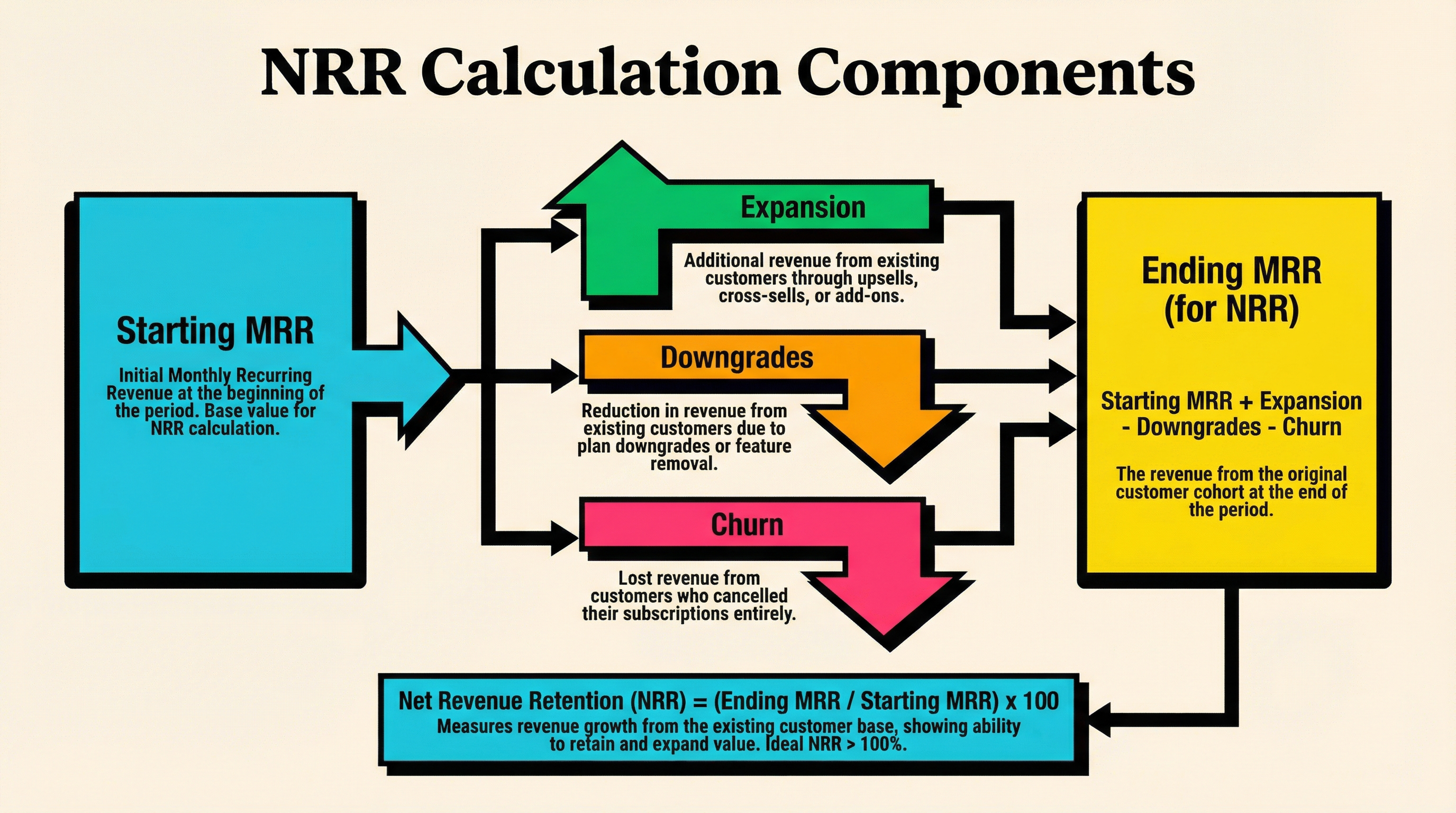
Net Revenue Retention measures the revenue retained from your existing customer base over a specific period, accounting for upgrades, downgrades, and churn.
Unlike gross revenue retention (which only measures losses), NRR includes expansion revenue. This means you can have NRR above 100%—a sign that your existing customers are spending more even after accounting for those who left or downgraded.
The formula:
NRR = (Starting MRR + Expansion - Downgrades - Churn) / Starting MRR × 100
Example: You start the month with $100,000 MRR. During the month:
- Expansion revenue (upgrades, upsells): +$15,000
- Downgrades: -$3,000
- Churn: -$7,000
NRR = ($100,000 + $15,000 - $3,000 - $7,000) / $100,000 × 100 = 105%
This means you retained 105% of your starting revenue—you grew from existing customers alone, without adding a single new account.
Why NRR Matters More Than Growth Rate
New customer acquisition gets all the attention. But here's the uncomfortable truth: if you're losing revenue faster than you're adding it, you're building on quicksand.
The Power of Compound Retention
A company with 110% NRR can theoretically double revenue every 7 years from its existing customer base alone. No new customers required.
Meanwhile, a company with 85% NRR loses 15% of its revenue every year. To maintain flat revenue, it needs to replace that 15% plus add growth on top. That's an exhausting treadmill.
This is why investors love high NRR. It proves:
- Product-market fit: Customers find increasing value over time
- Pricing power: You can raise prices or upsell successfully
- Customer success works: You're preventing churn and driving expansion
- Sustainable growth: You're not dependent on perpetual new customer acquisition
NRR vs Other Metrics
Let's compare NRR to metrics founders typically track:
MRR growth: Can mask underlying problems. You might be adding $50K/month in new MRR while losing $45K to churn—that's growth, but barely sustainable.
Churn rate: Only tells half the story. A 5% churn rate sounds acceptable, but if you're not expanding remaining customers, you're still losing ground.
Customer acquisition cost (CAC): Important for unit economics, but useless if customers don't stick around long enough to become profitable.
NRR combines all of these into one number. It's the ultimate health check.
What Good NRR Looks Like (Benchmarks)
NRR varies by company stage, pricing model, and market segment. Here's what the data shows:
World-class SaaS (public companies):
- Snowflake: 168% NRR
- Datadog: 130% NRR
- Monday.com: 115% NRR
Typical benchmarks by stage:
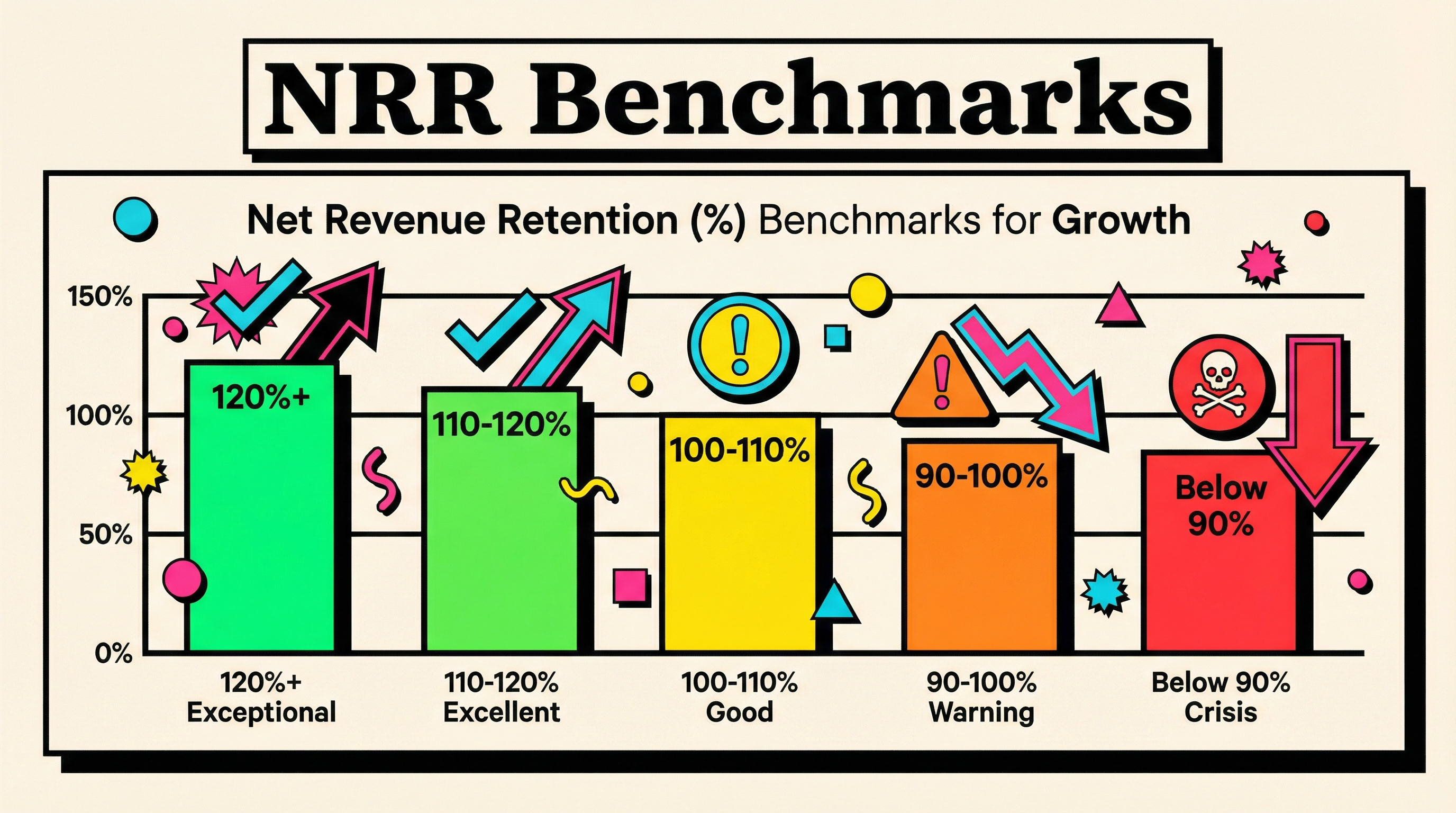
- 120%+: Exceptional. Rare. Often seen in infrastructure/platform businesses with usage-based pricing
- 110-120%: Excellent. Strong product-market fit and expansion motion
- 100-110%: Good. Healthy retention with some expansion
- 90-100%: Warning zone. You're losing revenue but have some expansion to offset
- Below 90%: Crisis. You're bleeding revenue and expansion isn't covering losses
For context: most successful SaaS companies have NRR between 100-120%. Anything above 115% is genuinely impressive.
How Pricing Model Affects NRR
Usage-based pricing tends to produce higher NRR because customers naturally expand as they use more. Seat-based models require active upselling. Per-user pricing falls somewhere in between.
If your NRR is below 100%, you have a retention problem that new customer acquisition won't solve. You need to fix the leak before scaling the boat.
The Three Levers of NRR
To improve NRR, you need to understand its components. There are exactly three levers:
1. Reduce Churn (Especially Involuntary)
Churn comes in two flavors:
Voluntary churn: Customers actively cancel. This is a product, pricing, or value delivery problem.
Involuntary churn: Customers want to stay but leave due to failed payments, expired cards, or billing issues.
Most founders focus entirely on voluntary churn—improving the product, adding features, better onboarding. That's important, but it ignores the low-hanging fruit.
Involuntary churn typically represents 20-40% of total churn in subscription businesses. Unlike product churn, it's almost entirely preventable with proper payment recovery systems.
Strategies to reduce involuntary churn:
- Implement card expiry management to update cards before they expire
- Set up smart retry logic for failed payments (not just Stripe's default)
- Send effective dunning emails that actually get customers to update payment details
- Monitor decline codes to understand why payments fail
Every percentage point of churn you prevent goes directly to your NRR.
2. Minimize Downgrades
Downgrades hurt just as much as churn but often get ignored in reporting.
Common causes:
- Customers over-provisioned initially and right-size later
- Seasonal businesses scaling down in off-season
- Features in higher tiers aren't delivering value
- Price increases that push customers to cheaper plans
To minimize downgrades:
- Make sure customers start on the right plan (not over-sold)
- Tie pricing to value metrics (seats, usage, outcomes) so growth aligns with value
- Build features that genuinely differentiate higher tiers
- Offer annual contracts with discounts to lock in current spend
3. Drive Expansion Revenue
Expansion is what takes NRR above 100%. It comes from:
Upsells: Moving customers to higher-tier plans
Cross-sells: Selling additional products or modules
Add-ons: Selling extra seats, storage, features
Usage expansion: Customers consuming more under usage-based pricing
The best expansion happens naturally—when customers grow and your pricing model captures that growth automatically. That's why usage-based pricing is trending.
If expansion requires manual intervention (sales calls, emails), you'll hit scaling limits. Build expansion into your product and pricing from day one.
How to Calculate NRR (The Right Way)
Most founders calculate NRR wrong. Here's how to do it properly.
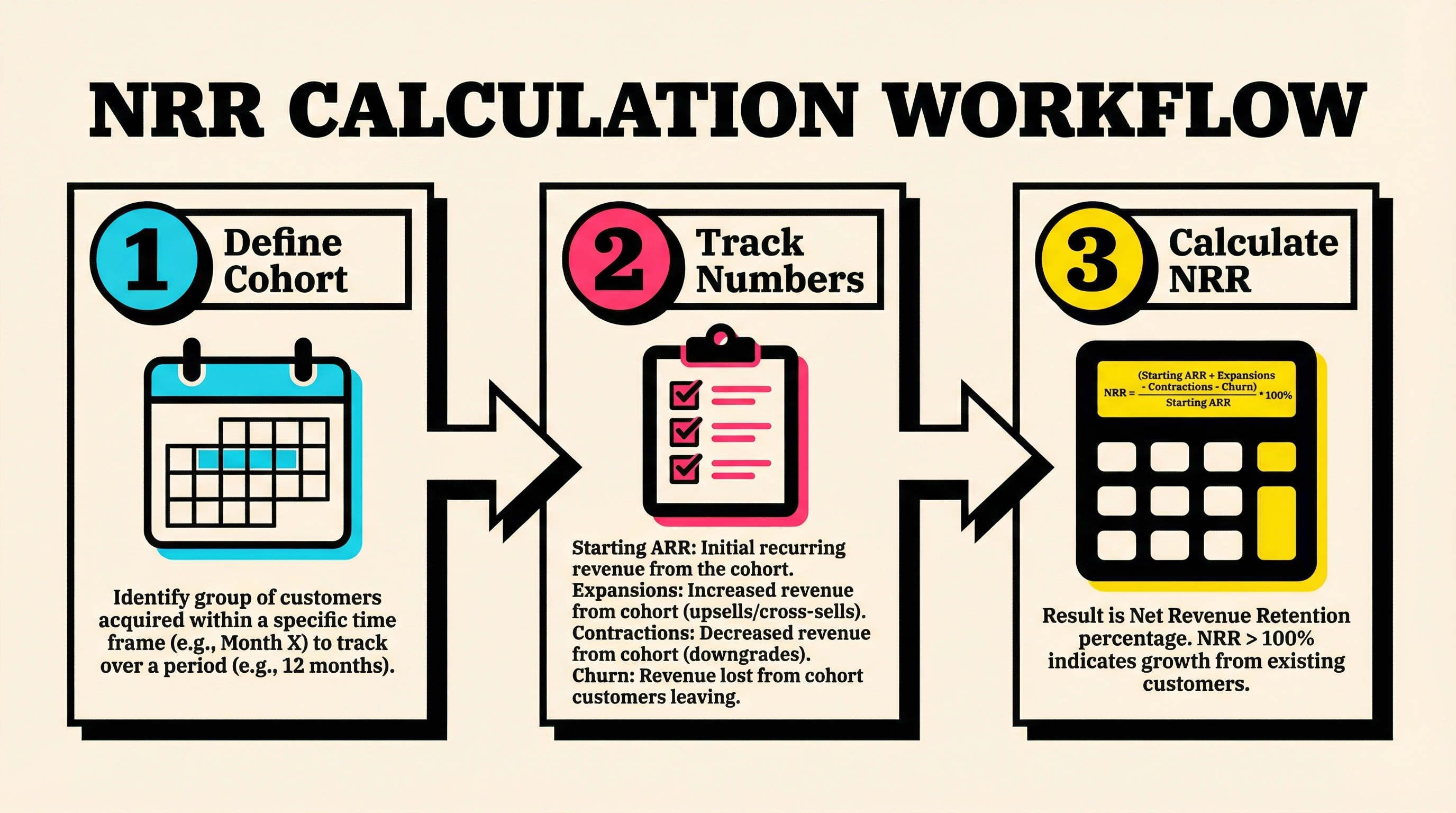
Step 1: Define Your Cohort
Pick a starting point (usually the first day of the month). Take all customers who existed at that point—this is your cohort.
Critical: Only include customers in the starting cohort. Don't include new customers acquired during the measurement period. NRR measures retention from existing customers only.
Step 2: Track the Four Numbers
- Starting MRR: Total MRR from the cohort at the start
- Expansion MRR: Upgrades and upsells from cohort customers during the period
- Downgrades: Reductions in MRR from cohort customers
- Churned MRR: Revenue lost from cohort customers who canceled
Step 3: Apply the Formula
NRR = (Starting MRR + Expansion - Downgrades - Churned MRR) / Starting MRR × 100
Common Mistakes
Mistake 1: Including new customer revenue in the calculation. This inflates NRR and defeats the purpose.
Mistake 2: Measuring over too short a period. Monthly NRR is noisy. Calculate it monthly but track trends over quarters or years.
Mistake 3: Not segmenting by cohort or customer type. Your NRR for enterprise customers might be 120% while SMB is 85%. Average those and you miss critical insights.
Mistake 4: Ignoring involuntary churn in the calculation. Failed payments should be categorized separately from voluntary cancellations so you know what's fixable.
Best Practice: Cohort Analysis
Don't just calculate overall NRR. Track NRR by:
- Acquisition cohort (when customers joined)
- Customer segment (SMB, mid-market, enterprise)
- Plan type or pricing tier
- Geography or industry
This reveals where you have retention strength and where you're bleeding.
What Your NRR Tells You (And What To Do About It)
Your NRR number is a diagnosis. Here's how to interpret it and what actions to take.
NRR 120%+: You Have Something Special
What it means: Your product is essential. Customers are expanding rapidly. You likely have network effects or usage-based growth built in.
What to do:
- Study why customers expand. Double down on those triggers.
- Invest in customer success to accelerate expansion
- Raise prices—you have pricing power
- Tell this story to investors. They'll pay a premium multiple.
NRR 110-120%: Strong Retention, Good Expansion
What it means: Healthy business. Customers are getting value and expanding, but not explosively.
What to do:
- Look for expansion opportunities you're leaving on the table
- Reduce friction in the upgrade path
- Build features that drive usage growth
- Minimize voluntary churn to push higher
NRR 100-110%: Treading Water
What it means: You're holding steady. Expansion roughly offsets churn and downgrades. Not terrible, but not great.
What to do:
- Focus on churn reduction first (especially involuntary churn)
- Build expansion into your product and pricing model
- Improve onboarding to drive activation and early value delivery
- Consider whether you're serving the right customer segment
NRR 90-100%: Leaking Revenue
What it means: You're losing ground. Every month you retain less than you started with. Growth from new customers is masking the problem.
What to do:
- Urgent: Diagnose your churn. Is it voluntary or involuntary?
- Fix payment recovery if involuntary churn is high
- Talk to churning customers. What's missing? Why did they leave?
- Pause aggressive customer acquisition until you fix retention
NRR Below 90%: Crisis Mode
What it means: You're hemorrhaging revenue. This is unsustainable. No amount of new customer acquisition will fix this.
What to do:
- Stop scaling marketing/sales immediately
- Conduct exit interviews with every churned customer
- Run a free churn audit to identify fixable revenue leaks
- Consider whether you have product-market fit at all
- Focus 100% of resources on retention until NRR exceeds 95%
NRR and Fundraising: Why Investors Care
If you're raising capital, your NRR is one of the first metrics investors will ask for. Here's why:
It validates market fit: A company with 115% NRR has proven customers get increasing value. That's hard to fake.
It de-risks growth: High NRR means the business compounds even without new customers. Lower capital requirements, higher efficiency.
It predicts outcomes: Studies show NRR is the single best predictor of SaaS company valuation multiples.
A SaaS company with 120% NRR and $5M ARR is often more valuable than one with 90% NRR and $10M ARR. The former will likely outgrow the latter within 18 months.
Investors use NRR to model growth without assuming heroic new customer acquisition. If you can grow 10-15% per year on existing customers alone, new customer revenue is pure upside.
How to Improve NRR Starting Today
You can't fix NRR overnight, but you can start moving the needle this week. Here's a tactical 30-day plan:
Week 1: Measure Accurately
- Calculate your actual NRR (use the formula above)
- Segment by cohort and customer type
- Separate voluntary and involuntary churn
- Identify your biggest leak (churn, downgrades, or lack of expansion)
Week 2: Fix Involuntary Churn
- Audit your current payment recovery process (or lack thereof)
- Implement card expiry alerts
- Set up smarter retry logic (don't just rely on Stripe defaults)
- Review your dunning email sequence—is it friendly and helpful?
Week 3: Reduce Voluntary Churn
- Call your last 10 churned customers. Ask why they left.
- Look for patterns: pricing, missing features, poor onboarding, competition
- Fix the easiest issues first (often onboarding or early value delivery)
Week 4: Build Expansion Paths
- Map out natural expansion points in your customer journey
- Make it easy for customers to upgrade (one-click if possible)
- Train your customer success team to identify expansion triggers
- Consider adding usage-based pricing elements to capture growth
Most SaaS companies can improve NRR by 5-10 percentage points in 90 days just by fixing preventable churn.
The Bottom Line
Growth is exciting. New logos feel like progress. But if you're not retaining and expanding the customers you already have, you're building a business on sand.
Net Revenue Retention is the single metric that tells you whether your business is fundamentally healthy. It combines product-market fit, pricing, customer success, and operational execution into one number.
World-class NRR (120%+) is rare but achievable. Good NRR (110%+) is the foundation of every successful SaaS company. And mediocre NRR (below 100%) is a red flag you can't ignore.
Start tracking NRR today. Segment it by cohort. Identify your biggest leaks. And fix them before you pour more money into customer acquisition.
Because the best new customer is the one you already have—if you can keep them.
Want to find the revenue leaks dragging down your NRR? Run a free churn audit at churnbot.co/audit and get a detailed breakdown of recoverable revenue in your Stripe account.
Related Posts
10 Early Warning Signs of Growing Payment Failure Risk
Regional Payment Failure Patterns: What the Data Shows

Why Gross Churn Rate Doesn't Tell the Whole Story
How healthy is your Stripe account?
Get a free churn health report. Find pending cancellations, failed payments, and expiring cards putting your MRR at risk.
Run Free Audit